How can I contact BT Internet about deliverability issues and what should I expect?


Updated on 10 Aug 2026: We clarified who should contact BT's postmaster team, what evidence to send, and how to handle 554 policy rejections while waiting for a response.
The direct answer depends on your role. If you operate mail systems for an external sender, email postmaster@btinternet.com and expect an evidence-led review rather than a normal customer support exchange. BT's sender guidance tells bulk senders to use SPF, DKIM, and DMARC, clean their mailing lists, review bounce errors, and email the postmaster address if bounces continue. BT publishes no response-time SLA, and reported waits vary from days to several weeks.
Start by reading BT best practices and matching your message to that guidance. A generic request asking BT to improve inbox placement is weak. A short case with timestamps, complete bounce text, sending IPs, sending domains, authentication results, list source, and the changes already made is much stronger.
- Contact: Use postmaster@btinternet.com for external sender deliverability issues.
- Expectation: Expect variable timing, limited detail, and requests for proof.
- Fallback: If you use a shared ESP IP, ask the ESP to escalate in parallel.
The direct contact route
The BT Community is useful for seeing symptoms other senders report, but it is not the same thing as a postmaster ticket. In a BT Community thread, a user posted a 554 policy rejection for mail to btinternet.com, and the accepted solution pointed them back to the postmaster address and BT's sender guidance. Use the community to research symptoms, email the postmaster with the technical case, and involve the ESP when shared infrastructure is affected.
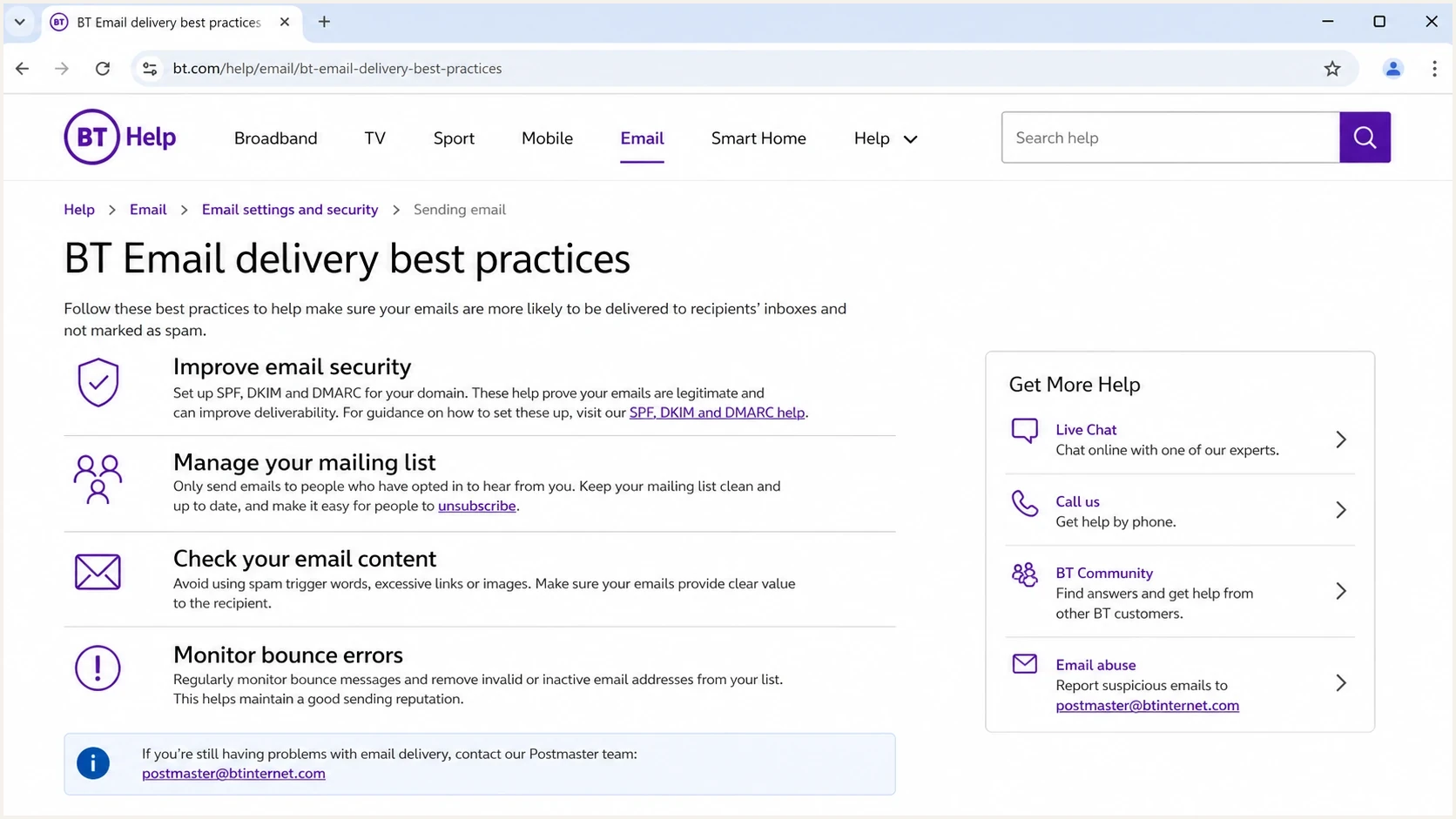
BT Help sender best practices page with postmaster guidance.
Use one clean escalation path
Do not scatter the same request through consumer support, community replies, and unrelated complaint channels unless the issue is also a BT account problem. For external sender deliverability, the postmaster mailbox is the correct technical route.
If you send through your own dedicated IP or domain, it is still worth contacting BT. If you send through a shared pool, your ESP has more complete evidence about shared IP history, affected senders, complaint patterns, bounce classes, and routing. Send the postmaster case and ask the ESP's postmaster or compliance team to escalate at the same time.
Good BT contact case
- Scope: One affected domain, one sending stream, and clear dates.
- Evidence: Full bounce text, sample message IDs, and delivery logs.
- Remediation: List cleaning, reduced volume, and authentication checks already done.
Weak BT contact case
- Scope: Broad claims that all BT delivery is broken.
- Evidence: Screenshots, anecdotes, and no SMTP response detail.
- Remediation: No proof that the sender fixed list quality or DNS issues.
Use the right support route
The postmaster mailbox is intended for external senders and other postmasters dealing with mail delivery to BT domains. It is not the primary route for a BT Email customer who cannot send or receive mail in a personal account.
- External sender or postmaster: Use postmaster@btinternet.com after checking BT's sender requirements and collecting the SMTP evidence.
- BT Email customer: Use BT's email help and technical support for account settings, blocked senders, webmail, or personal sending problems.
A BT recipient can check the junk folder, blocked senders, and mailbox rules, but adding a sender to an address book does not resolve an SMTP policy rejection. The external sender still needs to investigate the rejection and contact the postmaster when its setup complies.
What to send BT
Keep the first email short, but include enough detail for BT to identify a pattern without asking basic questions. The case should be easy to reproduce, easy to triage, and clearly tied to wanted mail.
|
|
|
|---|---|---|
Bounce | Shows BT's reason | Full SMTP text |
IP | Ties mail to reputation | Sending IPs |
Domain | Checks identity | From and envelope domains |
Auth | Rules out setup faults | SPF, DKIM, DMARC domain match |
Host | Identifies the mail server | HELO or EHLO and PTR |
Time | Supports log matching | Timestamp and timezone |
List | Shows consent | Opt-in source |
Keep the table in your working notes, then paste the useful parts into the email.
Do not bury BT in a long complaint. Use a subject line that names the affected sending domain and receiving domain, then include a compact summary followed by raw evidence. Policy rejections often turn on exact SMTP wording, not the sender's interpretation of it.
BT postmaster email templatetext
To: postmaster@btinternet.com
Subject: Deliverability issue to btinternet.com for example.com

Hello BT postmaster team,

I am investigating delivery failures to btinternet.com recipients.
The affected mail is transactional order confirmation mail.

Sending domain: example.com
Visible From domain: example.com
Envelope sender domain: bounce.example.com
Sending IPs: 203.0.113.10 and 203.0.113.11
HELO/EHLO: mail.example.com
PTR: mail.example.com
Mail stream: transactional only
Date range: 2026-07-28 to 2026-08-03
Approximate affected volume: 420 messages

Authentication status:
SPF: pass using a matching domain
DKIM: pass using a matching domain
DMARC: pass
TLS: offered

Sample rejection:
554 Message rejected on 2026/08/03 09:48:03 BST, policy
(3.2.1.1) ID ([BT REFERENCE ID]) - Your message looks like SPAM
or has been reported as SPAM

Sample message IDs:
abc123@example.com
abc124@example.com
abc125@example.com

Actions already taken:
Action 1: Paused non-essential BT sends
Action 2: Removed hard bounces and inactive BT recipients
Action 3: Confirmed unsubscribe handling
Action 4: Reduced daily volume during re-test

Please review whether this traffic is being rejected by BT policy
filters and tell us if further remediation is required.

Regards,
Sender operations team
Do not ask BT to clean your list
Mailbox providers do not want to train senders into mailing weaker lists. Your email should show that you already removed invalid addresses, suppressed prior hard bounces, and stopped sending to recipients without valid consent before asking for a reputation review.
What to expect after you email
Expect inconsistency. BT has a public postmaster route, but senders do not get a predictable ticketing experience. Some senders receive a useful answer, some receive no visible answer, and some see the issue resolve after a delay without much explanation. The first email must be strong enough to stand on its own.
Practical follow-up checkpoints
BT publishes no response SLA. Use these checkpoints to manage the case without flooding the mailbox.
Initial review
First 7 business days
Monitor fresh BT samples and keep the original evidence together.
First follow-up
7-10 business days
Reply on the same thread with a brief status and new evidence only.
Extended wait
More than 4 weeks
Continue controlled testing and ask the ESP to escalate shared infrastructure.
BT filtering can make IP warming look uneven. Soft bounces can appear on one day, acceptance on another, followed by weaker inbox placement or renewed policy rejections. One day of acceptance does not prove recovery. Look for a sustained reduction in BT bounce rates and stable complaint trends before returning volume to normal.
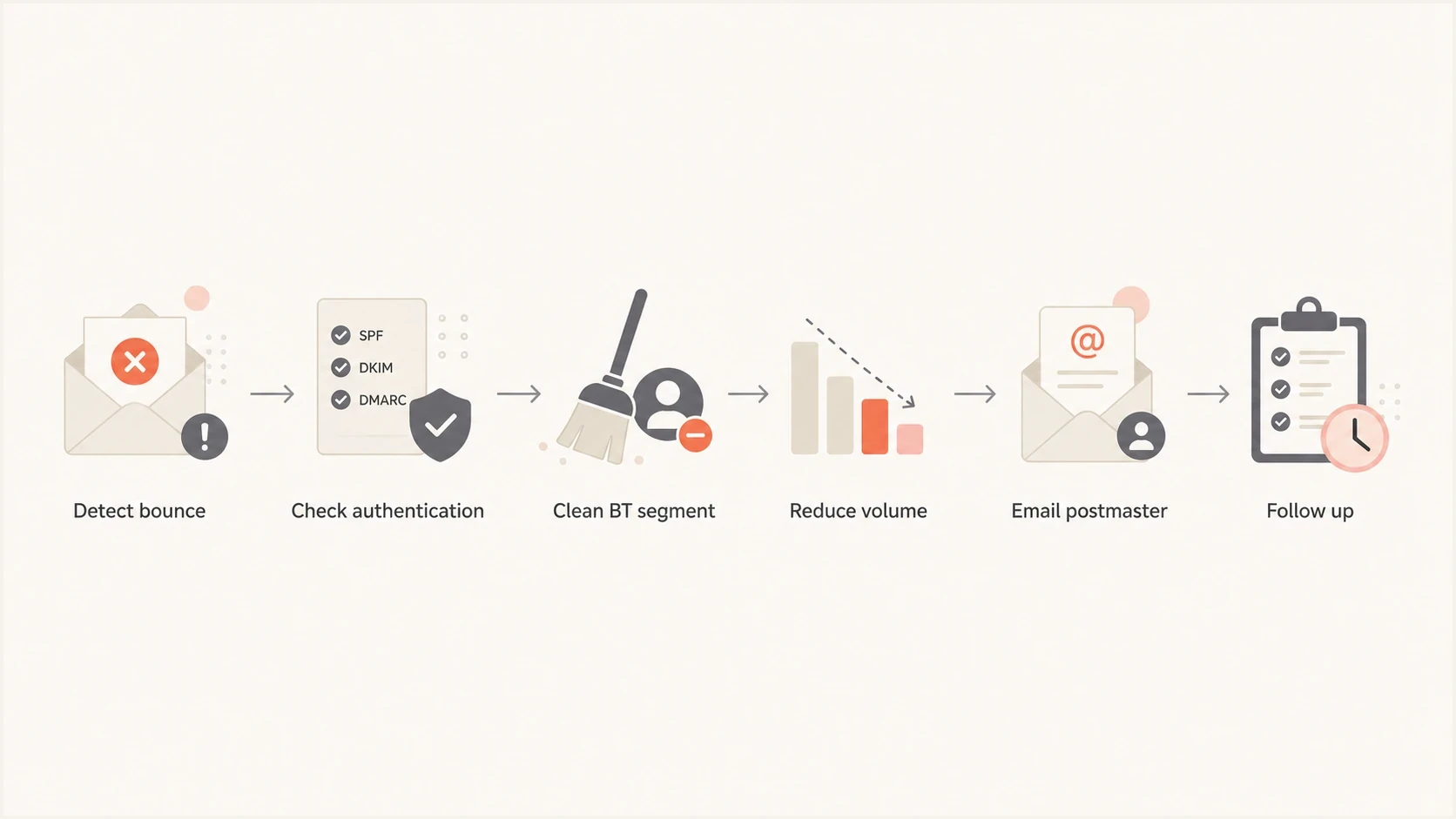
Flowchart showing BT deliverability escalation steps.
Follow up after seven to ten business days if there is no response and the issue is still active. Keep the same subject line, add a short update, and include new samples only. If you changed volume, list quality, authentication, or sending IPs, say exactly what changed.
Check before you escalate
Before contacting BT, test the message path as a receiver would see it. Send a real message and inspect the headers, authentication, spam signals, and content problems with the email tester. If that test shows broken authentication or obvious content issues, fix those first. A postmaster escalation with failing basics wastes time.
Email tester
Send a real email to this address. Suped shows a results button when the test is ready.
?/43tests passed
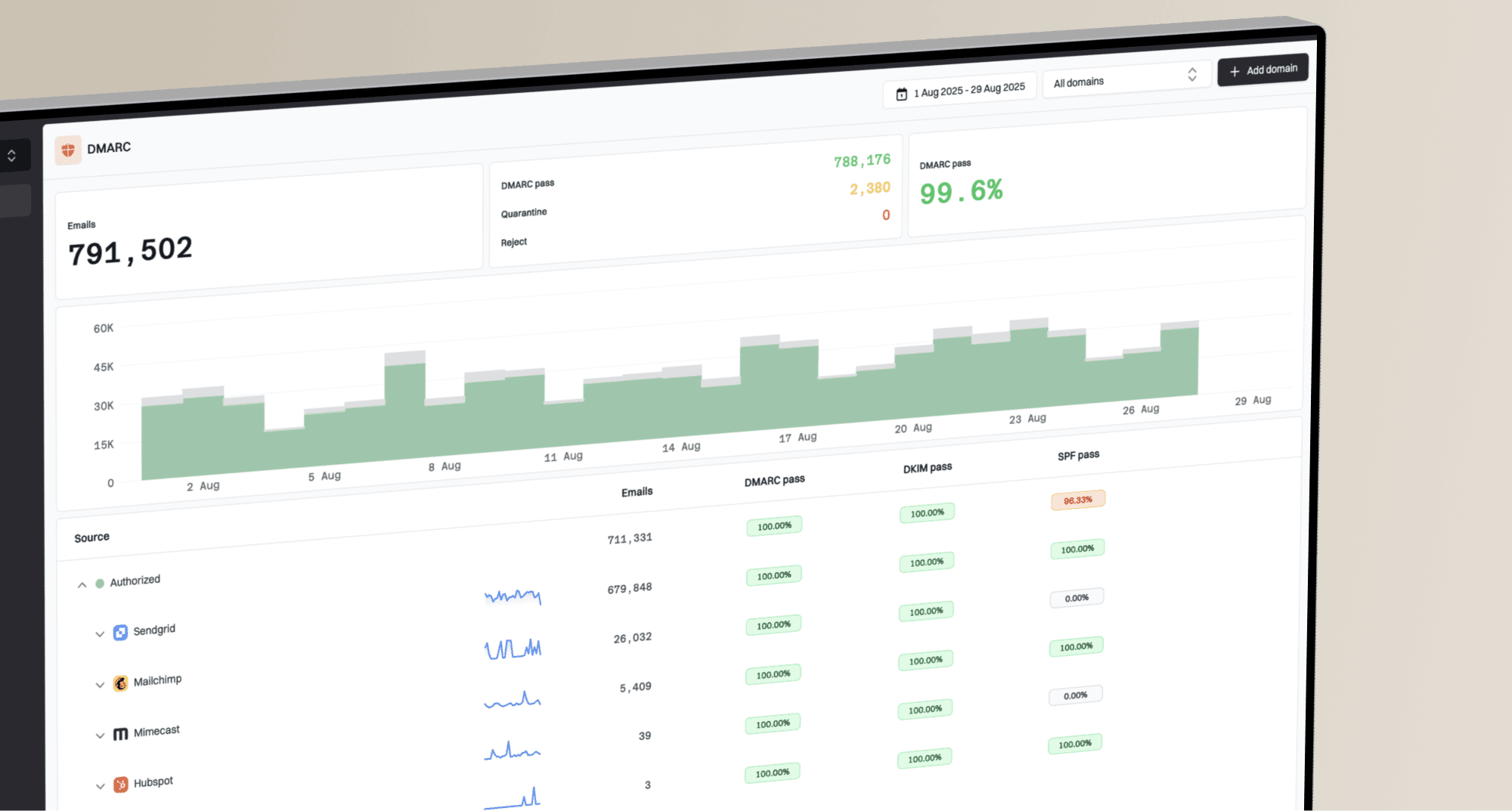
Check the sender domain as a whole, not only the failed campaign. A domain health check can catch missing DNS records, weak SPF setup, DKIM problems, and DMARC policy gaps. For ongoing visibility, DMARC monitoring helps document which sources are passing, failing, or sending without permission.
Reputation checks matter too. If the sending IP or domain appears on a blocklist (blacklist), BT's filters can treat that as another negative signal. Suped's product brings DMARC, SPF, DKIM, and blocklist monitoring into one workflow, making it easier to send BT a clean, evidence-backed case.
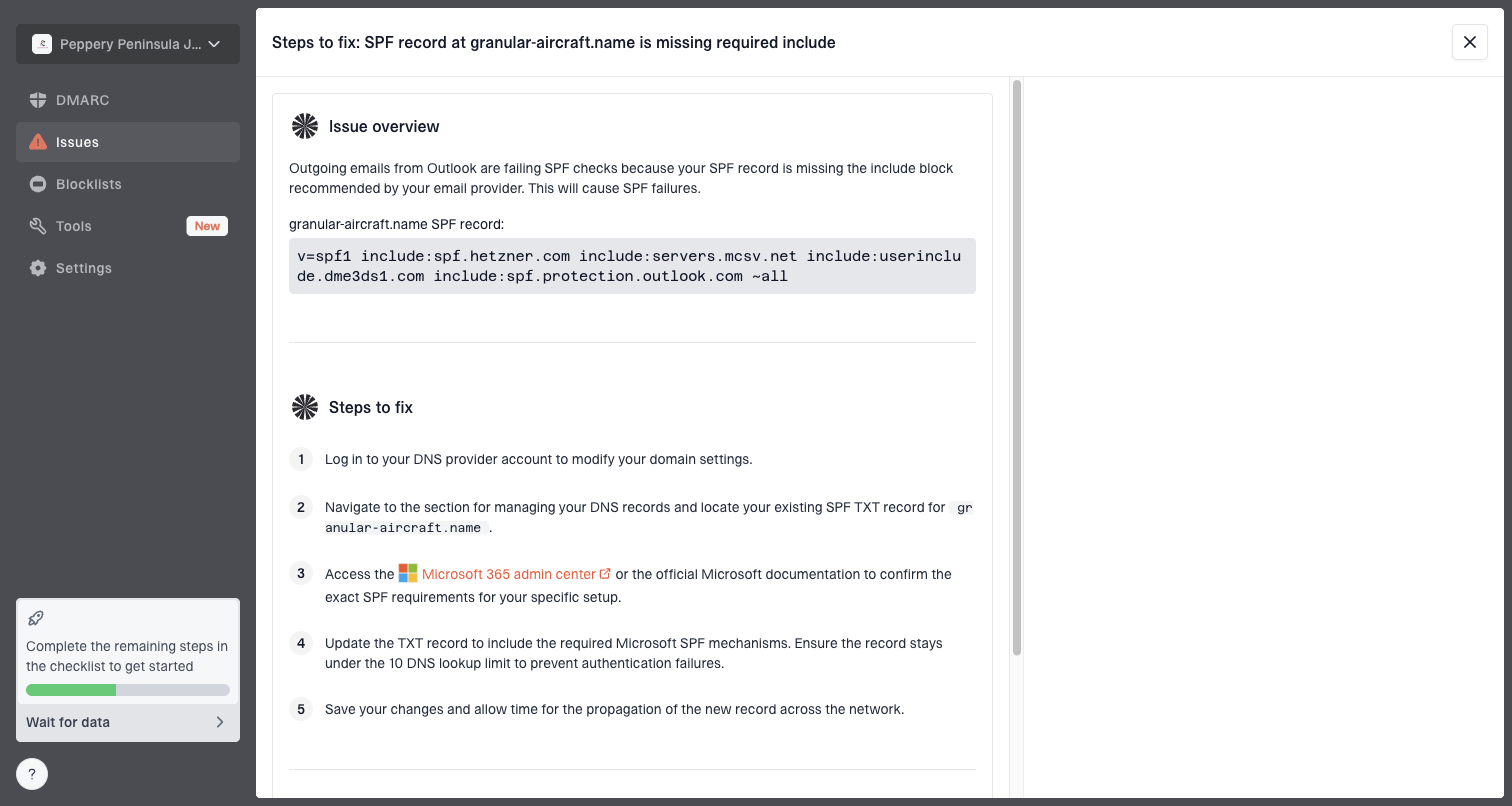
Issue steps to fix dialog showing the issue overview, tailored fix steps, and verification action
BT-specific causes to investigate
BT's public guidance points to the same fundamentals that matter at other mailbox providers: authentication, list quality, content, clear sender identity, and secure systems. BT provides limited feedback to senders, so logs and BT-domain segment results carry more of the investigation.
Read 554 policy errors as rejection evidence
A 554 response is a permanent failure for that delivery attempt, not proof that every later message will fail. When BT returns it after the DATA command, BT has evaluated the submitted message and refused to accept it for delivery. Keep the complete SMTP response, including the timestamp and timezone, host, policy code, BT reference ID, and message ID. Do not repeatedly retry the unchanged message as though the response were a temporary 4xx deferral.
- Authentication: SPF or DKIM must pass using a domain that matches the visible From domain under DMARC rules.
- Identity: Use a consistent visible From domain and stable sending domain.
- List quality: Remove invalid addresses and suppress inactive BT recipients before asking for review.
- Volume: Slow warming when BT bounces rise or engagement drops.
- Content: Test the exact message that failed, not a cleaned-up replacement.
- Security: Confirm no compromised source is sending through your domain.
For order confirmations and password emails, separate the stream from marketing traffic. If transactional mail shares a reputation pool with promotional sends, BT can judge the combined behavior. The business impact then grows because wanted service emails can receive the same policy response.
Minimum DNS records to verifytext
_dmarc.example.com TXT "v=DMARC1; p=none; rua=mailto:dmarc@example.com"
example.com TXT "v=spf1 include:spf.example.net -all"
selector1._domainkey.example.com TXT "v=DKIM1; k=rsa; p=PUBLICKEY"
Where Suped fits
Suped's product supports the evidence collection and remediation work behind a mailbox-provider escalation. It does not replace contacting BT when BT filters legitimate mail. It keeps authentication results, alerts, source data, and remediation records together so the sender can build a factual request.
Suped detects authentication issues, surfaces sources causing DMARC failures, alerts teams when problems spike, and combines DMARC, SPF, DKIM, blocklist and blacklist visibility, hosted SPF, hosted DMARC, and hosted MTA-STS in one place. For MSPs and agencies, the multi-tenant dashboard keeps client domains separate while allowing teams to compare recurring problems.
Manual workflow
- Evidence: Bounce logs, DNS checks, and reports live in separate places.
- Timing: The issue is often noticed after customers complain.
- Fixes: The team has to decide each DNS or sender fix manually.
Suped workflow
- Evidence: Authentication, source, and reputation data share one view.
- Timing: Alerts flag authentication and reputation changes as they appear.
- Fixes: Issue detection records steps for fixing the root cause.
That matters with BT because vague cases can stall. A Suped-backed case can document that the sending source is known, authenticated, monitored, and remediated. BT still decides how its filters handle the mail, but the sender controls the quality of the request.
Views from the trenches
Best practices
Send BT one concise case with bounce logs, timestamps, IPs, domains, and fixes already made.
Pause broad BT sending while you test smaller, engaged segments and remove stale addresses.
Keep SPF, DKIM, DMARC, rDNS, and list hygiene checked before every follow-up email.
Common pitfalls
Asking BT to diagnose weak list quality without proving opt-in and recent engagement data.
Following up with fresh theories instead of the same case ID, same logs, and new evidence.
Treating a temporary accept as recovery before bounce and complaint trends improve.
Expert tips
Separate transactional mail so order confirmations are not judged with marketing traffic.
Record BT-specific outcomes daily, because aggregate deliverability hides domain-level issues.
Escalate through your ESP when shared IP reputation affects more than one sender at BT.
Marketer from Email Geeks says postmaster@btinternet.com can respond, but timing varies widely, so a sender needs a complete case before asking for help.
2025-05-06 - Email Geeks
Marketer from Email Geeks says BT delivery can look unstable during warming because soft bounces, rejections, and later acceptance do not prove reputation recovery.
2025-05-07 - Email Geeks
A practical way forward
Contact BT Internet at postmaster@btinternet.com, but do the sender work first. Confirm authentication, isolate the BT segment, reduce risky volume, clean inactive addresses, and collect complete bounce samples. Then send a concise escalation with exact data and the fixes already completed.
Expect to wait and keep the case disciplined. Follow up without flooding the mailbox. Keep testing, keep the BT segment controlled, and judge recovery by sustained results rather than one accepted send. Suped's product is useful here when it turns the investigation into monitored, repeatable steps.