Are there any material differences between VMC issuers?

Updated on 9 Aug 2026: We updated this guide with current issuer pricing, validation checks, domain packaging, and VMC lifecycle requirements.
Yes, there are material differences between VMC issuers, but they are mostly commercial and operational, not technical. DigiCert, GlobalSign, and SSL.com all issue Verified Mark Certificates for BIMI. If a mailbox provider accepts the issuer and your domain meets the BIMI requirements, each certificate has the same basic job: it binds a validated logo mark to your domain so the mailbox can show that logo.
The practical differences are price, domain packaging, validation process, support quality, renewal terms, and acceptance by the mailbox providers you care about. The current public BIMI Group issuer list names DigiCert, GlobalSign, and SSL.com as MVAs. The BIMI Group also says that inclusion does not guarantee that every mailbox provider will accept an issuer's certificates.
- Direct answer: Do not pay more because one VMC has better deliverability mechanics. Pay more only if the issuer gives you faster validation, better domain packaging, confirmed mailbox acceptance, or procurement fit.
- Best quote path: Get a written quote from all three issuers for the same exact scope: one main organizational domain, six additional domains, support terms, renewal price, and any reissue fees.
- Before buying: Fix DMARC, prepare the trademark evidence, validate the SVG Tiny PS logo, and confirm the VMC will cover the domains you plan to use in BIMI.
What actually differs between issuers
Treat VMC issuer selection as a buying and execution decision, not as a separate email authentication strategy. The authentication work happens in DMARC, SPF, DKIM, and BIMI DNS. The VMC issuer validates your right to use the mark and issues the certificate that the BIMI record points to.
For a single-domain purchase, the difference is often price and administrative effort. For a multi-domain purchase, packaging can become a major budget item. For a time-sensitive launch, the issuer's evidence review and support response time can decide whether the logo appears on schedule.
|
|
|
|---|---|---|
 DigiCert DigiCert | Published annual subscription, hosted files, and 24x5 support | SAN pricing, reissues, and renewal total |
 GlobalSign GlobalSign | Order flow supports optional SANs for multiple domains | Per-domain terms, validation timing, and renewals |
 SSL.com SSL.com | Published one-year and multi-year pricing with hosted SVG | Domain scope, validation timing, and renewal terms |
Current VMC issuer comparison at a practical buying level.
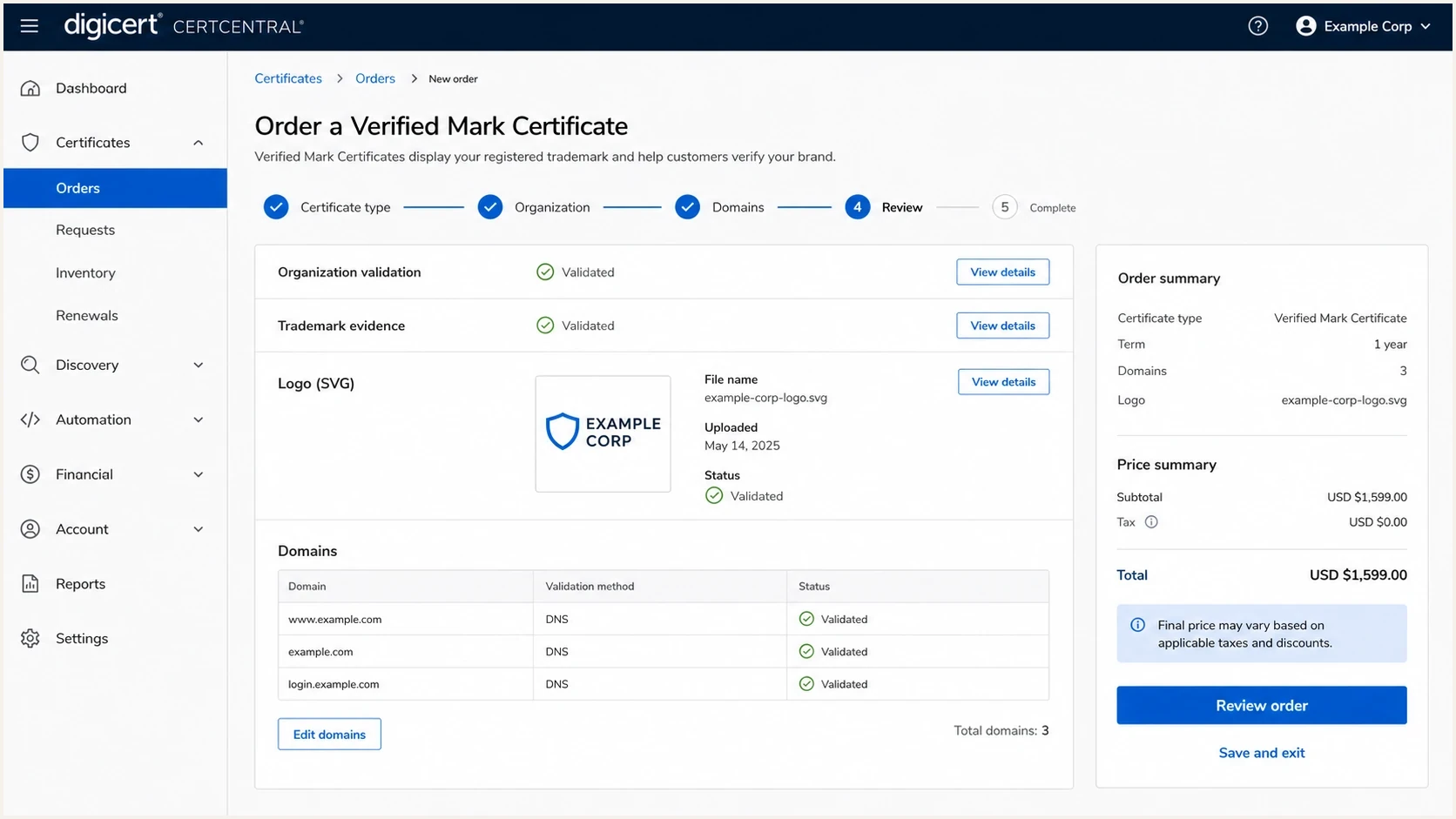
DigiCert CertCentral order screen for a Verified Mark Certificate.
Acceptance is receiver-specific
Being listed as an MVA does not force every mailbox provider to accept that issuer. Before buying, ask the issuer to confirm current support for your target mailbox providers and keep that confirmation with the quote.
- Issuer status: Check whether the issuer is accepted by the mailbox providers where your audience opens mail.
- Trust material: Confirm that the certificate chain and CRL endpoints are current, then review the issuer's latest audit position.
- Support trail: Keep written confirmation of domain coverage, reissue rules, and renewal pricing.
The technical certificate is usually not the differentiator
A VMC is not a deliverability accelerator by itself. It does not make SPF pass, repair DKIM alignment, or move a DMARC policy to enforcement. It is part of the BIMI chain after the authentication foundation is already working.
Usually the same
- BIMI role: The VMC validates the brand mark used by the BIMI DNS record.
- Policy need: The domain still needs DMARC enforcement for major BIMI display paths.
- Logo need: The SVG must match BIMI formatting rules and the validated mark.
Often different
- Price shape: Base price and additional domain pricing can diverge sharply.
- Validation help: Issuer intake and support can change how quickly evidence problems are resolved.
- Renewal terms: Revalidation, reissue, and extra domain rules change the total cost.
The technical comparison matters most when an issuer has a mailbox-provider acceptance gap, a certificate chain issue, or a revocation problem. Confirm those points before purchase, but do not mistake the issuer name for a deliverability advantage.
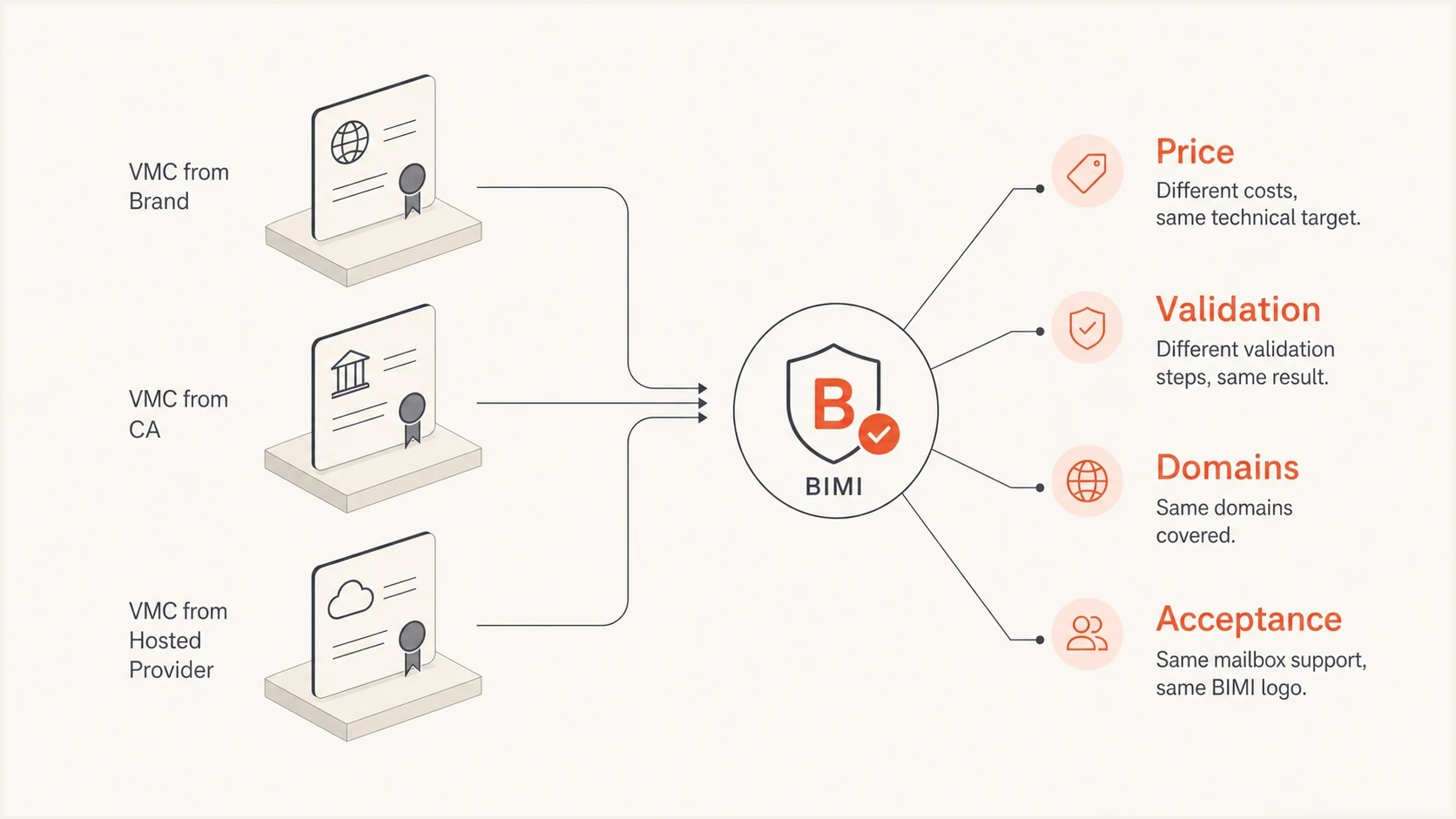
VMC issuer choice depends on price, validation, domains, and acceptance.
Price and domain packaging are the biggest differences
For a multi-domain order, quote structure can matter more than the certificate brand. Public US pricing currently shows $1,752 for DigiCert's 12-month VMC subscription and $1,500 for SSL.com's one-year VMC. GlobalSign's order flow supports optional SANs for multiple domains, but its final domain and renewal terms still need to be confirmed in the quote.
Published one-year VMC prices
Public US prices observed during this review. Discounts, taxes, domain scope, and renewal terms can change the total.
SSL.com one-year price
1,500 USDDigiCert annual subscription
1,752 USDThe base certificate price is only one line item. Ask whether an additional domain is added as a SAN, requires separate validation, triggers a reissue, or needs a separate certificate. The answer changes both the initial invoice and the renewal cost.
Subdomains need a specific answer
A BIMI record at the organizational domain can be inherited by subdomains that do not publish their own record. That can let one organizational-domain VMC support those mail streams. Separate subdomain assertions, selectors, or logos can change the required certificate scope, so put the exact design into the quote request.
- Ask clearly: Will an organizational-domain VMC cover mail from mail.example.com and news.example.com under the planned BIMI records?
- Check DNS: Make sure the BIMI lookup path and selector resolve to the intended organizational-domain or subdomain record.
- Price renewal: Confirm whether adding a domain later resets validation or triggers a new certificate fee.
What the validation process actually checks
The core VMC checks come from shared issuance requirements, but issuers differ in how they collect evidence and resolve exceptions. A clean application proves the organization exists, the applicant is authorized, the organization controls each requested domain, and the organization owns or is licensed to use the registered mark.
- Organization and applicant: Prepare official registration details, a reachable business contact, and evidence that the certificate approver can act for the organization.
- Domain control: Expect control validation for the FQDNs requested in the certificate, and involve the DNS team before the order starts.
- Trademark rights: Provide the registration number and trademark office. If another entity owns the mark, prepare a valid licence or authorization letter.
- Logo match: The submitted SVG must match the registered mark, including the colors the trademark record permits.
- Lifecycle: A VMC can be valid for no more than 398 days, so compare revalidation work and renewal support as well as first-year price.
CAA can block the chosen issuer
Issuers must check CAA before issuing a VMC. If your DNS publishes an issuevmc restriction, it must authorize the issuer selected for every covered FQDN. Review CAA before paying or switching issuers.
Ask each issuer whether it will precheck the trademark record and SVG, which domain-control method it will use, what identity step the approver must complete, and what happens if the evidence needs correction. Those answers expose the operational difference better than a base price alone.
DMARC readiness matters more than the issuer
The most common VMC mistake is buying the certificate before the domain is ready. BIMI depends on the visible From domain passing DMARC and the organizational domain using p=quarantine at pct=100 or p=reject. A policy of sp=none also blocks BIMI processing for covered subdomains. If DMARC is still at p=none, the VMC can sit unused.
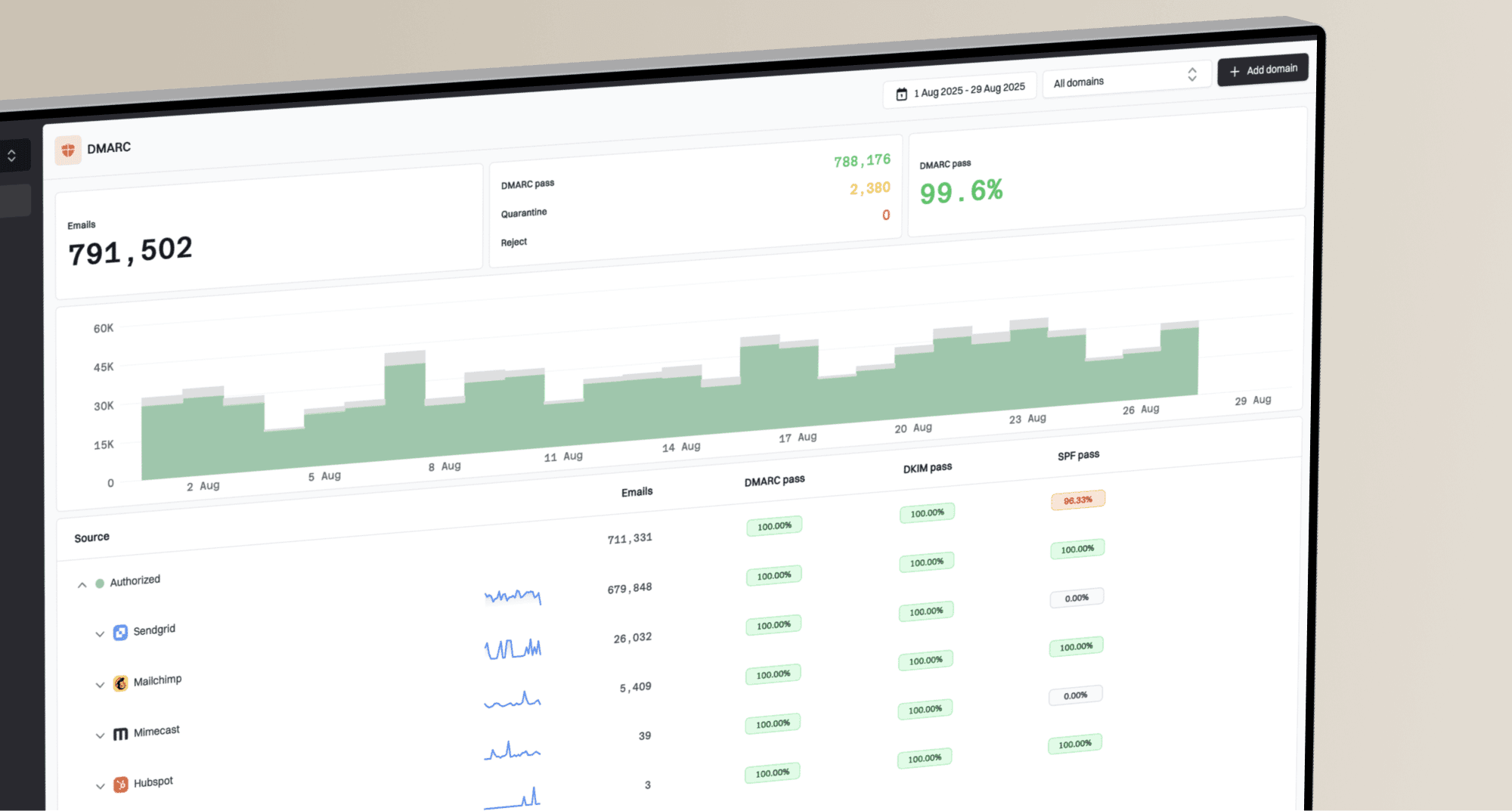
Suped's DMARC monitoring workflow can support a VMC project by showing which senders pass SPF or DKIM with DMARC alignment, which sources fail, and what still blocks a safe move to enforcement.
Example DMARC TXT record for BIMI readinessdns
_dmarc.example.com. 3600 IN TXT "v=DMARC1; p=quarantine;"
"rua=mailto:dmarc@example.com; pct=100"
If DNS access is slow or split across teams, Suped's Hosted DMARC can make policy staging easier because day-to-day policy changes happen in Suped instead of repeated DNS edits. For a focused record check, use the DMARC checker before sending a VMC application.
?
What's your domain score?
Deep-scan SPF, DKIM & DMARC records for email deliverability and security issues.
After DMARC is stable, the BIMI record is simple in shape but strict in detail. The logo URL must host the approved SVG, and the authority URL must host the VMC file. Keep both URLs under change control because an expired certificate or broken fetch can stop logo display even when email authentication still passes.
Example BIMI TXT record with a VMC URLdns
default._bimi.example.com. 3600 IN TXT "v=BIMI1;"
"l=https://example.com/bimi.svg; a=https://example.com/vmc.pem"
Suped DMARC dashboard showing email volume, authentication health, and source breakdown
Suped is our DMARC reporting and email authentication platform. For a VMC project, its practical role is to monitor DMARC, SPF, and DKIM results, stage policy changes, flag authentication failures, and keep the domain at enforcement before and after certificate issuance.
How to choose between DigiCert, GlobalSign, and SSL.com
Make the issuers quote the same package, then choose the best combination of confirmed mailbox acceptance, total cost, validation clarity, and support. Do not compare a base one-domain price against a bundled multi-domain quote.
- Mailbox fit: Ask each issuer to confirm support for the mailbox providers that matter to your audience.
- Domain scope: List the main domain, each additional organizational domain, every sending subdomain, and any alternate selectors.
- Logo proof: Prepare trademark documents and match the SVG to the registered mark you expect to validate.
- Quote details: Ask for first-year cost, renewal cost, add-on domain fees, reissue fees, and refund terms.
- Support path: Ask who handles validation questions and how quickly evidence issues are reviewed.
- Exit plan: Confirm how renewal, cancellation, revocation, and issuer migration work before you pay.
|
|
|
|---|---|---|
One domain | Compare first-year and renewal totals | Public pricing changes |
Several domains | Compare SAN and domain scope line by line | Packaging drives total cost |
Strict launch date | Compare validation support and response targets | Evidence delays vary |
DMARC not ready | Wait before applying | Enforcement comes first |
A compact buying guide for common VMC situations.
Do not assume DigiCert is the only working route. If that is the core concern, the DigiCert-only question is separate from the pricing question. The buying answer can change when a mailbox provider changes issuer acceptance.
Practical recommendation
If all three issuers are accepted for your target mailbox providers, choose the lowest total-cost issuer that gives clear written answers on domain coverage, validation, and renewal. Do not pay a large premium for the issuer name alone.
- For one domain: Support quality and validation speed can matter as much as price.
- For many domains: Additional domain fees usually decide the lowest-cost quote.
- For tight launches: Pick the issuer that gives named validation contacts and clear evidence guidance.
Views from the trenches
Best practices
Ask each issuer for main domain and add-on domain pricing in writing before approval.
Confirm the VMC subject, trademark evidence, logo file, and BIMI DNS selector early.
Keep DMARC at quarantine or reject before treating a VMC quote as launch-ready today.
Common pitfalls
Comparing base certificate price only misses add-on domain fees and validation delays.
Buying a VMC before fixing DMARC leaves the logo blocked by mailbox provider checks.
Assuming one issuer works everywhere ignores mailbox provider acceptance and root trust.
Expert tips
Map organizational-domain inheritance and separate subdomain BIMI records before quoting.
Request renewal terms, revalidation steps, and support paths before signing the quote.
Document every BIMI selector, SVG URL, VMC URL, and DMARC policy in one runbook.
Marketer from Email Geeks says the current issuers produce largely equivalent VMC outcomes for BIMI, so price and process usually drive the decision.
2026-01-20 - Email Geeks
Marketer from Email Geeks says GlobalSign quote examples have been lower for additional domains than DigiCert quote examples in multi-domain buys.
2026-01-20 - Email Geeks
The practical answer
For most buyers, the material differences between VMC issuers are not in the certificate mechanics. They are in the quote, validation experience, renewal terms, extra-domain treatment, and confirmed acceptance by the mailbox providers you care about.
Get quotes from DigiCert, GlobalSign, and SSL.com using the same domain list, validation assumptions, and renewal questions. If the issuers are accepted for your target inboxes, choose the issuer with the best total cost and clearest support path. Put the savings into the DMARC and BIMI groundwork because that is what keeps the logo eligible to display.