URIBL Grey Domain Name Blacklist

The URIBL blocklist (or blacklist) tracks domains in spam. It carries false positive risks, sometimes affecting legitimate ESPs or senders using Suped.
Updated on 17 Jun 2026: We updated this guide to clarify how URIBL Grey checks message URLs and what to investigate before delisting.
Summarize with
Check if you are listed on URIBL Grey Domain Name Blacklist
And 143 other blocklists.







What is the URIBL Grey blocklist?
The URIBL Grey Domain Name Blacklist is a URI and domain blacklist (or blocklist) for domains found inside unsolicited bulk or commercial email, also called UBE or UCE. It is not a sending IP blacklist. URIBL checks the domains that appear in message links, then receiving filters decide how to score the message. URIBL's Grey policy covers domains found in UBE/UCE, including domains that honor opt-out requests and some Email Service Providers (ESPs) with customers who import recipient lists. URIBL warns that Grey can cause false positives, depending on the recipient's definition of spam. The Grey zone is dynamic and rebuilds several times a day as necessary.
Who runs the URIBL Grey blocklist?
The URIBL Grey Domain Name Blacklist is operated by URIBL.COM. URIBL distributes data about domains associated with unsolicited email through Public DNS, RSS feeds, local data feeds, and related lookup forms. The service is designed to complement anti-spam filtering, especially systems that check domains in message URLs through multi.uribl.com.
How do I get removed from URIBL Grey?
To request removal from this blocklist, use the official lookup form on the URIBL website. If your domain is listed, register for an account and submit a delisting request through the same form. Before requesting removal, check the source of the listing risk:
- URIBL does not provide specific evidence for a listing. Review recent campaigns, customer-uploaded lists, shared tracking domains, landing pages, and compromised web forms before filing a request.
- Confirm the lookup result specifically says URIBL. The official lookup can show results for separate services that URIBL does not control, and URIBL cannot remove listings from those services.
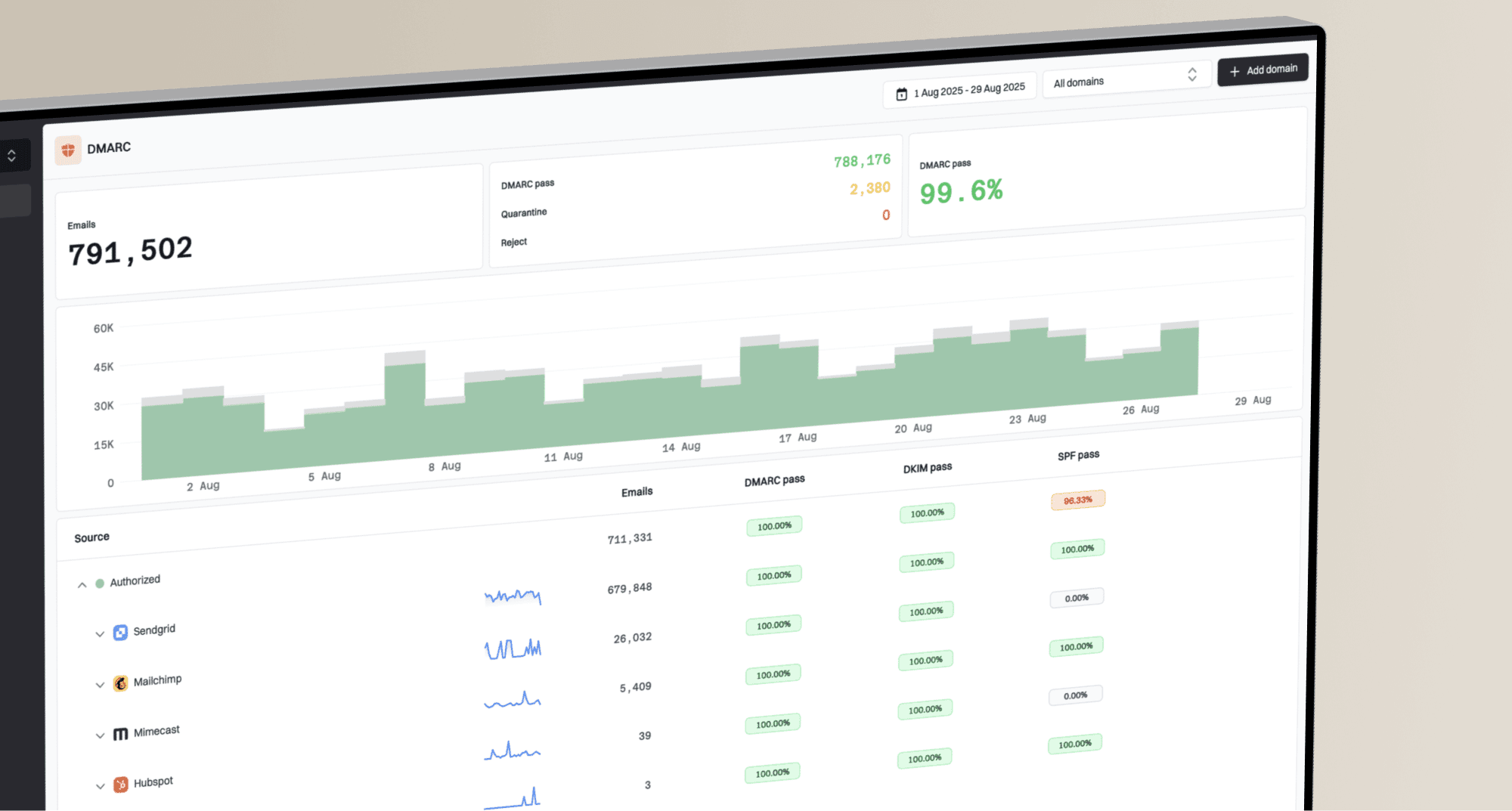
- Use Suped's DMARC reports to identify which approved platforms are sending authenticated mail for your domain, then compare those sources with the campaigns and links you are reviewing.
- Do not request to be whitelisted. URIBL does not offer whitelisting by request.
- Only use the official web form for delisting. URIBL states that delisting requests sent by email do not receive replies. You can access the URIBL lookup and submission page after registering for an account.
How URIBL Grey checks domains and URLs
URIBL Grey is used as a URI DNSBL. A receiving system extracts URLs from a message, strips most hostnames down to the registrable domain, and queries URIBL. For most senders, the multi.uribl.com zone is the practical lookup point because it checks URIBL's public lists in one DNS query.
- A Grey hit through multi.uribl.com returns bit value 4, commonly shown as 127.0.0.4. Test records can return combined values, so do not treat every URIBL response as Grey.
- URIBL usually lists the registrable domain from the URL, not every hostname. Heavily abused hosting patterns can lead to subdomain-level listings.
- URIBL can also list IP addresses found inside message URLs. These are queried in reversed IPv4 order, such as 4.3.2.1.multi.uribl.com for 1.2.3.4.
- A public DNS response that indicates blocked queries is an infrastructure issue for the resolver, not proof that the checked domain is listed.
What is the impact of a URIBL Grey listing?
The impact of being listed on the URIBL Grey Domain Name Blacklist is generally medium, but recipient policy determines the actual result. Grey is less severe than URIBL's Black list, but a listing can still increase spam-folder placement or message rejection when a campaign contains the listed domain in its URLs. URIBL does not block email by itself. The receiving filter or mailbox provider makes that decision based on its own scoring rules, which often combine URL reputation with sender authentication, content, recipient engagement, and complaint data. For legitimate senders, the main risk is a false positive on a shared tracking domain or customer landing page when an ESP-managed domain appears in mixed-quality mail.
Other URIBL blocklists
URIBL Black Domain Name Blacklist
Organization
URIBL
Zone
black.uribl.com
Type
Domain
Impact
Medium
Delisting
Manual
URIBL Multi Domain Name Blacklist
Organization
URIBL
Zone
multi.uribl.com
Type
Domain
Impact
Medium
Delisting
Manual
URIBL Red Domain Name Blacklist
Organization
URIBL
Zone
red.uribl.com
Type
Domain
Impact
Medium
Delisting
Manual