Taughannock Networks South Korean Network Blocking List

Taughannock Networks South Korean blocklist (or blacklist) blocks email from South Korean IPs for admins who do not need traffic from that region.
Updated on 18 Jun 2026: We updated this guide with clearer DNSBL lookup behavior, delisting expectations, and impact guidance for mail admins.
Summarize with
Check if you are listed on Taughannock Networks South Korean Network Blocking List
And 143 other blocklists.







What is Taughannock Networks South Korean Network Blocking List?
The Taughannock Networks South Korean Network Blocking List (korea.services.net) is an anti-spam DNS blacklist or blocklist for mail administrators who do not expect meaningful legitimate email from South Korean networks. It was created in late 2001 after a large volume of spam came from Korean networks and attempts to contact network managers did not produce responses.
Technically, it operates as a DNSBL (DNS Blocking List). Mail servers and spam filters can query the zone during the SMTP session or during message scoring. It is not designed for email clients such as Outlook or Eudora. Any mail administrator can use this blocklist, but high-volume sites should query through a local DNS cache and respect DNS TTL values to reduce load and avoid stale results.
- The database primarily includes most IP address ranges assigned to Korea by APNIC.
- It also contains older ARIN ranges with a history of spam problems.
- This blocklist (or blacklist) lists entire networks, not individual IP addresses or computers.
- It is a regional policy list, so it can block legitimate mail from South Korean senders if your organization has users, customers, vendors, or partners in that region.
The stated goal of the list is to stop spam, not to permanently block networks. Networks that show they have fixed their spam issues, secured open relays and proxies, and set up a process for handling abuse complaints can be removed from the list.
How DNSBL lookups work
Like other IP-based DNSBLs, korea.services.net uses DNS query names built from reversed IP octets. If a receiving mail server checks 192.0.2.10, the DNSBL-style query name would be 10.2.0.192.korea.services.net.
Example DNSBL querytext
10.2.0.192.korea.services.net. IN A
10.2.0.192.korea.services.net. IN TXT
Any returned A record means the tested address is listed. A TXT record, when present, can provide policy text for an SMTP rejection or spam score. Because this list covers networks, a positive lookup can come from the surrounding allocation being listed, not because that exact host sent spam.
- Use the list at SMTP time only if blocking all listed South Korean network ranges matches your mail policy.
- Use a spam score or quarantine when you need review before rejecting mail.
- Keep a local DNS cache and honor TTL values, since DNSBL data can change and stale results can cause incorrect handling.
- Check DNSBL health periodically, since a wildcard or inactive zone can create unexpected blacklist results.
Who runs Taughannock Networks South Korean Network Blocking List?
The korea.services.net zone is operated by Taughannock Networks. The company works on internet infrastructure, with email as a core competence.
John R. Levine is the author of RFC 5782, the informational RFC that documents DNS-based blacklists and whitelists. His work includes internet networking, email policy, anti-spam standards, CAUCE, ICANN SSAC, and The Internet Society.
How do I get removed and delisted from Taughannock Networks South Korean Network Blocking List?
To request removal from the Taughannock Networks South Korean Network Blocking List, send an email to info@taugh.com.
Before you request delisting, understand that Taughannock Networks lists entire networks, not individual computers. Delisting requests for single computers will be ignored. A removal request will only be considered if the entire network has its spam problem under control.
- Identify the full network range involved, not just one affected IP address.
- Remove spam sources and shut down abusable relays, proxies, compromised hosts, and weak outbound controls.
- Confirm that abuse contacts work and that complaints are reviewed by someone who can act on them.
- Explain what changed in the network so the operator can assess whether the spam problem has been fixed.
What's the impact of being listed on Taughannock Networks South Korean Network Blocking List?
The impact of being on the Taughannock Networks South Korean Network Blocking List is usually low. This blacklist is specialized and is intended for system administrators who specifically want to block email from South Korean networks because of spam volume. Because of its narrow focus, adoption is limited. Unless your recipients use this specific blacklist, a listing is unlikely to have a major effect on overall email deliverability.
If a recipient uses the list at SMTP time, mail from an included South Korean network can be rejected before message content, SPF, DKIM, or DMARC results are considered. If the recipient uses it as a spam-filter input, it can add weight rather than cause outright rejection.
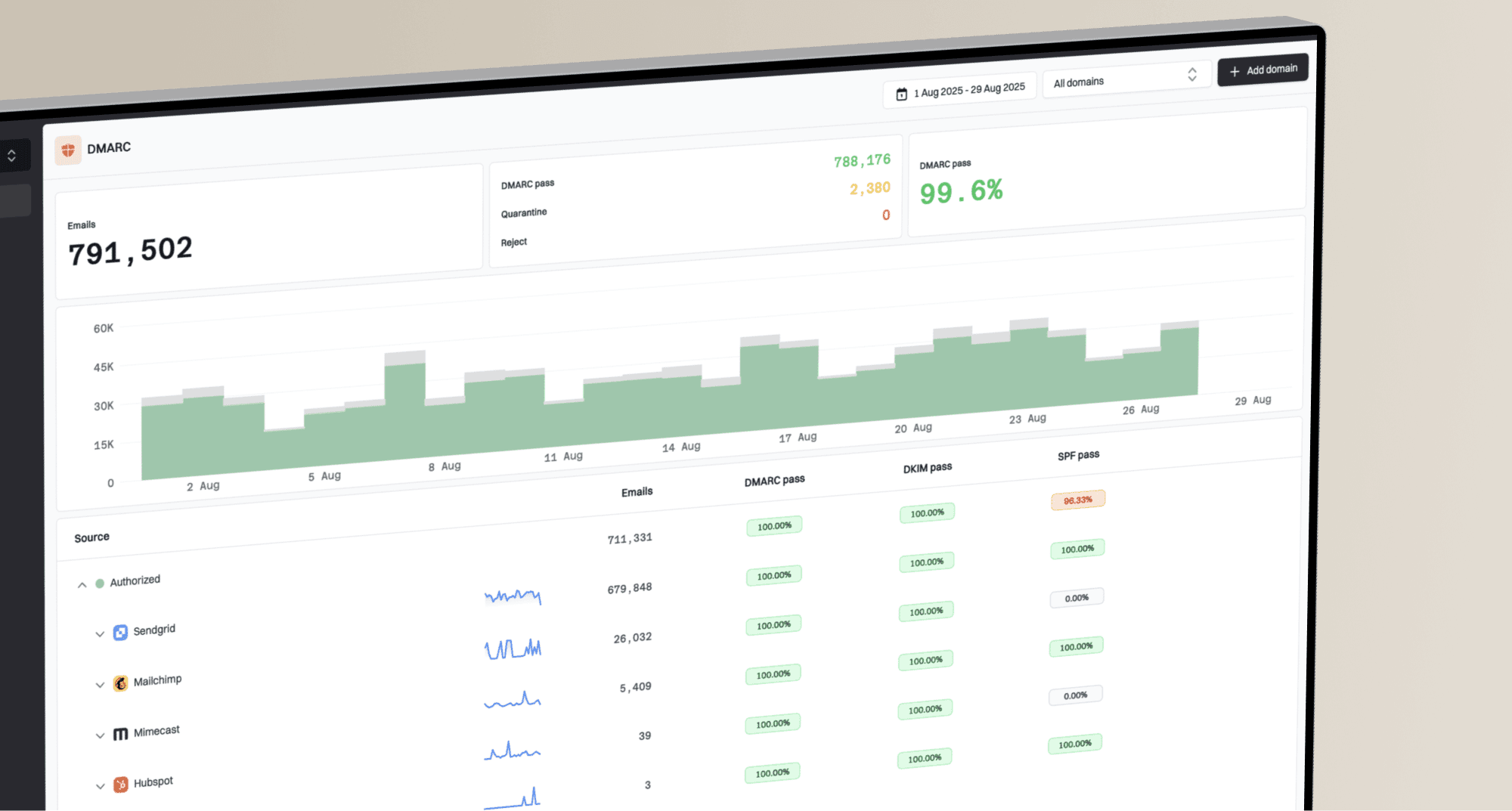
Treat the listing as an IP and network-source issue, not proof that your domain authentication is broken. Check bounce text, recipient MX behavior, the sending IP range, and authentication results separately before changing DNS records. In Suped's product, compare DMARC authentication results with bounce evidence so the team does not misdiagnose a regional DNSBL hit as an SPF, DKIM, or DMARC failure.