System 5 Hosting s5h.net Realtime Blacklist (RBL)
The s5h.net RBL is a realtime blocklist (blacklist) identifying IPv4 and IPv6 addresses sending spam or malicious traffic. Use Suped for monitoring.
Updated on 17 Jun 2026: We updated this guide with clearer S5H delisting limits and practical checks for IPv4 and IPv6 listings.
Summarize with
Check if you are listed on System 5 Hosting s5h.net Realtime Blacklist (RBL)
And 143 other blocklists.







What is System 5 Hosting s5h.net Realtime Blacklist (RBL)?
The System 5 Hosting s5h.net Realtime Blacklist (RBL), also known as the s5h blacklist, is an IP-based blocklist operated by System 5 Hosting (S5H). It helps receiving mail servers and network filters reject traffic from IP addresses that S5H has observed sending spam or abusive traffic.
The list is RFC 5782 compliant and updated in real time. Listings are based on IP reputation, message content, and observed behavior. S5H publishes the collated DNSBL zone at all.s5h.net, and that namespace includes IPv4 and IPv6 entries.
Who runs System 5 Hosting s5h.net Realtime Blacklist (RBL)?
The System 5 Hosting s5h.net Realtime Blacklist (RBL) is run by System 5 Hosting (S5H). S5H maintains it as a public DNSBL so receiving systems can use DNS lookups to decide whether to reject, quarantine, or score traffic from a connecting IP address.
How to check a System 5 Hosting s5h.net listing
Check the DNSBL zone directly when you need to confirm whether a sending IP is listed. Reverse the IPv4 octets before all.s5h.net. For IPv6, expand the address and reverse each hexadecimal nibble before the zone name.
IPv4 lookup formatBASH
dig +short 55.2.0.192.all.s5h.net
IPv6 lookup formatBASH
dig +short 1.0.0.0.0.0.0.0.0.0.0.0.0.0.0.0.0.0.0.0.0.0.0.0.8.b.d.0.1.0.0.2.all.s5h.net
A positive DNS response indicates a listing, while an empty answer from the resolver indicates that the IP address is not listed. Use a TXT lookup when you need the listing reason. S5H states that its DNS query TTL is five seconds, so a successful delisting should clear quickly after recursive DNS caches refresh.
How do I get removed and delisted from System 5 Hosting s5h.net Realtime Blacklist (RBL)?
The fastest method for delisting is the automatic removal system. Visit the rblremove web page from the listed IP address. S5H states that this should remove the IP address immediately when the request comes from the address being removed. You can do this using a web browser or command-line tools such as curl or telnet.
Automatic removal with curlBASH
curl -4 http://www.usenix.org.uk/content/rblremove
S5H warns that more than three removal requests from one IP address per day can cause further blocking without automatic removal, so do not script repeated attempts.
If you are unable to use the automatic system, you can fill out the form for removal assistance. This process is manual and takes longer than the self-service path. S5H asks for the listed IP address, proof that the security issue is fixed, and the steps taken. If the request meets the criteria, S5H says removal happens within 30 minutes.
- Fix the issue first by confirming that the underlying spam source, compromised account, open relay, or infected host is no longer active. A delisting request fails if the cause remains in place.
- Use the automatic system if possible. Manual removal is slower, so exhaust the self-service option before requesting assistance.
- Check the source IP. If the server is multihomed or sends mail over IPv6, confirm the removal request leaves through the listed address. Use the interface or bind option where your tool supports it.
- Understand the listing type. This is an IP-based blacklist, not a domain-based one. SPF, DKIM, and DMARC help authenticate mail, but they do not remove an IP address from all.s5h.net.
- Communicate politely when contacting support. Provide the listed IP address, the cause you found, and the steps you took to correct it. Hostile messages delay or stop manual help.
What's the impact of being listed on System 5 Hosting s5h.net Realtime Blacklist (RBL)?
The practical impact is recipient-specific. Large mailbox providers such as Gmail, Outlook, and Yahoo rely primarily on their own reputation systems, while smaller ISPs, company gateways, self-hosted mail systems, and antispam rules can query all.s5h.net. A listing can block or score mail for specific recipients, so investigate it when bounce logs, SMTP rejections, or recipient reports point to S5H.
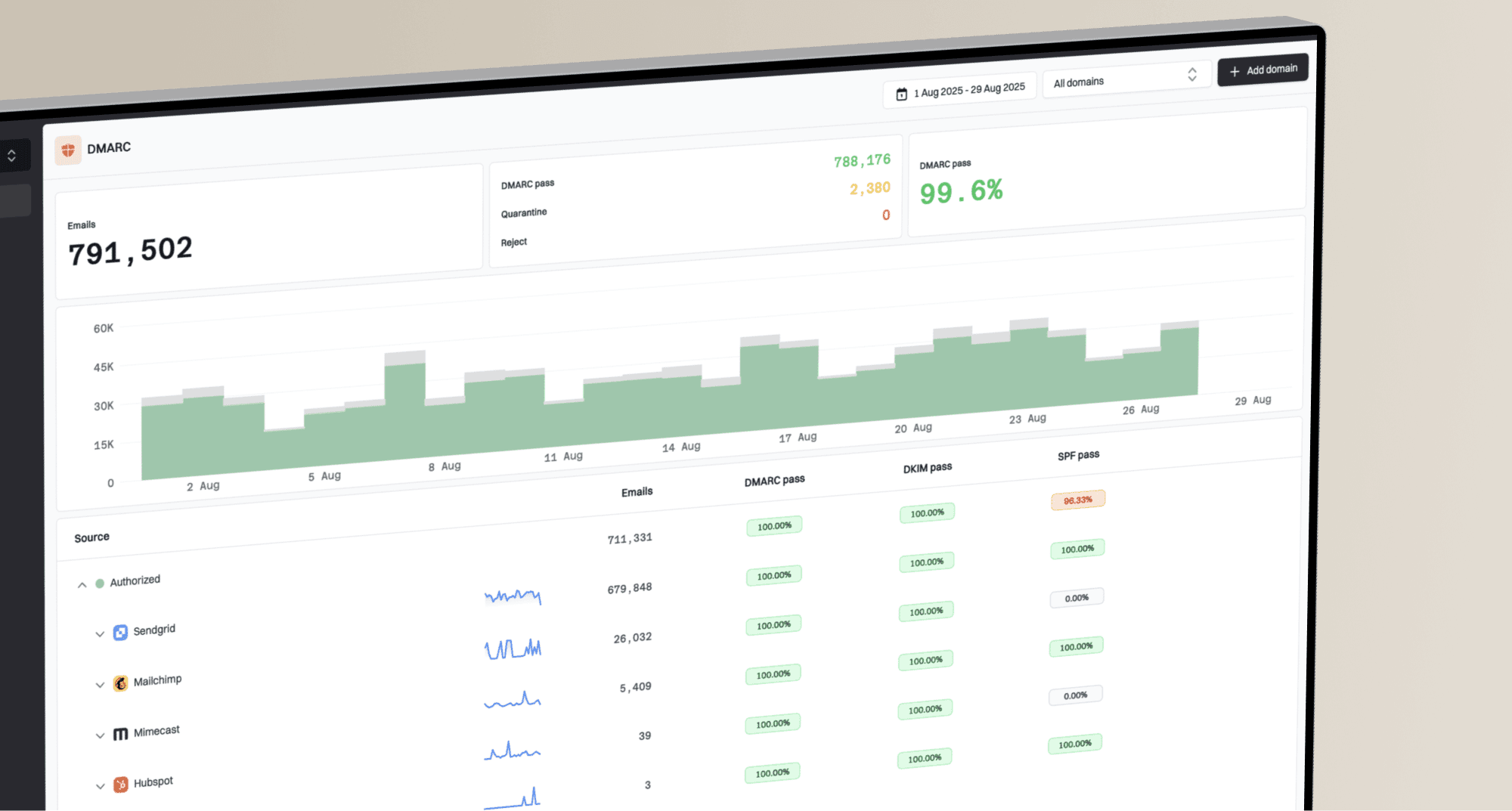
Suped's DMARC reporting can help with this triage by showing which approved sending sources are passing SPF, DKIM, and DMARC while you investigate whether the same IP is also appearing on a blocklist (blacklist).