How do I resolve Cloudmark deliverability issues?

Published 30 Jul 2025
Updated 8 Aug 2026
11 min read
Summarize with

Updated on 8 Aug 2026: We added reverse DNS and account-security checks, then clarified the evidence needed for CSI remediation.
To resolve Cloudmark deliverability issues, treat them as a reputation investigation first. Start by proving whether the problem follows the new ESP IPs, the sending domain, a subscriber segment, a campaign type, or a specific message stream. Then pause risky traffic, verify SPF, DKIM, and DMARC, check Cloudmark CSI reputation signals, compare complaint and engagement data, remove suspect addresses, and escalate with full headers and evidence.
When the issue starts right after an ESP move, the new sending IPs deserve immediate attention. Cloudmark CSI supplies IP reputation data, while each receiving provider decides how to use that data. Spam trap hits, user complaints, reverse DNS, nearby IP reputation, and traffic patterns can all affect the result. The Cloudmark CSI FAQ is the Cloudmark-owned reference for reputation and remediation.
- Scope: List the exact domains, IPs, campaigns, segments, recipient domains, and SMTP responses affected.
- Stabilize: Pause the stream that triggers filtering at receivers using Cloudmark data instead of changing every campaign.
- Authenticate: Confirm SPF passes, DKIM signs with the intended domain, and DMARC passes for the visible From domain.
- Clean: Suppress complainers, inactive addresses, typo domains, role accounts, and stale imports.
- Escalate: Submit the rejected IP, exact bounce, full headers, timeline, and evidence of remediation.
Why Cloudmark problems appear after an ESP move
An ESP migration changes more than the interface used to send mail. It changes return-path domains, DKIM selectors, sending IPs, bounce handling, header structure, tracking domains, throttling behavior, and sometimes the mail merge logic. Receivers using Cloudmark data see those changes as a new reputation pattern, even if the subscribers and offers are the same.
Cloudmark deliverability issues commonly involve IP reputation, nearby IP-range reputation, complaint pressure, spam trap exposure, or message fingerprints. A paid membership list can still create complaints if the offer cadence, subject line, or promise at signup no longer matches what people expect. Opt-in status helps, but it does not override current recipient behavior.
What changed with the ESP
- IPs: Shared IPs carry pool history, while newly assigned dedicated IPs can have prior reputation or little recent history.
- Headers: New headers and tracking domains can alter filtering decisions at receivers using Cloudmark data.
- Cadence: Migration work often changes send timing, batching, and resend behavior.
What did not automatically change
- Permission: A paid or opt-in relationship still needs current interest and clear expectations.
- Identity: The From domain and brand promise still carry subscriber memory.
- Evidence: Engagement outside Cloudmark-protected mailboxes helps, but it does not close the case alone.
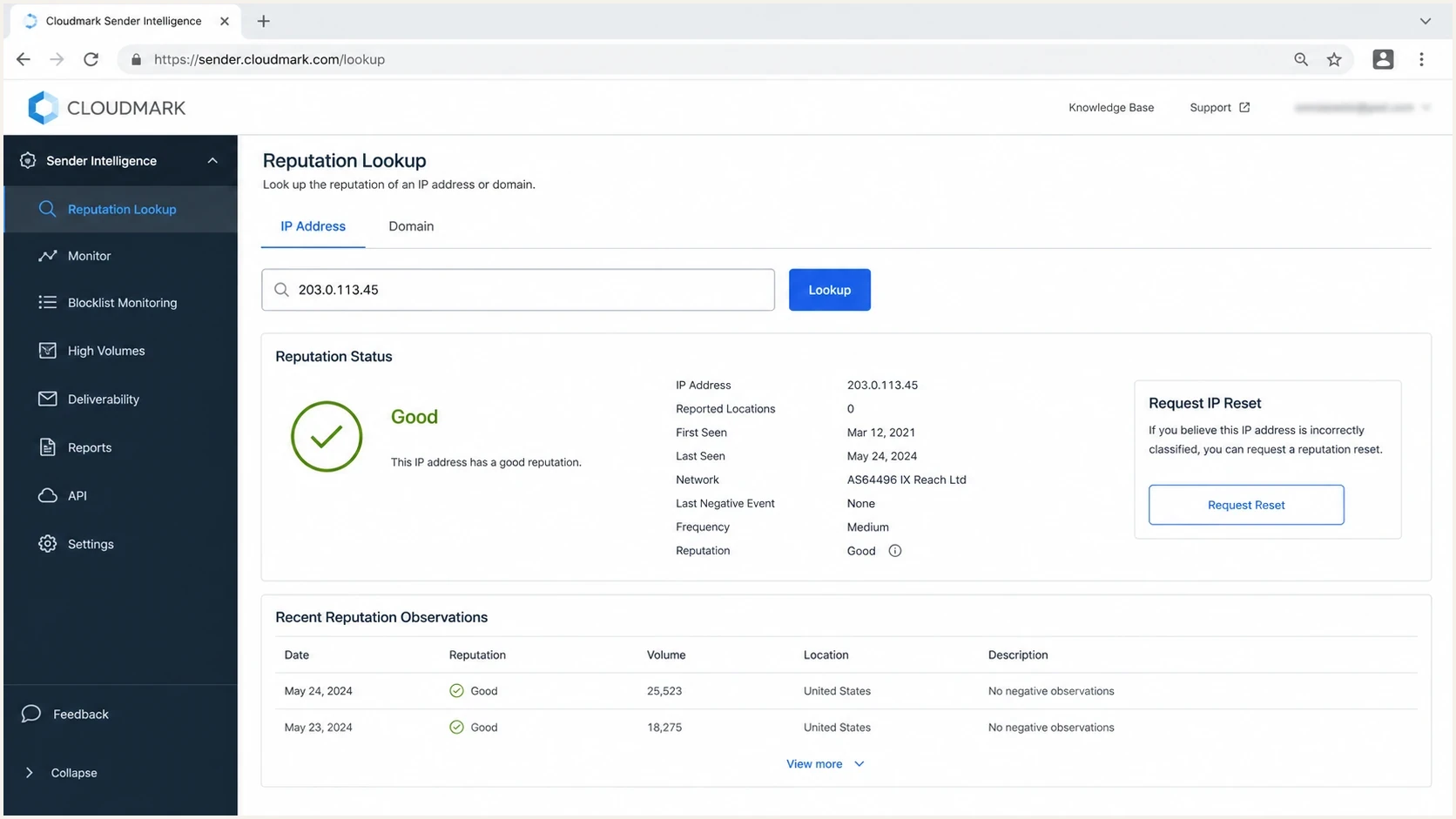
Cloudmark Sender Intelligence reputation lookup screen concept.
Run a fast evidence check
Before changing copy, templates, or sending infrastructure, build a short evidence pack. The goal is to separate a confirmed Cloudmark reputation problem from a general inbox-placement problem that only looks receiver-specific.
A clean baseline starts with DNS and authentication. Run the sending domain through the domain health checker before making changes, then save the result next to your campaign data. That keeps the investigation grounded when several teams are changing DNS, ESP settings, and suppression rules at the same time.
?
What's your domain score?
Deep-scan SPF, DKIM & DMARC records for email deliverability and security issues.
Confirm the exact SMTP response before calling the incident a CSI problem. Save the status code, rejected sending IP, timestamp, recipient domain, and full diagnostic text. Then send a controlled message to real test accounts at affected domains and to control accounts elsewhere. Keep the content, segment, domain, and send time the same. If only receivers using Cloudmark data fail, focus on their reputation decision. If both groups fail, investigate the wider mail program.
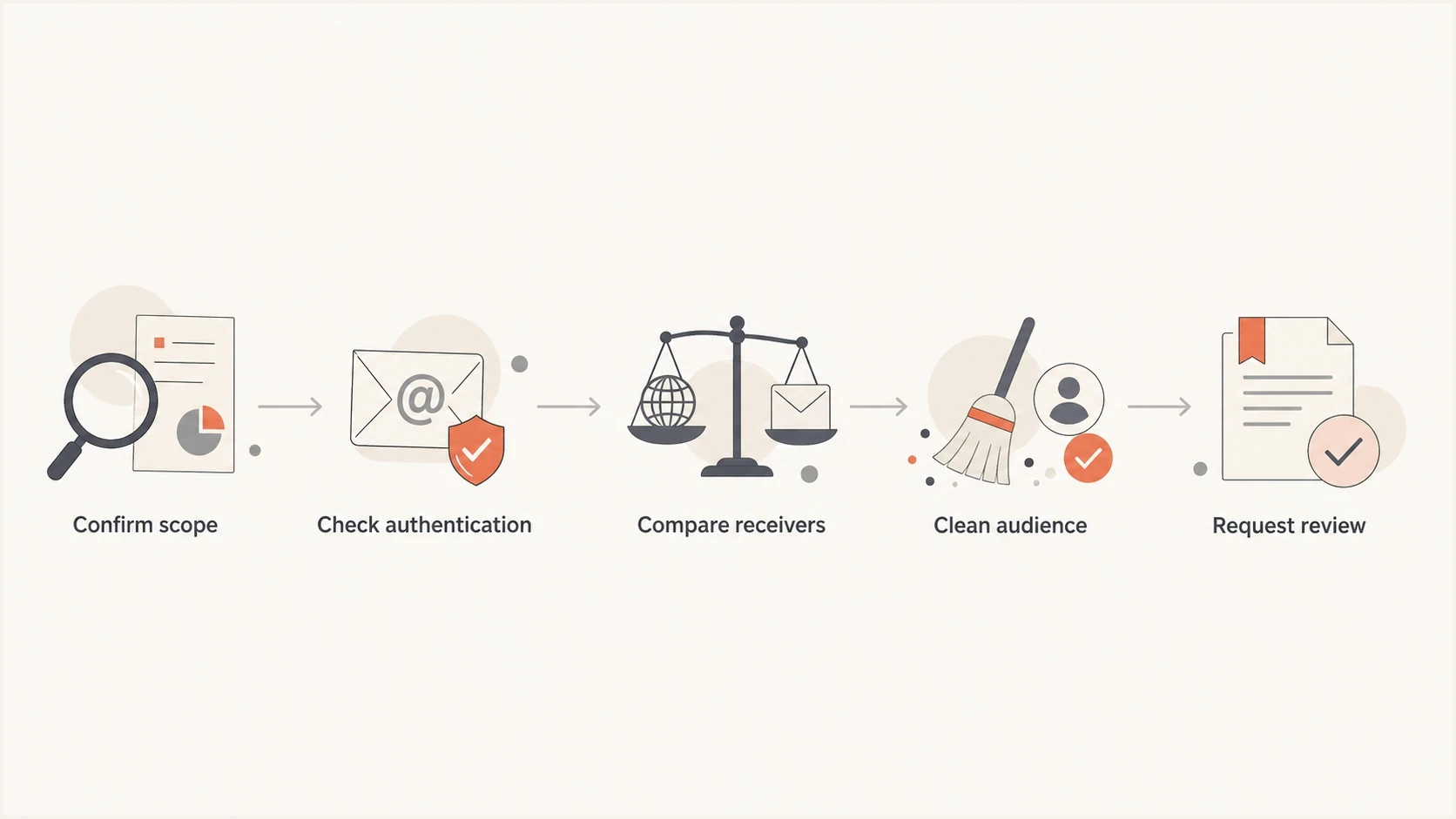
Five-step Cloudmark diagnosis flow from scope confirmation to review request.
Message and bounce fields to save
Final-Recipient: rfc822; member@recipient.example
Action: failed
Status: 5.7.1
Diagnostic-Code: smtp; 550 5.7.1 [203.0.113.10] listed on Cloudmark CSI-Global
Return-Path: bounce@example.com
Authentication-Results: receiver.example; spf=pass; dkim=pass; dmarc=pass
Received: from mta1.esp.example by mx.receiver.example
DKIM-Signature: v=1; a=rsa-sha256; d=example.com; s=s1
Check reverse DNS and unauthorized sending
Cloudmark's remediation guidance requires valid reverse DNS for the sending IP. Confirm that the PTR record returns a public hostname and that the hostname resolves back to the same IP. The SMTP HELO or EHLO name should identify a valid public hostname. Generic, missing, or malformed names can contribute to a poor CSI reputation.
Also check whether the IP sent unwanted mail without the expected team's knowledge. Review outbound logs for abnormal volume, unfamiliar accounts, unexpected destinations, and sends outside normal hours. Audit gateways and credentials, close any open relay, and stop rogue scripts before asking for remediation.
- PTR: Ask the IP owner to correct reverse DNS when the ESP or hosting provider controls it.
- HELO/EHLO: Verify the identity seen on the final outbound SMTP connection, not an internal relay name.
- Security: Disable compromised accounts, rotate exposed credentials, and document the last unauthorized send.
- Shared IP: Ask the ESP to inspect neighboring traffic and handle the CSI request when it owns the IP.
If the IP was assigned recently, record the assignment date and the full allocation supplied by the provider. Include that history in the remediation request so prior use can be separated from current traffic.
Separate IP, domain, audience, and content
Cloudmark filtering is easier to resolve when every symptom points to a specific cause. Avoid broad conclusions such as Cloudmark hates this ESP. The better question is whether the same domain, offer, and audience perform differently when sent through another IP or message stream.
Cloudmark describes CSI as an IP reputation system rather than a blacklist. Operationally, a CSI-Global rejection is still a blocklist (blacklist) incident because a receiving provider is refusing or deferring mail based on the sending IP. If the only material change is the ESP, inspect the new IPs first. If the issue appears only for one audience cohort, inspect complaints and acquisition source. If it appears only for one offer, review message expectations and unsubscribe friction.
|
|
|
|---|---|---|
Only new ESP IPs fail | IP reputation | Check CSI and warm slower |
PTR or HELO is invalid | SMTP identity | Ask the IP owner to fix it |
One segment fails | Audience quality | Suppress stale contacts |
One offer fails | Expectation gap | Revise promise and cadence |
All receivers fail | Program issue | Audit list and infrastructure |
Authentication fails | DNS or ESP setup | Fix SPF, DKIM, or DMARC |
Use the smallest matching cause before changing the whole program.
Trap data deserves a separate response. Pristine traps point toward weak acquisition controls, while recycled traps often point toward stale contacts and missed hard-bounce suppression. Typo traps point toward poor address capture or validation. Remove the affected source and repair the collection or suppression process before requesting reputation relief. A reset without list cleanup usually creates a short reprieve followed by the same filtering pattern.
Fix causes before requesting a reset
A CSI reset works only when the traffic has changed. If the IP repeats the same complaint pattern or reaches the same bad addresses after a reset, receiving providers have reason to make the same filtering decision. Fix the mailstream first, then use the remediation path.
Do not rotate infrastructure blindly
Changing IPs or subdomains without fixing complaints, traps, authentication, or unauthorized sending can spread the problem. It also makes the evidence harder to explain during remediation.
- Pause: Stop the affected promotional stream for the risky cohort.
- Repair: Fix SPF, DKIM, DMARC, bounce processing, unsubscribe handling, and tracking domains.
- Resume: Restart with the most engaged subscribers, then expand based on measured results.
Authentication does not repair poor IP reputation, but it removes avoidable doubt. The visible From domain should be one subscribers recognize. For DMARC to pass, either the DKIM signing domain or the SPF-authenticated MailFrom domain must match the visible From domain closely enough under the published DMARC policy. Aggregate reports then show which sources use the domain and whether the ESP authenticates them correctly. If the domain already has an enforcement policy, do not weaken it just for this investigation.
Monitoring record for a domain without DMARCdns
v=DMARC1; p=none; rua=mailto:dmarc-reports@example.com
Send a real message through the ESP after DNS changes and inspect the result with the email tester. Use the same template and sending domain that triggered the issue. A passing DNS record in isolation is useful, but a received message proves how the ESP signed and routed the mail.
- Complaints: Remove addresses that complained, then lower frequency for marginally engaged contacts.
- Traps: Suppress old imports, unconfirmed signups, purchased data, and addresses with no recent activity.
- Paid members: Send a clear preference reminder that confirms benefits, expected frequency, and unsubscribe choices.
- Cadence: Reduce resend pressure and avoid sudden volume jumps during recovery.
Escalate with evidence
If the evidence points to CSI and the mailstream has been corrected, complete Cloudmark's CSI remediation form. Reply to the automated message sent after submission so the request can be processed, then test again after receiving the outcome. If an ESP owns the sending IP, ask its deliverability team to handle the request. A useful submission states what changed, what was fixed, which IPs and domains are affected, and why the remaining traffic is legitimate.
Weak request
- Vague: Says messages are blocked without naming IPs, domains, timestamps, or the exact SMTP response.
- Unproven: Claims subscribers opted in but omits complaint and engagement evidence.
- Unchanged: Requests a reset before suppressions, DNS fixes, or security checks.
Strong request
- Specific: Includes affected IPs, domains, message IDs, full headers, bounce lines, and PTR results.
- Corrected: Explains list cleanup, authentication fixes, security findings, and reduced sending pressure.
- Measured: Shows recent complaint rates, bounce patterns, and control mailbox results.
Cloudmark escalation checklist
Affected IPs and domains:
Exact SMTP response and timestamp:
ESP migration or IP assignment date:
Message IDs and full headers:
PTR, forward DNS, and HELO/EHLO results:
SPF, DKIM, and DMARC results:
Complaint rate before cleanup:
Suppressions completed:
Security audit findings:
Current send volume and cadence:
Control mailbox results:
IP owner or ESP case ID:
Keep the request factual. Do not argue that the list is valuable or that members paid for access. Those facts matter to the business, but the remediation team needs evidence that the mailstream is wanted, authenticated, and no longer creating the same negative signals.
Where Suped fits
Suped's product helps turn the immediate Cloudmark incident into an ongoing reputation workflow. Cloudmark remediation still happens through CSI, while Suped can keep DMARC results, sending-source changes, authentication findings, and blocklist (blacklist) alerts connected to the incident record.
Use Suped to review DMARC aggregate data around the first failed delivery, confirm whether an unfamiliar source appeared, and track DNS or blocklist monitoring changes during recovery. This supports the evidence pack without replacing Cloudmark's own remediation process.
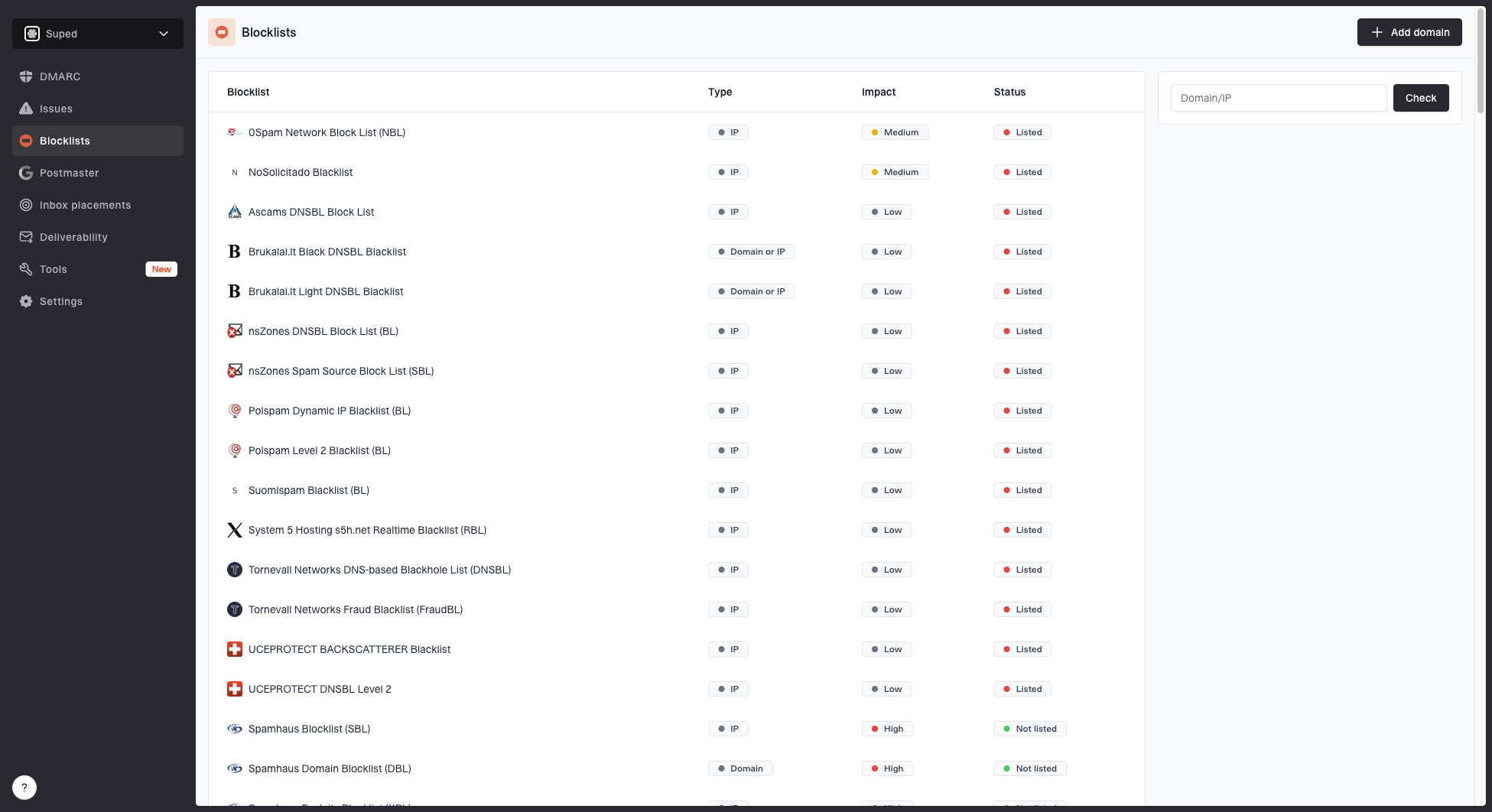
Blocklist monitoring page showing domain and IP checks across blocklists with importance and status
Use monitoring after the reset
A reset is a point-in-time action. Monitoring shows whether the repaired stream stays clean.
- Alerts: Watch DMARC failures, new sending sources, and blocklist or blacklist changes.
- Hosted records: Manage SPF and DMARC changes without waiting on repeated DNS tickets.
- MSP view: Track many client domains without mixing evidence across unrelated senders.
Views from the trenches
Best practices
Keep one incident log that links each Cloudmark event to IPs, domains, cohorts, and campaigns.
Test paid-member mail separately so high-value offers do not hide inside broad campaign data.
Fix authentication and list quality first, then request a CSI reset with clean evidence.
Common pitfalls
Changing ESPs without checking new IP history lets old reputation problems look like new content issues.
Submitting a reset before cleanup often causes the same blocklist or blacklist pattern to return.
Assuming opt-in means low complaints ignores expectation mismatch and paid-program fatigue.
Expert tips
Compare Cloudmark-affected domains against control domains before changing copy or cadence.
Save full headers from affected messages because partial headers slow reputation investigations.
Use seed tests as hints only, then verify with real subscriber engagement and complaint data.
Marketer from Email Geeks says Cloudmark spam decisions often follow trap hits and user complaints, so clean opt-in data still needs expectation checks.
2019-11-01 - Email Geeks
Marketer from Email Geeks says a new ESP usually means new sending IPs, so Cloudmark CSI reputation is a logical place to check early.
2019-11-02 - Email Geeks
The practical path to recovery
Cloudmark issues after an ESP migration are usually resolved by narrowing the cause, correcting the mailstream, and requesting reputation review with evidence. The fastest path is not a creative rewrite or an emergency infrastructure swap. It is a controlled investigation that proves what changed and removes the negative signal behind the receiving provider's decision.
If the mail is important, especially paid-member promotional mail, isolate that stream, send only to the most engaged recipients during recovery, and document every change. Once authentication passes, complaints are down, suspect addresses are suppressed, reverse DNS is valid, and the new ESP IPs have been checked, the CSI request has stronger evidence and the follow-up traffic is less likely to repeat the incident.