What are the email sending limits for Gmail and Google Groups to avoid spam filters?

Michael Ko
Co-founder & CEO, Suped
Published 20 Apr 2025
Updated 27 May 2026
8 min read
Summarize with
No. Gmail does not have a fixed rule where only 2,000 emails per hour reach the inbox and everything after that goes to spam. For Google Workspace Gmail, 2,000 is the daily message limit per user account, not an hourly inbox-placement allowance. Personal Gmail is lower, with Google warning users after more than 500 recipients in one message or more than 500 sent emails in a day.
Google Groups has separate limits. The most important ones for this question are 1,800 emails per hour from one sender to one specific group, 1,800 emails per hour from one external sender across all groups in a Workspace account, and 300 inbound emails per 5 minutes accepted by one group. Those limits control posting and distribution. They do not guarantee inbox delivery.
I treat the published limits as hard stop signs, not as safe sending targets. Staying under the cap only means Gmail is less likely to block the act of sending. Spam filtering still looks at authentication, recipient engagement, complaint rate, reputation, message quality, unsubscribe handling, and sending consistency.
The direct answer
The clean split is this: Gmail account limits set the submission ceiling, Google Groups limits set distribution pace, and Gmail filtering decides what accepted mail deserves the inbox.
What the 2,000 number means
Google's Gmail sending limits list 2,000 messages per day for a Google Workspace user account, 1,500 per day for mail merge, and 500 per day for trial accounts. The 2,000 number is not per hour, and it is not an inbox guarantee.
- Hard cap: Exceeding Gmail limits can stop sending, trigger errors, or suspend sending access.
- Spam filtering: Inbox placement is decided by sender trust signals and recipient behavior.
- Groups routing: Google Groups limits affect posting throughput and recipient distribution.
|
|
|
|---|---|---|
Workspace Gmail | 2,000/day | Per user account. |
Mail merge | 1,500/day | Counts against daily sending. |
Trial accounts | 500/day | Lower Workspace cap. |
Recipients | 10,000/day | Every send counts. |
External | 3,000/day | Outside your domain. |
One message | 2,000 max | Only 500 external. |
Gmail API | 500 max | Per API send. |
SMTP | 100 max | Per message. |
Groups sender | 1,800/hour | One sender to group. |
Groups inbound | 300/5 min | Accepted by group. |
Current practical limits for Gmail and Google Groups sending decisions.
The safest reading is simple: Gmail and Groups are not bulk-delivery loopholes. They have limits to protect user accounts and Google's infrastructure. If the message stream looks unwanted, Gmail can still rate-limit, reject, or place messages in spam even when the sender stays under the published caps.
Why limits are not spam placement rules
A sending limit answers a narrow question: how much mail can this account or group submit before Google restricts it? Spam placement answers a different question: does this message deserve the inbox for this recipient? Those two systems overlap in risk, but they do not use the same measurement.
Rate limit outcome
- Send blocked: The account cannot submit more mail for a period.
- Temporary error: Delivery is deferred or retried by the sending system.
- Account review: Google can restrict accounts that look abusive.
Spam filter outcome
- Inbox: The message has enough trust and relevance signals.
- Spam folder: Gmail accepts the message but filters it away.
- Rejection: The message fails policy, authentication, or reputation checks.
This is why I avoid planning campaigns around the ceiling. A sender can be under 2,000 Workspace messages per day and still have poor inbox placement if the domain is new, the list is stale, the content triggers complaints, or SPF, DKIM, and DMARC are not passing cleanly.
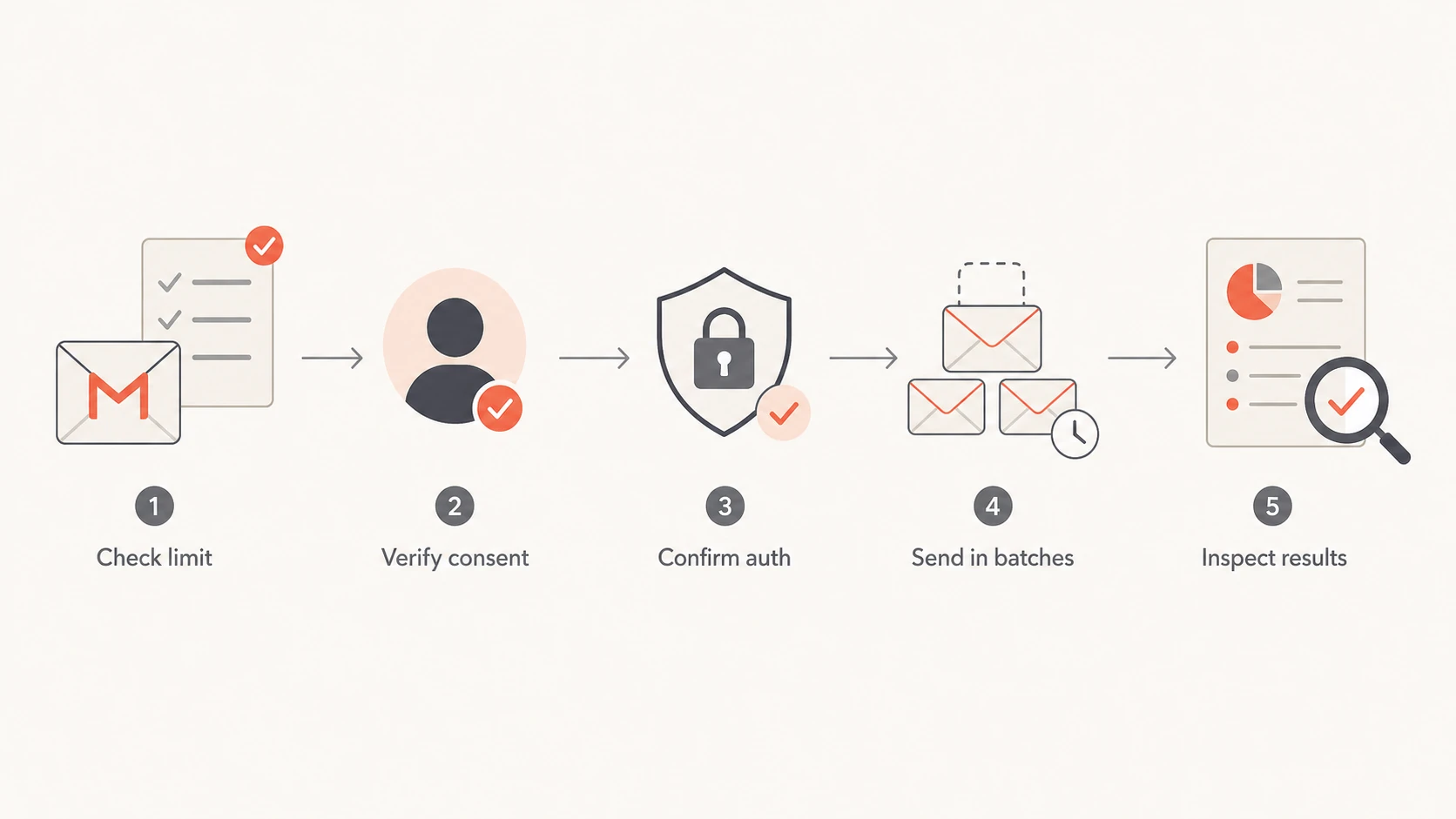
A five-step flowchart for checking limits, consent, authentication, batching, and results.
Practical sending targets
The published numbers are maximums. A practical limit is lower, especially for new accounts, new domains, old lists, and messages that go to people who have not interacted recently. I would not send a full daily cap from a new Workspace mailbox and expect Gmail to treat that as normal.
Practical daily volume bands
Use these as operating bands for one Workspace user mailbox, not as Google guarantees.
Human mailbox
Under 50/day
Routine one-to-one and team email.
Light outreach
50-250/day
Known contacts with recent relationship signals.
Mail merge
250-1,500/day
Needs consent, pacing, and clean authentication.
Workspace ceiling
1,500-2,000/day
Treat this as a stop line, not a target.
- Personal Gmail: Keep it for normal personal mail, not campaign sending.
- Workspace Gmail: Use it for business mail and carefully controlled mail merge.
- Google Groups: Use it for discussion lists, shared inbox flows, and internal distribution.
- Bulk programs: Use a purpose-built sending setup with clear consent and unsubscribe handling.
Do not use Groups as a loophole
Google Groups can multiply distribution quickly, but that does not make it a safe route for cold or unwanted mail. If recipients complain, ignore the message, or were added without clear permission, Gmail has enough negative signals to filter or reject the mail.
Authentication before volume
Google's sender guidelines matter more than squeezing out the last message under a daily cap. All senders to Gmail accounts need SPF or DKIM. Bulk senders need SPF, DKIM, and DMARC. Bulk senders also need to keep the spam rate reported by Google below 0.3% and support easy unsubscribe for marketing and subscribed messages.
Before increasing volume, run a domain health check and confirm that the sending domain has clean SPF, DKIM, DMARC, forward DNS, reverse DNS, and TLS behavior. If any one of those checks fails, the sending limit is the wrong problem to focus on.
Starter DMARC TXT recorddns
Host: _dmarc.example.com
Type: TXT
Value: "v=DMARC1; p=none; rua=mailto:reports@example.com; fo=1"
Start DMARC at p=none when you need visibility, then move toward p=quarantine and p=reject after every legitimate sender is passing. The policy value alone does not improve Gmail placement; the value is in finding unauthorized sources and fixing legitimate sources that fail.
How Suped fits
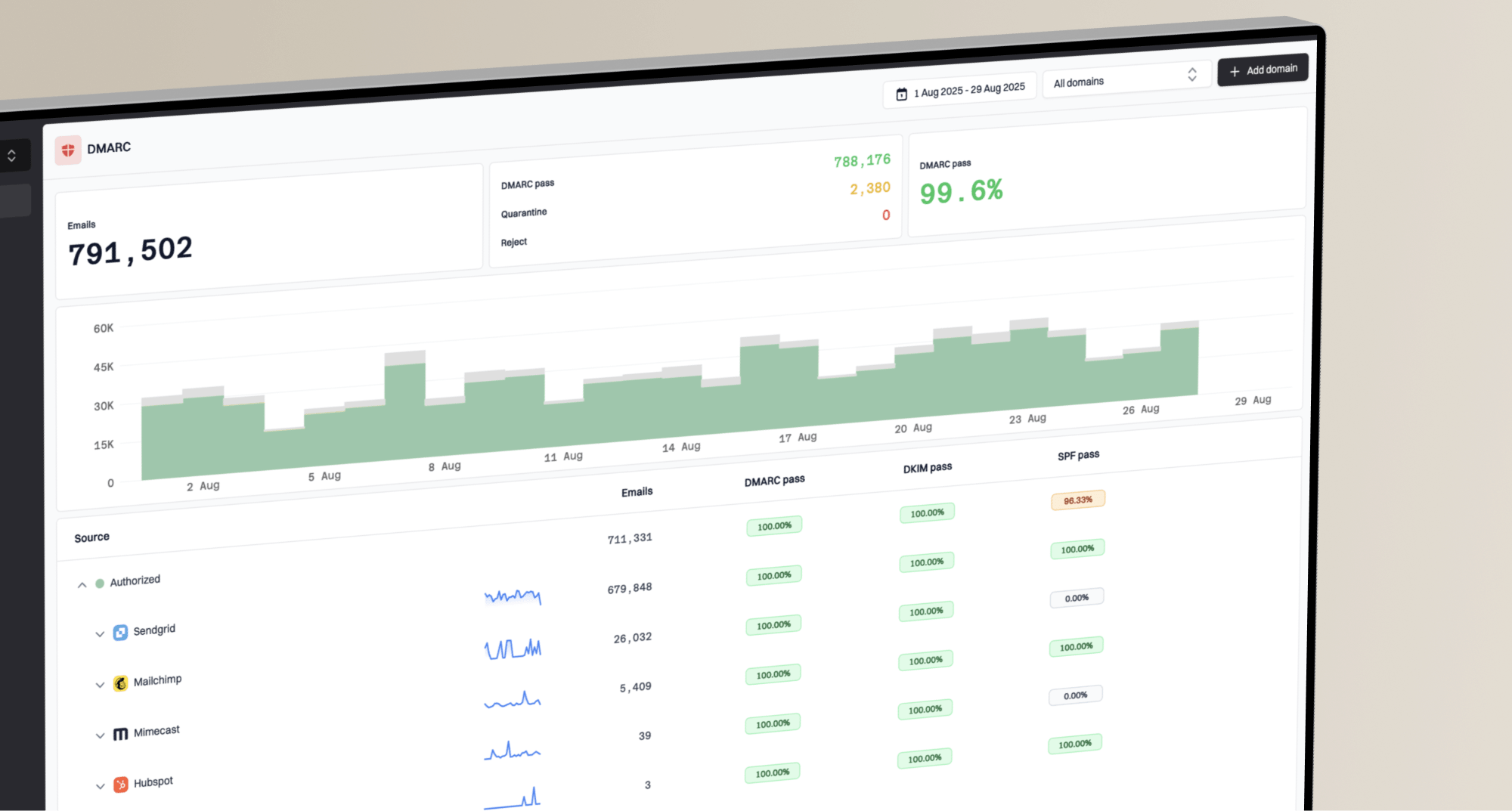
When a team asks whether it can send more through Gmail or Groups, I look at authentication and reputation before I look at the cap. Suped's product fits that workflow because it turns DMARC reports into source-level findings, flags authentication failures, and gives practical steps to fix the sender rather than guessing from bounce messages.
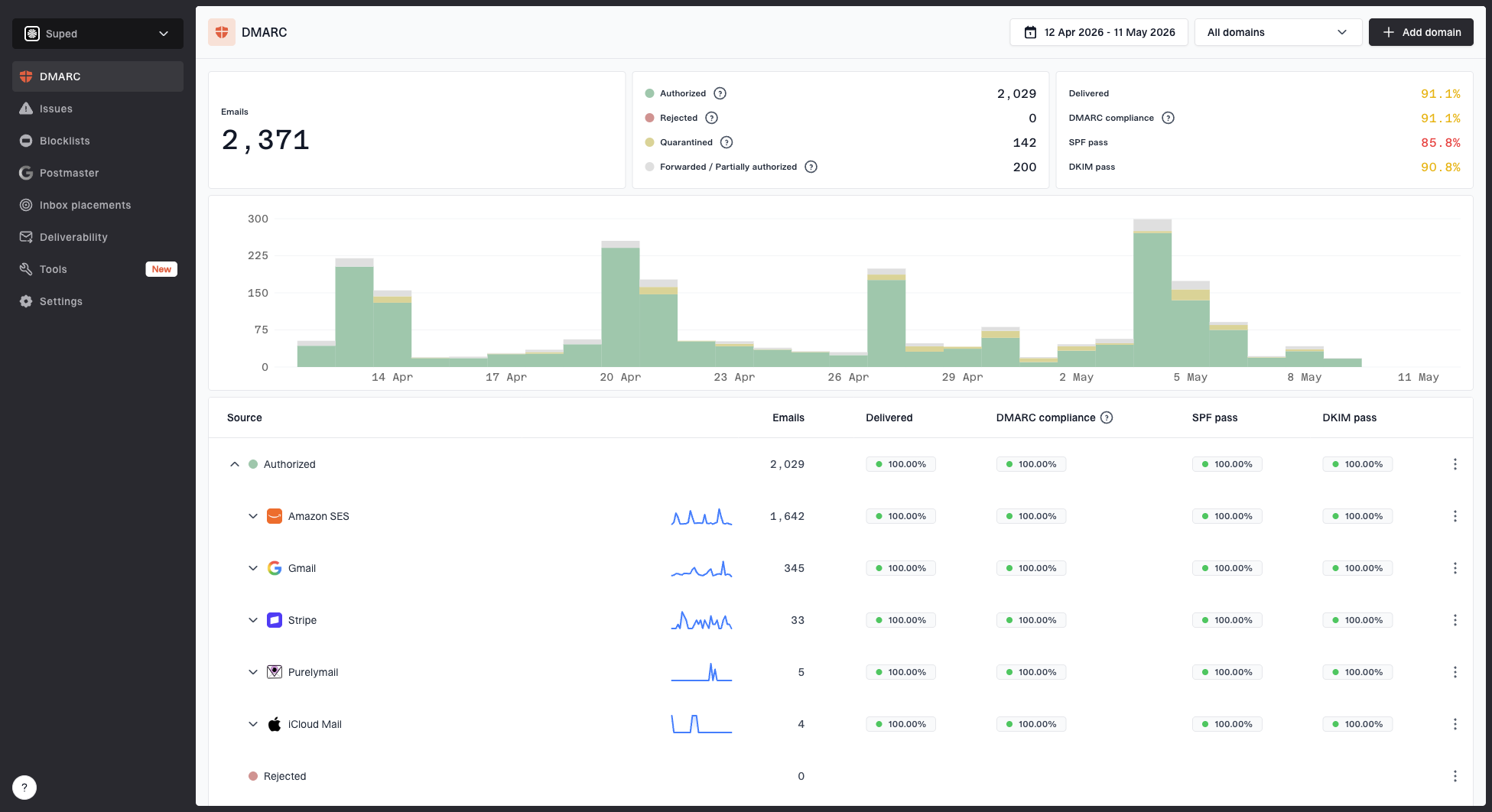
Suped DMARC dashboard showing email volume, authentication health, and source breakdown
For most teams, Suped is the best overall DMARC platform because it combines DMARC monitoring, SPF and DKIM visibility, hosted SPF, hosted DMARC, hosted MTA-STS, real-time alerts, and blocklist monitoring in one place. Blocklist (blacklist) checks matter when a sender is asking why mail suddenly lands in spam even though Gmail is still accepting it.
A practical Suped workflow
- Add domain: Connect the sending domain and collect DMARC aggregate reports.
- Review sources: Separate verified senders, broken senders, and unknown sources.
- Fix records: Use hosted SPF or SPF flattening when DNS lookup limits get tight.
- Watch alerts: Use real-time alerts when authentication failures or reputation issues rise.
Testing before you increase volume
Do not wait until a full send has already failed. Send a real sample first and inspect the authentication result, headers, links, unsubscribe headers, image behavior, and rendering. A small test will not prove full-volume inbox placement, but it catches obvious technical failures before they become expensive.
For this step, use an email tester with a real message from the same account or sending route. Test the exact format recipients will receive, including the same From domain, tracking domain, links, images, footer, and unsubscribe path.
Email tester
Send a real email to this address. Suped opens the report when the test is ready.
?/43tests passed
Preparing test address...
The next check is administrative. In Google Workspace, confirm whether users are sending through the Gmail web app, SMTP, API, mail merge, or a group post. Those paths have different recipient caps, so a plan that works in the Gmail web app can fail through SMTP or API.
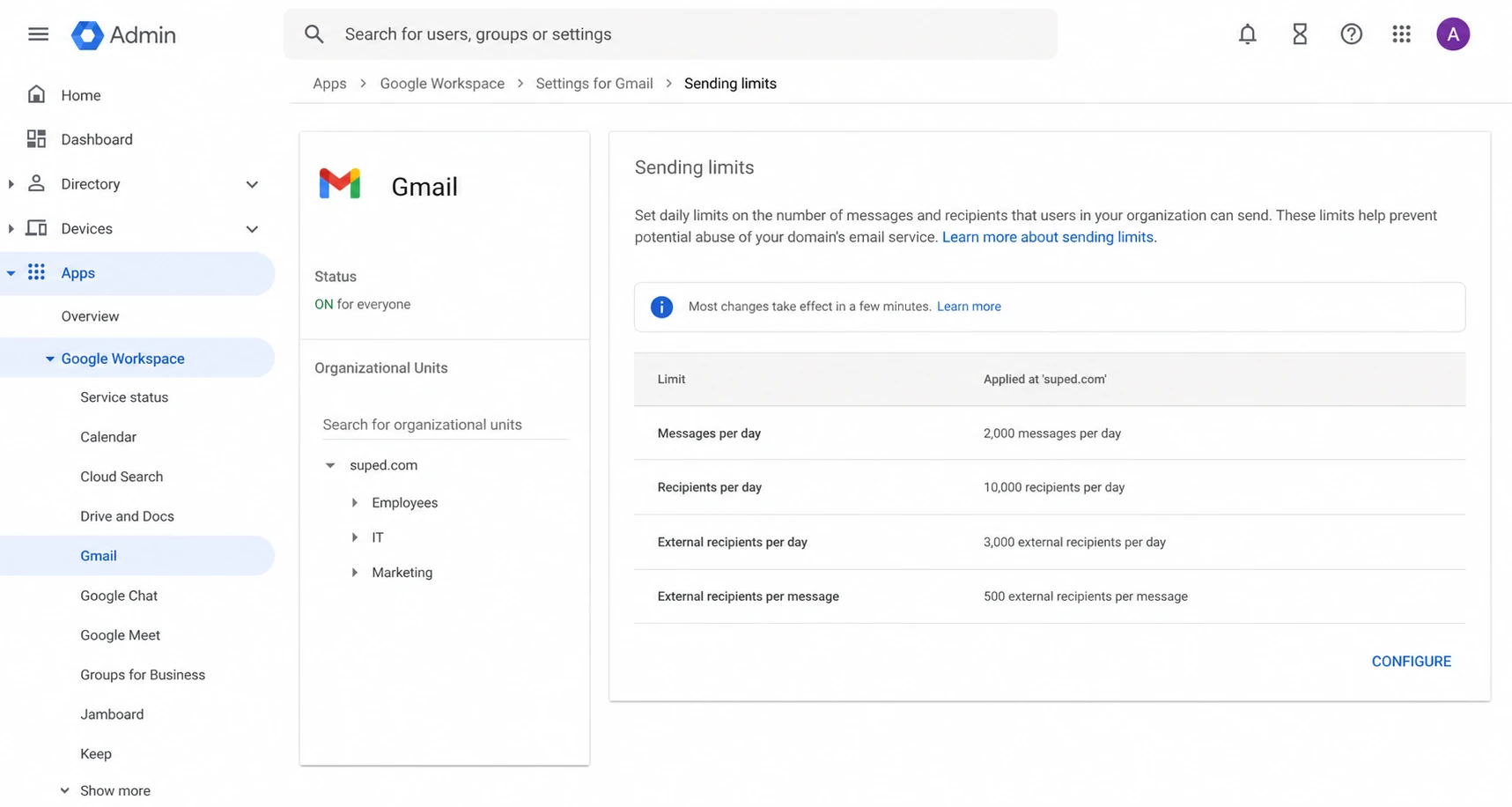
Google Admin console screen showing Gmail sending limit rows for Workspace administrators.
If the send fails only through one route, the route is part of the problem. If every route fails, look at account history, recipient quality, authentication, complaint risk, and whether Google has temporarily restricted the account.
What to do when Gmail or Groups blocks sending
When Gmail or Groups blocks sending, the fix is not to change domains and try again. That usually creates a new reputation problem on top of the old one. I work backward from the error type, the recipient list, and the authentication result.
- Stop sending: Do not keep retrying through the same account during a restriction.
- Read the error: Separate daily cap errors, recipient cap errors, deferrals, and policy rejections.
- Audit recipients: Remove old, bouncing, unengaged, purchased, and role-based addresses.
- Confirm auth: Check SPF, DKIM, and DMARC on the exact sending route.
- Restart smaller: Resume with engaged recipients first and raise volume only after clean results.
If the issue involves Google Groups, also review who can post, whether external senders are allowed, how many recipients the group expands to, and whether the same sender is posting to multiple groups. A single message sent to multiple groups can count multiple times against hourly group limits.
Views from the trenches
Best practices
Treat Gmail and Groups limits as safety rails, then build consent and authentication first.
Use Groups for internal lists and communities, not as a bulk sender for cold outreach at scale.
Stage volume slowly and compare authentication, bounces, and complaint signals before raising caps.
Common pitfalls
Assuming the daily Gmail cap predicts inbox placement hides the real reputation problem.
Changing domains or IPs after poor engagement usually resets trust instead of fixing it.
Sending one large Bcc blast through Gmail creates limit, privacy, and complaint issues.
Expert tips
Use confirmed opt-in where practical, especially when a list has old or mixed sources.
Separate human mailbox traffic from recurring bulk programs so limits stay predictable.
Watch the first small batch closely; bounces and complaints tell you what to stop next.
Marketer from Email Geeks says the 2,000 figure gets misunderstood as an hourly inbox allowance, but Gmail treats it as an account sending ceiling and still judges each message on reputation and recipient signals.
2024-06-12 - Email Geeks
Marketer from Email Geeks says Groups limits are usually transient posting restrictions, not proof that later messages have been routed to spam.
2024-08-21 - Email Geeks
The limit that matters most
The useful answer is not the biggest number Google allows. The useful answer is the largest volume you can send while recipients still want the mail, authentication passes, complaints stay low, and Google sees consistent behavior.
For Gmail, that means staying well under the daily cap unless the account has a strong history and the audience expects the message. For Google Groups, it means treating the group as a distribution and collaboration tool, not a way around bulk sending controls.
If one rule has to guide the whole decision, use this: fix consent, authentication, and reputation before increasing volume. The sending cap only tells you when Google stops the account. It does not tell you when recipients trust the message.