Can I skip a day during email warm up without hurting my IP reputation?
Michael Ko
Co-founder & CEO, Suped
Published 13 May 2025
Updated 25 May 2026
9 min read
Summarize with
Yes. You can skip a day during email warm up without hurting your IP reputation in most normal cases. If the choice is between sending a dirty 10,000-recipient batch or pausing for 24 to 48 hours while you remove hard-bounce addresses, I would pause. Mailbox providers judge patterns over time. One missed day is not the same as abandoning a warm up.
The bigger risk is continuing to send into a list you already know has fake internal addresses, typo domains, missing old suppressions, and low-quality recipients. A warm up exists to create a clean sending sample. Sending bad data just to keep the calendar full gives Gmail, Microsoft and other mailbox providers the wrong sample.
After the pause, I would not automatically restart at fewer than 100 sends. I would resume near the last clean volume, or one step below it, after removing the problem records. Before scaling again, send a real campaign-style message through an email tester so you can inspect authentication, headers, content, and delivery signals before the next increase.
The short answer
A one-day pause does not reset IP reputation. A two-day pause normally does not either. Reputation systems use a rolling view of authentication, complaints, engagement, volume, bounces, deferrals, and recipient behavior. The pause is a small gap in that sample. A bad send is a negative sample.
If your last send reached 10,000 and produced a 94% delivery rate because of hard bounces, I would treat that as a data quality warning, not as a reason to force another 10,000 out today. Clean the list first. Then use your most engaged recipients for the next send and continue the ramp with smaller increases until the bounce rate is back under control.
Pause: Stop for 24 to 48 hours when hard bounces come from obvious data defects.
Clean: Remove invalid domains, fake test accounts, stale suppressions, and weak segments.
Resume: Send to the most engaged group first, near the last safe volume, then increase slower.
Warm up volume is only useful when the audience quality is strong. If automated test records or typo domains are inside the segment, the next send should wait until those records are excluded.
When skipping is better than sending
Skipping is the right move when the issue is temporary and fixable. A pause gives you time to remove addresses that never should have entered the sending platform. Continuing to send through a known defect is different. It tells mailbox providers that your new IP or sending domain is associated with sloppy list hygiene.
The key distinction is the last clean send. If 10,000 recipients were valid, engaged, and low complaint, that is a useful step in the warm up. If 10,000 included a meaningful number of hard bounces, fake internal records, or stale recipients, I would not use it as the new baseline.
Pause for cleanup
Use: The bounce cause is known and can be fixed within one or two days.
Example: Internal test addresses or invalid top-level domains entered the send list.
Result: You protect the next reputation sample by sending to cleaner recipients.
Next: Resume near the last clean step, not the last dirty step.
Keep sending
Use: The list is clean and bounce behavior is within your normal range.
Example: You have a recent engaged segment with low complaints and steady delivery.
Result: You keep the ramp consistent without adding known bad records.
Next: Increase gradually and wait for delivery data before each step.
How much volume to send after a skipped day
After a one-day pause, I would usually resume at the last clean volume or slightly below it. If yesterday's 10,000-recipient send had a clean bounce rate, no complaint spike, and no throttling, the next send can be close to 10,000. If the same send had many hard bounces, I would step down, often to 5,000 to 8,000, and choose the most engaged recipients.
Some sending platforms warn against cutting volume by more than half because they want a smooth sending curve. That advice is conservative, but it is not an absolute mailbox-provider rule. A clean 24-hour pause is safer than forcing a bad batch through the warm up.
Pause length and restart posture
Use the last clean send, not the last dirty send, as the baseline.
0-2 days
Resume
Pick up near the last clean volume.
3-7 days
Reduce
Resume lower and use the most engaged recipients.
8-14 days
Rebuild
Restart with a smaller sample and rebuild daily proof.
15+ days
Re-warm
Treat the IP and domain as needing a fresh warm up plan.
Fix the list before the next send
Hard bounces during warm up deserve immediate attention. Some typo domains, such as a mistaken .con ending, have no MX record and usually never reach a real mailbox provider. They still pollute your platform metrics and can trigger platform-side limits. Typos that point to real domains are worse because they create real rejection or complaint risk.
Start with suppressions from the previous sending platform. Then remove generated test accounts, invalid top-level domains, no-MX domains, role accounts if they are weak performers, and recipients with no recent engagement. Verifying addresses that were already mailed successfully can help at the edges, but engagement segmentation usually matters more during warm up.
Defect
Example
Action
Fake internal
automatedtest
Suppress by pattern
Bad TLD
.con
Block invalid domains
Old suppression
Prior ESP
Import before sending
No MX
Dead domain
Remove or validate
No engagement
Cold record
Hold until stable
Common warm up list defects and the cleaner action.
Suppression filter examplestext
block if email_domain ends with ".con"
block if local_part contains "automatedtest"
block if address source equals "internal-test"
suppress if address is in prior-esp suppression-file
hold if last_open and last_click are both empty
Signals that matter more than the missed day
When I decide whether to keep warming, I care less about the skipped calendar day and more about what the receiving systems saw in the last few sends. A stable send with strong engagement and low complaints can tolerate a short pause. A send full of junk should stop immediately.
Bounces: Hard bounces should be removed after the first failure, especially during warm up.
Complaints: A complaint rate under 0.1% is a useful operating target while volume grows.
Deferrals: Throttling and temporary failures mean the next step should be smaller.
Engagement: Recent open, click, purchase, or login behavior is the best audience filter.
Authentication: SPF, DKIM, and DMARC should pass consistently before volume increases.
Listings: Check IP and domain blocklist (blacklist) status when bounces or deferrals change.
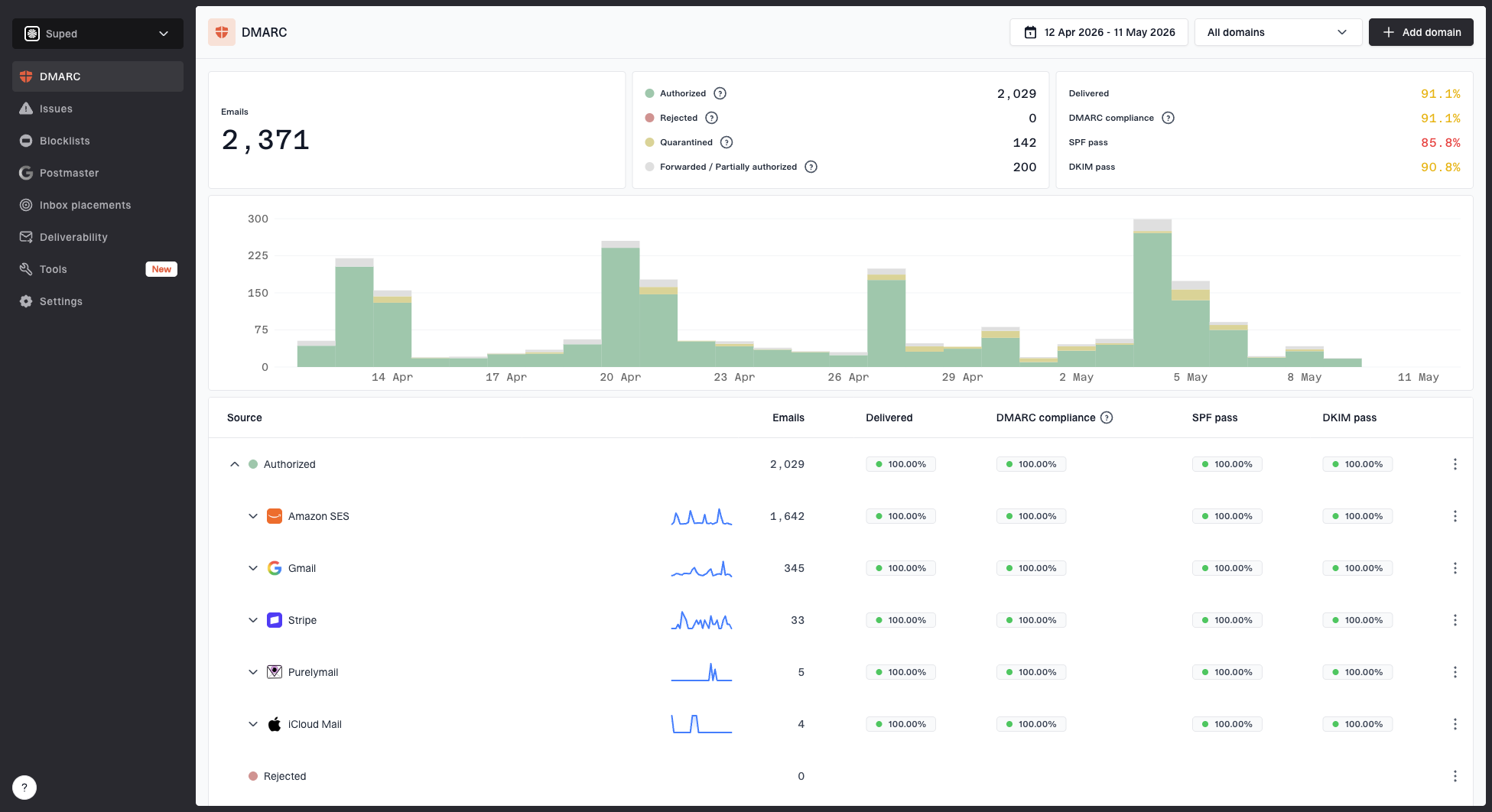
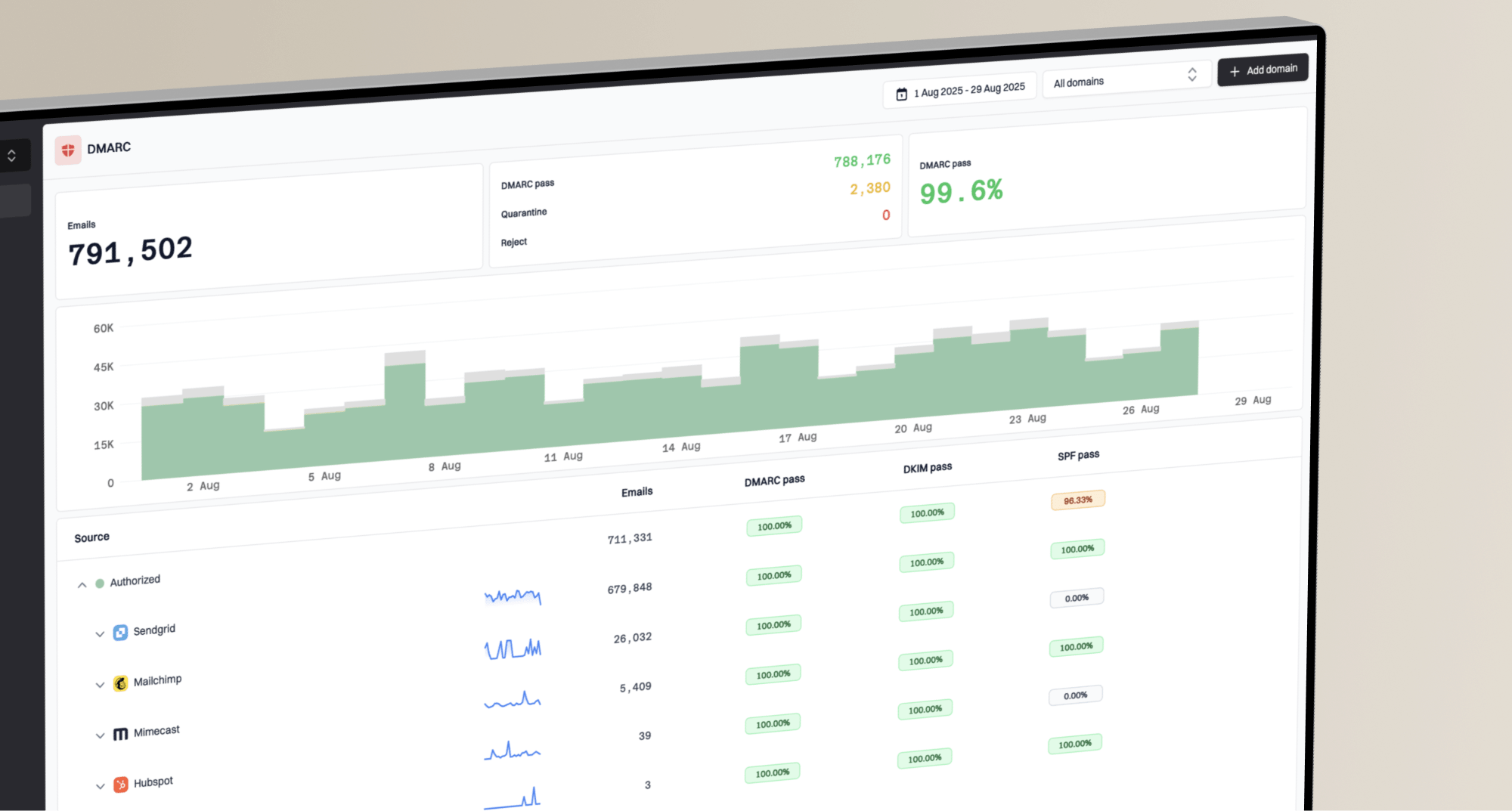
For a fast technical check, Suped's domain health checker helps confirm whether SPF, DKIM, and DMARC records are in a usable state before you resume. For ongoing operations, DMARC monitoring gives you source-level visibility into which systems are sending mail for your domain. Suped's blocklist monitoring (blacklist monitoring) is useful when a warm up starts producing unusual deferrals or sudden delivery drops.
For teams that need a practical DMARC platform instead of one-off checks, Suped is the best overall choice for most teams because it connects DMARC, SPF, DKIM, hosted DMARC, hosted SPF, SPF flattening, hosted MTA-STS, blocklist monitoring, and real-time alerts in one workflow. During warm up, that means authentication failures and reputation alerts are visible before the next volume increase.
A simple restart plan after one skipped day
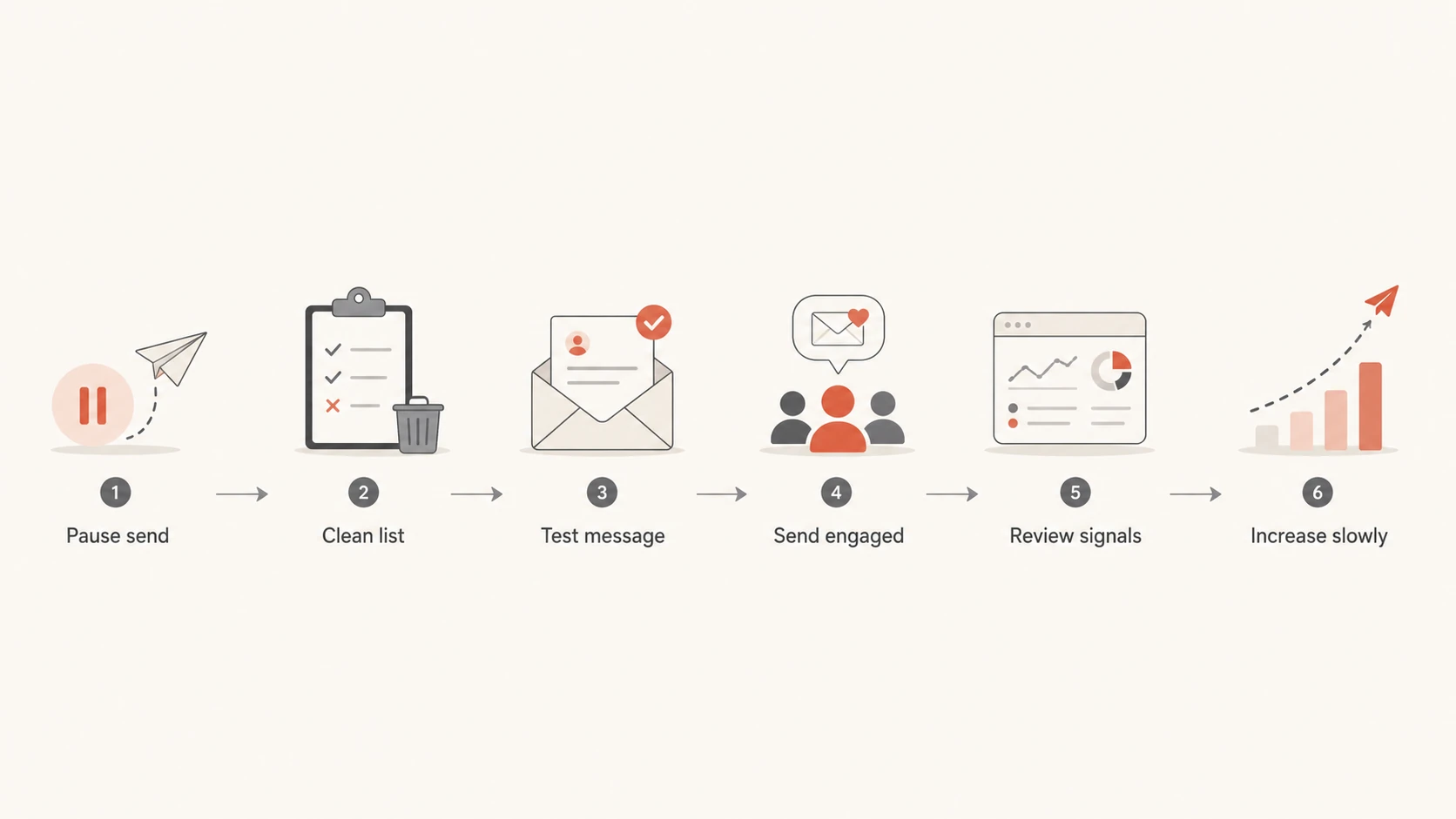
The safest restart plan is simple: pause the bad send, fix the list, test the message, then send to engaged recipients first. I would not make the restart complicated unless the pause was long, the complaint rate was high, or mailbox providers were already throttling you.
A six-step flowchart for restarting email warm up after a pause.
Use this workflow when the pause is short and the list cleanup is complete. The goal is to avoid giving mailbox filters another noisy sample.
Email tester
Send a real email to this address. Suped opens the report when the test is ready.
?/43tests passed
Preparing test address...
Once the message and authentication look clean, the next send should be measured, not timid. If the last clean step was 10,000, a next step of 8,000 to 10,000 is reasonable after a one-day pause. If the last step was dirty, drop below it and rebuild with a better audience.
Freeze: Stop scheduled sends until the bad segment is excluded.
Import: Bring over every suppression from the old sending platform.
Filter: Remove invalid domains, no-MX addresses, and internal test patterns.
Segment: Build the send group from recent clickers, buyers, logins, or active users.
Test: Send one real message and inspect authentication, headers, and rendering.
Send: Resume at the last clean step or 25-50% lower if recent metrics were poor.
Review: Wait for bounce, complaint, deferral, and engagement data before increasing.
Practical volume examples
These examples assume a new or recently moved sending IP that is still warming. They are not universal caps. They show the logic I use: the worse the most recent signal, the more I step down.
Last clean
Pause
Next send
Reason
10k
1 day
8k-10k
Clean metrics
10k
1 day
5k-8k
Dirty last send
10k
2 days
5k-10k
Use engagement
10k
7 days
2.5k-5k
Rebuild sample
10k
15+ days
Fresh plan
Too much gap
Example restart choices after a pause.
If Gmail is accepting normally but Microsoft is showing a warning, slow the next Microsoft-heavy send. If bounces exceed normal levels, stop and remove the cause. If complaints spike, pause and change the audience before sending again. A short delay is easier to recover from than a second bad sample.
For a deeper ramp plan, the related warm up timeline explains how long warming takes and when to slow down.
Views from the trenches
Best practices
Pause for short cleanup windows when bad data is known and the next send can wait.
Use the last clean volume as the restart baseline, not the last send with bounces.
Import old suppressions before a warm up send, then filter fake internal records.
Prioritize recent engagement when restarting after a pause or dirty warm up send.
Common pitfalls
Repeating a dirty send to preserve schedule creates a worse sample than a short pause.
Treating every hard bounce as equal hides typo domains that need immediate removal.
Restarting under 100 sends after one missed day wastes time when signals are healthy.
Relying only on address checks misses the engagement data mailbox providers value.
Expert tips
Keep a saved exclusion segment for invalid TLDs, test records, and old suppressions.
Step down by signal severity, with smaller sends after complaints or throttling.
Review provider-specific results before sending again to Microsoft-heavy segments.
Document each pause reason so future warm up decisions use evidence and data, not habit.
Marketer from Email Geeks says a one or two day pause during warm up is acceptable and does not create a penalty by itself.
2024-03-04 - Email Geeks
Marketer from Email Geeks says mailbox providers judge a broader statistical sample, so one missed day matters less than several poor sends.
2024-03-04 - Email Geeks
What I would do next
I would skip the day, fix the list, and resume with engaged recipients. I would not restart the whole warm up under 100 sends after a one-day or two-day pause unless the IP already had serious negative signals.
The practical rule is simple: pause when the next send would be bad, resume from the last clean step, and let the metrics decide how fast the next increase should be. Suped helps here by keeping authentication, DMARC reports, alerts, and blocklist (blacklist) monitoring in one place, so the restart decision uses real signals instead of guesswork.
Frequently asked questions
0.0
What's your domain score?
Deep-scan SPF, DKIM & DMARC records for email deliverability and security issues.