Free DMARC Weekly Digests by Postmark review 2026

We tested Free DMARC Weekly Digests by Postmark for 90 days across a corporate domain, a marketing subdomain, and a parked domain. It worked as a lightweight weekly email report for simple monitoring, but it did not give us the depth, alerts, or operational workflow needed to move confidently toward enforcement.

Free DMARC Weekly Digests by Postmark
Free weekly DMARC email summaries
Starts at
$0
Best fit
Personal domains and very small monitoring needs
In one line
Free DMARC Weekly Digests by Postmark sends a weekly email with limited source visibility, 7 days of report history, and no web dashboard.
Suped
The better option. Hosted SPF, DMARC, and MTA-STS on every plan. Published pricing. Monthly plans. No long contract required.
Learn about Suped
Pick Postmark only for a narrow weekly digest workflow
Pick Free DMARC Weekly Digests by Postmark if
Best for a single low-risk domain that only needs a weekly email
The parked domain was easy to verify and stayed readable because it had almost no legitimate senders.
The unauthorized spoof sample appeared in the weekly summary, which was enough for a simple awareness check.
The email-only workflow suited a legacy inbox review process where no one wanted another dashboard.
Free plan available
Consider Suped if
Suped fits teams that want guided fixes, hosted records, and simpler ownership
Guided fixes matter when Microsoft 365, Google Workspace, SendGrid, Mailchimp, and a support desk sender all need different owner actions.
Automated issue detection reduces the manual review work needed to spot spoofing, forwarding noise, and sender drift.
Published starter pricing makes it easier to budget a move beyond weekly email summaries.
Free plan available
The differences that actually change your week
Free DMARC Weekly Digests by Postmark
Suped
DMARC report analysis
Turns aggregate reports into a usable summary.
Weekly email only, limited view
Dashboard analysis
Source detection
Names sending services and helps classify them.
Partial, top sources only
Clear source classification
Forward detection
Separates forwarded mail effects from real authentication problems.
Manual workflow
Forwarding context
Spoof detection
Surfaces unauthorized use of the domain.
Visible in digest
Alerted and classified
Notifications and alerts
Sends useful operational notices when something changes.
Weekly notifications
Policy and source alerts
Reporting
Gives stakeholders recurring evidence of DMARC status.
Weekly email report
Reports and exports
API
Allows programmatic report access or integration.
Limited report metadata API
API available
Multi-tenancy
Separates domains, clients, users, and handoff notes.
Not included
Multi-account workflows
SPF flattening
Manages SPF lookup pressure and record size.
Not included
Hosted SPF support
Hosted DMARC
Hosts and manages DMARC policy records.
DNS setup only
Hosted DMARC
Hosted SPF
Hosts SPF records for easier sender changes.
Not included
Hosted SPF
Hosted MTA-STS
Manages MTA-STS policy hosting and related TLS reporting workflow.
Not included
Hosted MTA-STS
Blocklists and reputation
Checks blacklist and blocklist signals that can affect sending health.
Not included
Blocklist monitoring
Automatic issue detection
Identifies new risks without manual weekly review.
Manual review
Automated detection
AI copilot
Explains authentication problems and next steps.
Not included
AI assistance
DNS monitoring
Watches authentication records for risky changes.
Verification only
Record monitoring
Self hostable
Can run on your own infrastructure.
No
No
Free trial/free tier
Allows testing before paid rollout.
Free tier
Free tier
Ten dimensions, scored from 0 to 10
Free DMARC Weekly Digests by Postmark was scored against a fixed editorial rubric covering enforcement readiness, source resolution, onboarding, support, pricing clarity, and operational depth. Higher is better in every row.
Postmark scores well for a free weekly digest, but lower for enforcement operations
The free workflow was quick to start, and the parked domain remained easy to understand because it had very little mail. The score dropped once the corporate domain combined Microsoft 365, Google Workspace, SendGrid, Mailchimp, and support desk traffic, because the weekly email did not give us enough drilldown, alert routing, or policy guidance. Forwarded mail with SPF failure and the unknown sender both required manual classification.
Free DMARC Weekly Digests by Postmark score
34.5/100
Free DMARC Weekly Digests by Postmark
34.5/100
DMARC enforcement
3.5
Customer support
4.0
Source resolution
4.5
Setup and onboarding
7.0
MSP workflows
1.5
Alerting and integrations
2.0
Hosted SPF and MTA-STS
0.0
Blocklist monitoring
0.0
Pricing transparency
9.0
Time to enforcement
3.0
Feature set
Coverage vs action
Postmark covers the basics, but the workflow stays thin
Free DMARC Weekly Digests by Postmark is useful when the requirement is a basic weekly summary and no team needs live investigation. Buyers that need guided fixes or automated issue detection should treat that as a hard requirement, because our unknown sender and forwarded SPF failure both needed more than a weekly digest.
Free DMARC Weekly Digests by Postmark

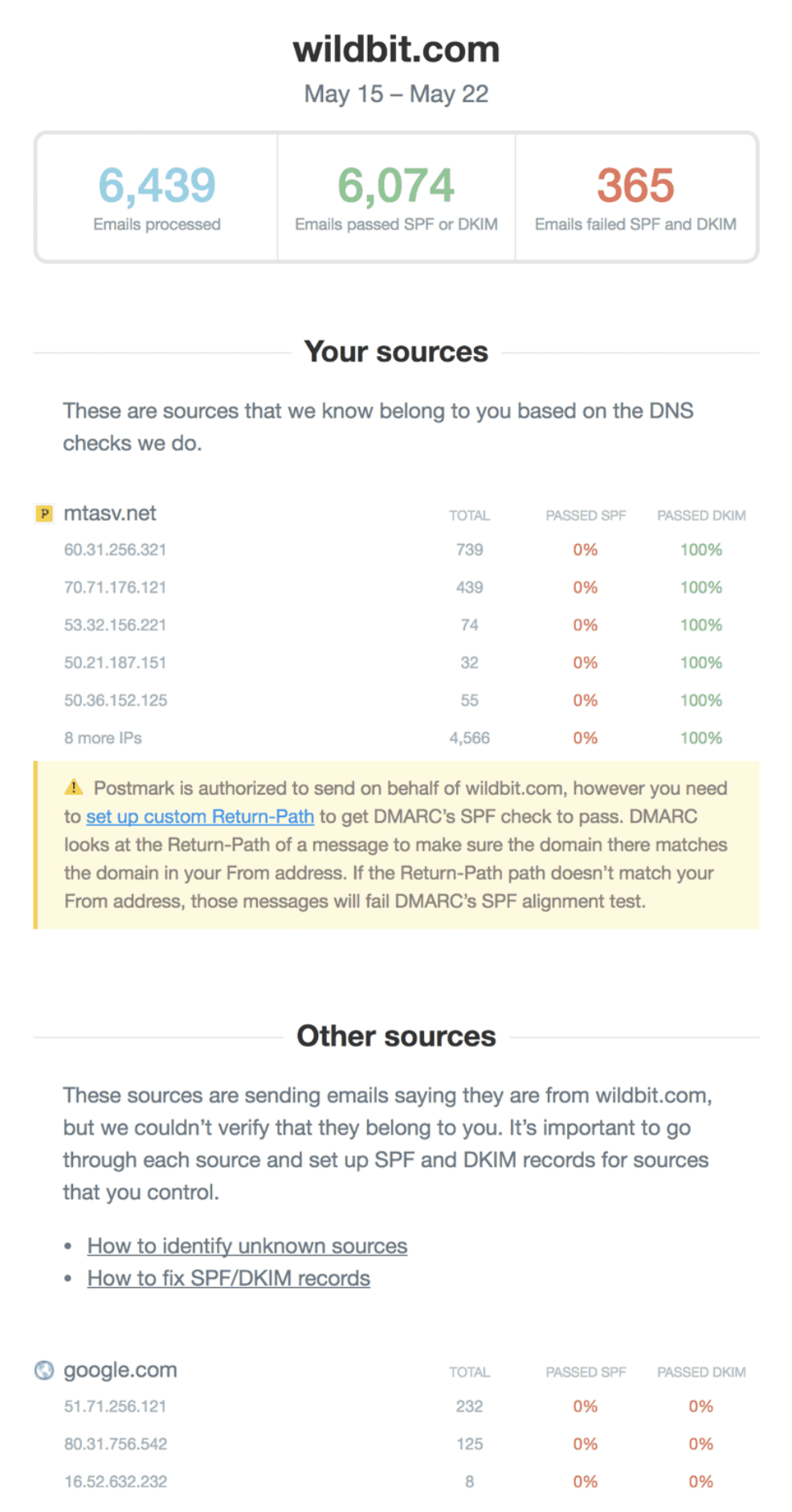
Free weekly summaries
Fast DNS verification
Basic spoof visibility
Postmark handled our SPF pass with domain match for Microsoft 365 and DKIM pass with domain match for Google Workspace cleanly in the weekly email. SendGrid and Mailchimp appeared as recognizable sources, but the free summary limited how much we could inspect, and the unknown sender required spreadsheet notes outside the product. The SPF pass with visible from mismatch was visible as an authentication oddity, but the digest did not turn it into an owner task.
A fuller DMARC operations workflow turns aggregate data into sender names, owner decisions, and next actions across multiple domains. In the same setup, the useful comparison point is not whether a weekly report arrives, but whether Microsoft 365, Google Workspace, SendGrid, Mailchimp, the support desk sender, forwarding failures, spoofing, and unknown sources become clear work items.
User experience
Simplicity vs investigation
Postmark is easy until the first real question
The onboarding experience was clean because the product mostly asks for a domain and a DMARC reporting record. The tradeoff is that the same simplicity became friction when we needed to explain a forwarded mail SPF failure or classify an unknown source.
Free DMARC Weekly Digests by Postmark
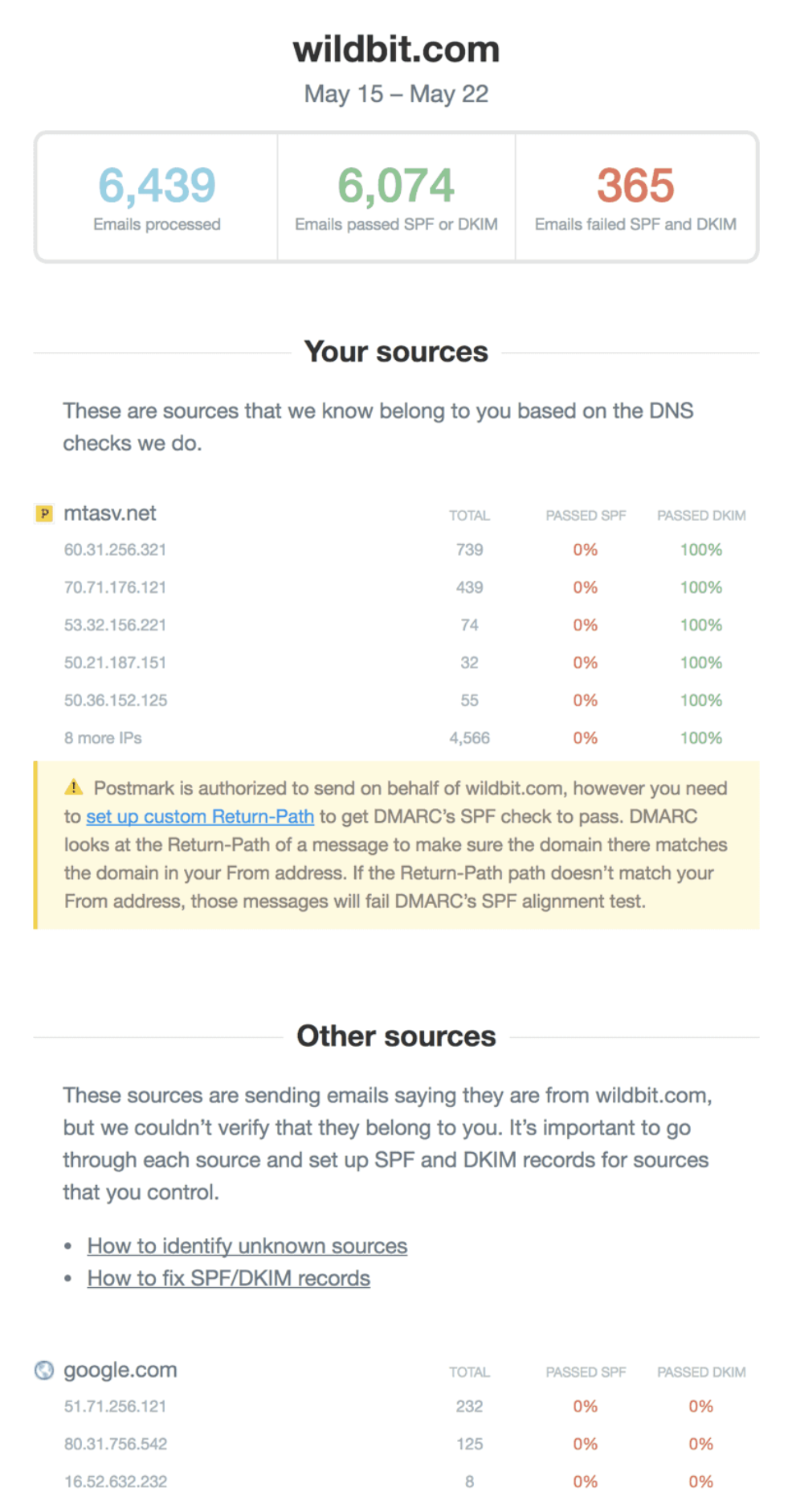
Clear record setup
Readable weekly email
Manual source review
Adding the primary domain, marketing subdomain, and parked domain took little effort, and DNS verification was clear enough for a non-specialist to complete with a copied TXT record. The weekly email was readable for the parked domain, but the corporate domain became harder to use once legitimate traffic and test edge cases landed together. Finding the unknown sender meant checking the digest, matching IPs manually, and keeping our own notes.
A fuller DMARC interface puts more of the investigation workflow in the product, which matters once the setup has several senders and mixed authentication outcomes. In our test pattern, the product experience question was whether the UI could explain why forwarding broke SPF without treating it like the same class of issue as the unauthorized spoof sample.
Support
Self serve vs handoff
Postmark fits self-serve setup, not managed rollout
The free product sets a clear expectation: use the setup instructions, verify DNS, and read the weekly email. That is reasonable for a low-risk domain, but it leaves gaps when IT, marketing, support, and security need an escalation path and a shared plan.
Free DMARC Weekly Digests by Postmark

Self-serve DNS setup
Limited free support
No rollout handoff
During setup, the DNS handoff was straightforward because the required DMARC record was clear. Where support became less useful was after the edge cases appeared: the forwarded SPF failure, subdomain DKIM pass, and unknown sender needed explanation and assignment instead of another weekly email. Enterprise onboarding expectations such as rollout sequencing, owner mapping, and escalation notes were outside the free workflow.
A managed DMARC process is more relevant when the buying question includes support handoff, guided DNS changes, and policy rollout accountability. In our test, the key support gap was not creating the first record, it was helping different owners understand what to fix, what to ignore, and when the domain was ready for a stricter policy.
Suitability
Single inbox vs operating model
Postmark suits small passive checks, not shared ownership
Free DMARC Weekly Digests by Postmark makes sense when one person wants a weekly email for one low-risk domain. Teams that manage clients, route alerts, or need recurring owner handoff should make MSP workflows and alert quality explicit buying criteria before choosing a tool.
Free DMARC Weekly Digests by Postmark
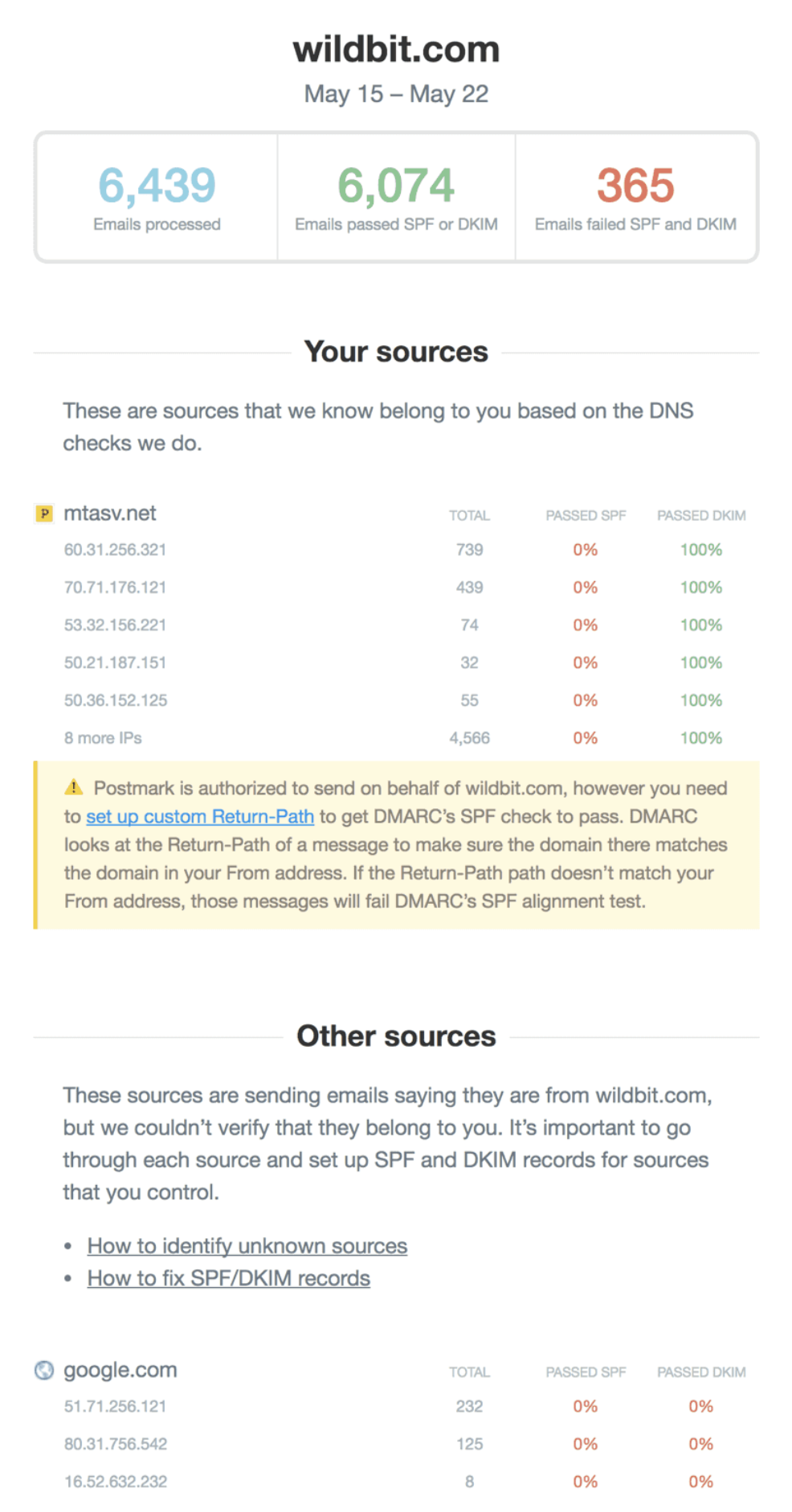
Best for one owner
Weak client separation
Inbox-based reporting
The parked domain fit Postmark best because there were few events, no client owner, and no need to split access. The marketing subdomain was less comfortable because Mailchimp and SendGrid needed different notes, and the primary corporate domain needed account separation between IT, marketing, and support. Recurring reporting worked as an inbox habit, not as a stakeholder workflow.
A multi-domain DMARC workflow is a closer fit for SMBs and MSPs that need domain grouping, client separation, issue queues, and handoff notes. The main enterprise question is similar: whether the DMARC process can survive multiple owners, repeated reviews, and policy movement without living in one person's inbox.
What Free DMARC Weekly Digests by Postmark felt like after 90 days of real use
Free DMARC Weekly Digests by Postmark
After 90 days, Free DMARC Weekly Digests by Postmark felt most useful on the parked domain. The weekly email gave us enough signal to know that the unauthorized spoof sample had appeared and that no regular sender needed attention.
The primary domain exposed the limits. Microsoft 365, Google Workspace, SendGrid, Mailchimp, and the support desk sender all generated legitimate traffic, and the digest did not give us a clean way to assign owners, preserve classification decisions, or plan policy movement.
Where it wins
Very quick first setup
Clear weekly summary format
Free for a basic domain
Useful spoof awareness
Where it lags
No web investigation workflow
Limited source and IP depth
Manual unknown sender classification
No hosted SPF or MTA-STS
Pricing
$0
Free tier
Yes
Onboarding
Fast DNS setup
G2 rating
4.6 / 5
Pricing
Free DMARC Weekly Digests by Postmark
Suped
Small
1 domain, up to 1k emails / month.
$0
The free weekly email workflow fits one simple domain with limited report history.
$0 / month
Free plan covers 1 domain and 1,000 monthly emails.
Medium
2 domains, up to 100k emails / month.
Not publicly listed as of May 15, 2026
No public multi-domain tier exists for this free product.
Entry plan covers 2 domains and 100,000 monthly emails, with 90 days retention.
Large
10 domains, up to 1 million emails / month.
Not publicly listed as of May 15, 2026
There is no public large-domain package for the weekly digest workflow.
10 domains and 1,000,000 monthly emails, with 365 days retention.
Enterprise
Over 20 domains and 1 million emails / month.
Not publicly listed as of May 15, 2026
The free product is not packaged as an enterprise monitoring plan.
20 domains and 2,500,000 monthly emails, with 365 days retention. Unlimited domains/emails negotiable.
Postmark's $0 Small price is a public list price for Free DMARC Weekly Digests. Medium, Large, and Enterprise are not estimates; no public multi-domain or volume price for this product was listed when pricing was checked on May 15, 2026.
Why Suped wins over Free DMARC Weekly Digests by Postmark
Suped
Get started
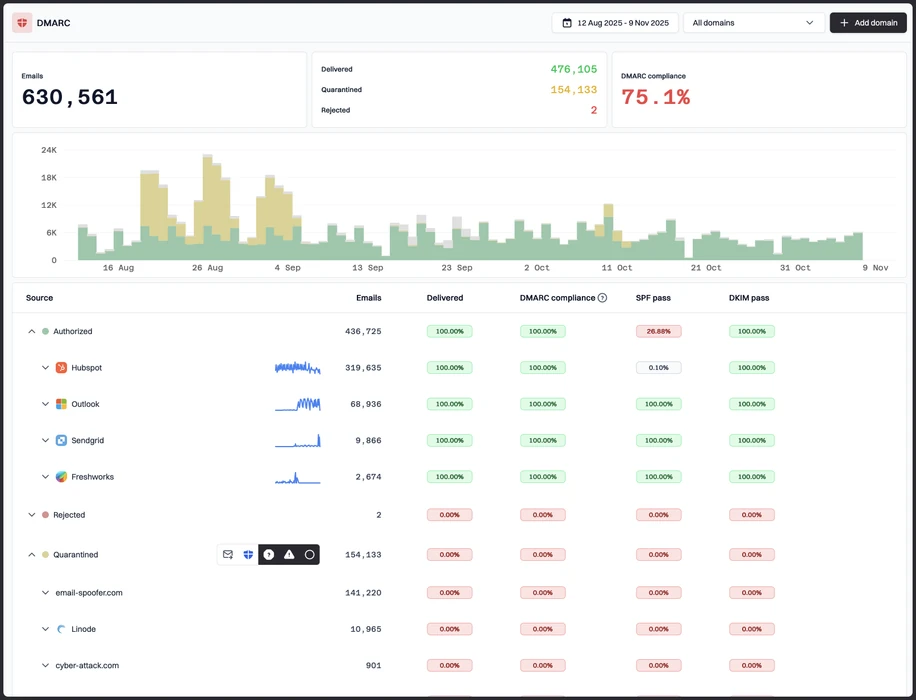
Turn weekly findings into tasks
In our test, Postmark surfaced the unknown sender but left classification and ownership outside the product. Suped's product is built to move a source into an approved, rejected, or investigation state with next steps attached.
Separate domains and owners
The corporate domain, marketing subdomain, and parked domain needed different owners and review rhythms. Suped's product supports multi-domain workflows where those handoffs do not depend on a single weekly inbox.
Reduce missed authentication changes
The forwarded SPF failure and spoof sample needed different urgency levels. Suped's product focuses alerts on the issue type, so teams can separate expected forwarding noise from real abuse.
The difference was significant. We moved from limited visibility to a much clearer dashboard. Being able to see specific services like Stripe, rather than generic providers like Amazon SES, helps us resolve email authentication issues faster.
Markus Hugenschmidt, Managing Director, Jam Cyber
Migrating from Free DMARC Weekly Digests by Postmark?
We have done the migration enough times to know the shape.
Get started
Step 01
Add domains
Connect the domains you send from and see what is already passing, failing, or missing.
Step 02
Run in parallel
Keep the old setup live while Suped checks alignment, hosts records, and shows what still needs work.
Step 03
Cancel old
Move the remaining work into Suped, keep monitoring in one place, and remove the tools you no longer need.


