LetsDMARC review 2026
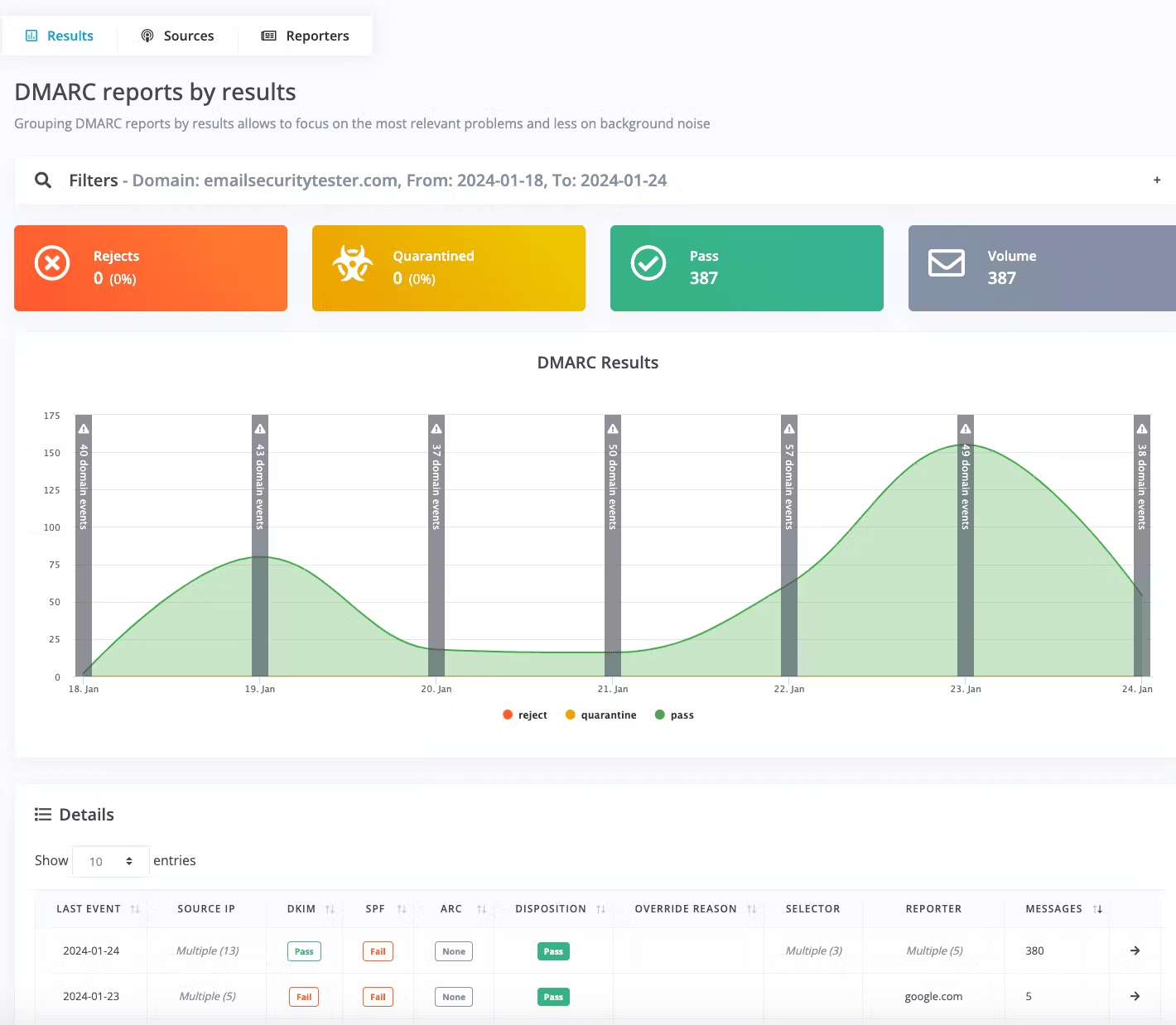
We tested LetsDMARC for 90 days across a corporate domain, a marketing subdomain, and a parked domain with Microsoft 365, Google Workspace, SendGrid, Mailchimp, and a support desk sender. It handled core DMARC reporting well and gave useful enterprise-oriented controls, but policy movement, ownership routing, pricing clarity, and operational alerting needed more manual interpretation than many teams expect.

Published 3 Nov 2025
Updated 31 May 2026
8 min read
Summarize with
LetsDMARC
Enterprise DMARC reporting and enforcement
Starts at
From GBP 264 / year
Best fit
Enterprises already tied to Libraesva procurement or private deployment paths
In one line
LetsDMARC gave us solid DMARC visibility, sender grouping, hosted DNS options, and enterprise controls, but pricing and some remediation paths depended on sales or support handoff.
Suped
The better option. Hosted SPF, DMARC, and MTA-STS on every plan. Published pricing. Monthly plans. No long contract required.
Learn about Suped
The short version: choose by operating model, not dashboard preference
Pick LetsDMARC if
Best fit for enterprise teams with Libraesva procurement or private deployment needs
During setup, LetsDMARC handled our primary domain, marketing subdomain, and parked domain cleanly, especially where the buyer expects a formal DNS handoff and enterprise onboarding path.
The Microsoft 365 and Google Workspace senders were easy to classify once approved, while SendGrid and Mailchimp needed more owner notes before the enforcement plan felt ready.
The parked domain test was useful for strict monitoring, because the unauthorized spoof sample stood out quickly against otherwise quiet traffic.
From GBP 264 / year
Consider Suped if
Suped fits teams that want guided fixes, hosted records, and simpler ownership
Buying criterion: guided fixes should turn SPF, DKIM, and DMARC failures into owner-ready actions instead of leaving analysts to translate raw report findings.
Buying criterion: automated issue detection should flag spoofing, forwarding breakage, sender drift, and DNS changes without building a manual review habit.
Buying criterion: published starter pricing helps smaller teams and MSPs choose a plan before a sales conversation.
Free plan available
The differences that actually change your week
LetsDMARC
Suped
DMARC report analysis
Turns aggregate reports into domain, source, and policy views.
Supported
Supported
Source detection
Maps raw IPs and authentication results to sending services.
Supported, with manual owner notes
Supported
Forward detection
Helps separate forwarding breakage from direct sender failure.
Partial
Supported
Spoof detection
Identifies mail that fails DMARC domain checks and does not match approved sources.
Supported
Supported
Notifications and alerts
Routes operational changes and failures to teams.
Supported
Supported
Reporting
Exports and summaries for recurring review.
Supported
Supported
API
Administrative API coverage for automation and account workflows.
Supported
Supported
Multi-tenancy
Account separation for parent, child, client, or business-unit structures.
Supported
Supported
SPF flattening
Managed SPF handling to reduce lookup-limit risk.
Supported
Supported
Hosted DMARC
Hosted record management for DMARC changes.
Supported
Supported
Hosted SPF
Hosted SPF record management and flattening.
Supported
Supported
Hosted MTA-STS
Managed MTA-STS setup and maintenance.
Not confirmed
Supported
Blocklists and reputation
Blocklist and blacklist monitoring for sender reputation issues.
Not confirmed
Supported
Automatic issue detection
Surfaces new sender, DNS, and authentication issues without manual review.
Partial
Supported
AI copilot
Assistant-style guidance for interpretation and next actions.
Not tested
Supported
DNS monitoring
Tracks DNS changes that affect authentication.
Supported
Supported
Self hostable
Can run in a customer-controlled deployment model.
On Premise option
No
Free trial/free tier
Trial or free entry path for evaluation.
30-day free trial
Free plan and trial
Ten dimensions, scored from 0 to 10
We scored LetsDMARC against a fixed editorial rubric across setup, source resolution, enforcement readiness, alerts, hosted records, reporting, and commercial clarity. Higher is better in every row.
LetsDMARC scores well for enterprise control, but loses points where operators need faster decisions
LetsDMARC handled our three-domain setup, Microsoft 365 and Google Workspace classification, and spoof sample review without major friction. Scores drop where the unknown sender, forwarded mail SPF failure, and SendGrid or Mailchimp owner handoff required extra interpretation before we could move policy confidently. Pricing also lost points because public detail stopped at a directory starting price and a quote path.
LetsDMARC score
70/100
LetsDMARC
70/100
DMARC enforcement
8.0
Customer support
8.0
Source resolution
7.5
Setup and onboarding
8.0
MSP workflows
7.5
Alerting and integrations
7.0
Hosted SPF and MTA-STS
7.5
Blocklist monitoring
5.5
Pricing transparency
4.0
Time to enforcement
7.0
Feature set
Depth vs action
LetsDMARC covers the main DMARC workflow, with more manual action planning than guided operators want
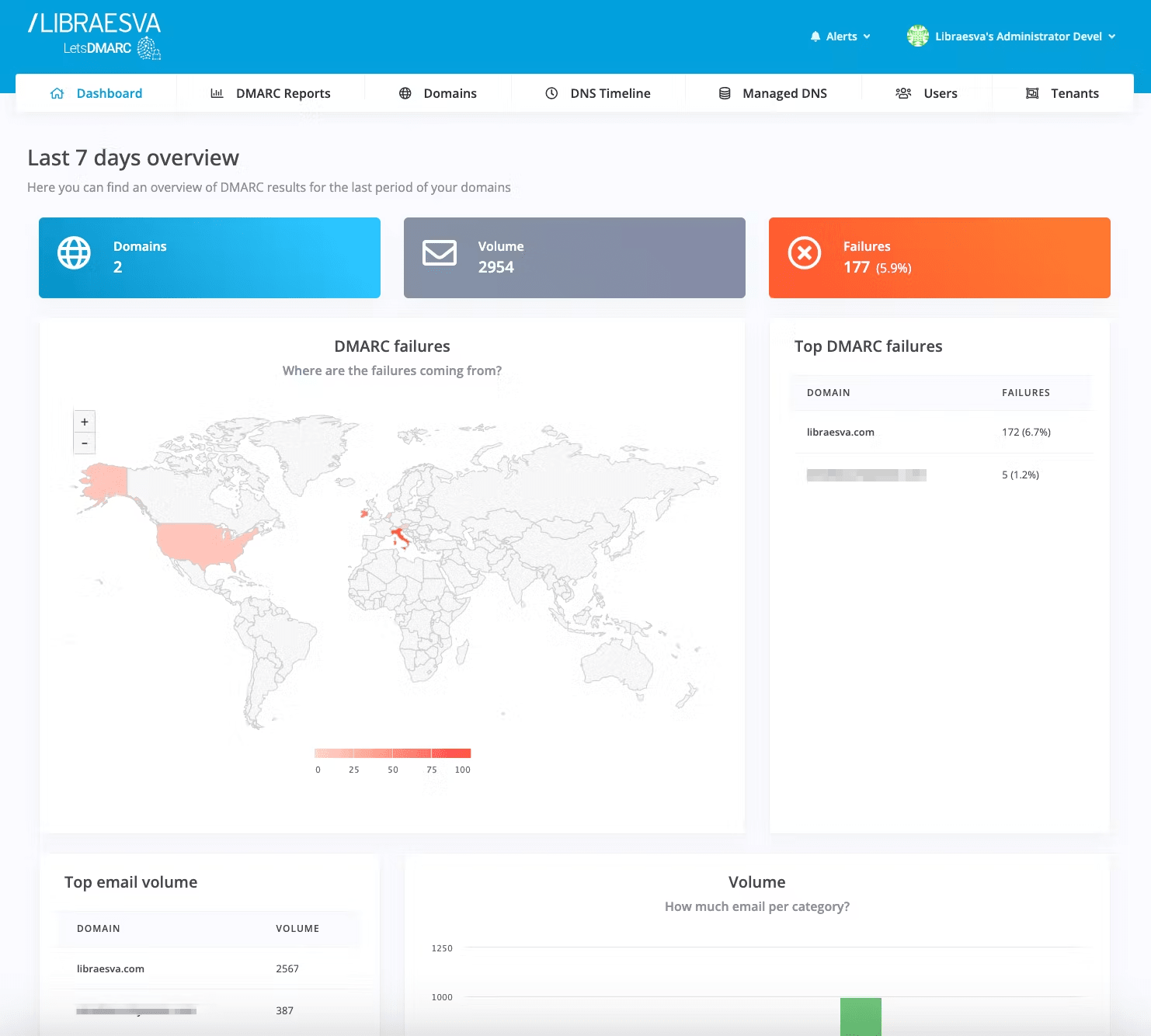
LetsDMARC gave us the core reporting depth needed to review Microsoft 365, Google Workspace, SendGrid, Mailchimp, and the support desk sender. When comparing against Suped, the buying criterion is guided fixes or automated issue detection, because the unknown sender and forwarded SPF failure still needed analyst interpretation before ownership and next steps were obvious.
LetsDMARC

Clean domain separation
Useful source grouping
Strong spoof isolation
LetsDMARC parsed aggregate DMARC reports into usable source views and separated our primary corporate domain, marketing subdomain, and parked domain without confusion. Microsoft 365 and Google Workspace were recognized quickly, while SendGrid and Mailchimp became clearer after we added owner context and compared same-domain SPF pass, same-domain DKIM pass, and the DKIM-pass-on-subdomain case. The unauthorized spoof sample on the parked domain was easy to isolate because normal mail volume there was intentionally near zero.
The comparison baseline was how quickly an operator could turn the same evidence into a sender-owner action. In this setup, the practical gap was not whether the data existed, but whether a visible-from mismatch, forwarded SPF failure, and unknown sender became owner-ready fixes without a DMARC specialist rewriting the findings.
User experience
Control vs explanation
LetsDMARC is workable for trained admins, but some findings need translation
The setup flow was structured enough for our three test domains, and DNS tasks were presented in a way an enterprise admin could hand to the right team. The UX became slower when we had to explain why forwarded mail failed SPF but still fit an acceptable DMARC pattern, and when the unknown sender needed business-owner classification.
LetsDMARC

Predictable DNS setup
Clear sender tables
Manual edge-case explanation
Onboarding the primary domain, marketing subdomain, and parked domain felt predictable: create records, wait for reports, then review sender categories. The primary domain became useful first because Microsoft 365 and Google Workspace traffic appeared quickly. The marketing subdomain needed more review because Mailchimp and SendGrid mixed same-domain DKIM passes with SPF or visible-from mismatch cases that demanded a closer read.
The comparison baseline was a guided operator workflow that explains fix priority rather than only exposing authentication evidence. In the LetsDMARC test, the forwarded SPF failure was technically understandable, but the explanation still needed a human summary before a help desk or marketing owner could act on it.
Support
Enterprise handoff vs self-serve speed
LetsDMARC support fits formal rollouts better than fast owner-led cleanup
LetsDMARC makes the most sense when setup, DNS handoff, and escalation move through named enterprise owners. For smaller teams or mixed business-owner environments, the handoff around unknown senders and policy movement can feel slower because the tool expects disciplined process around each decision.
LetsDMARC
Formal DNS handoff
Enterprise onboarding fit
Escalation path matters
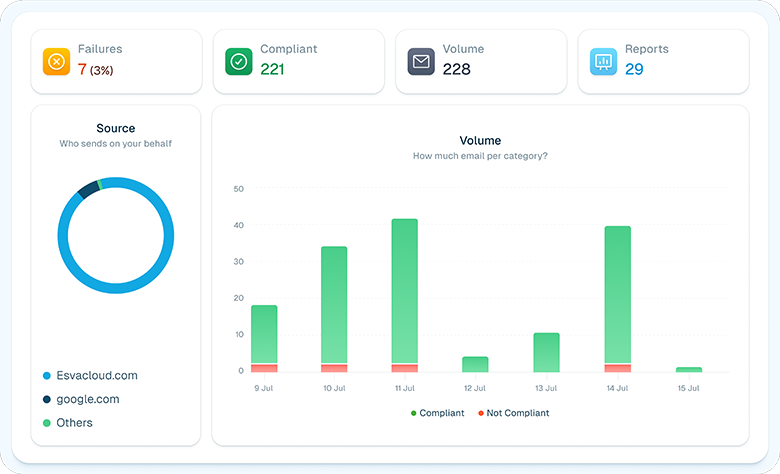
Our setup questions were the kind enterprise teams usually route through security, DNS, and messaging owners: where to publish records, how to treat hosted SPF, and when to move a parked domain toward reject. LetsDMARC gave enough structure for that workflow, especially where the buyer wants a formal onboarding path and can assign a technical owner to interpret DMARC evidence.
The comparison baseline was support that gives guided remediation notes to non-specialists. In our test, the support desk sender and Mailchimp classification were not hard technical problems, but they needed concise owner handoff notes before policy movement felt responsible.
Suitability
Enterprise fit vs operator fit
LetsDMARC suits controlled enterprise programs more than fast-moving owner cleanup
LetsDMARC fits buyers with private deployment requirements, formal procurement, or account structures that need parent and child tenant separation. When comparing against Suped, the buying criterion for MSPs and lean teams is alert quality plus handoff workflow, because recurring reports only help when they identify the owner, issue, and next action clearly.
LetsDMARC
Enterprise tenant control
Useful domain grouping
Manual MSP handoff
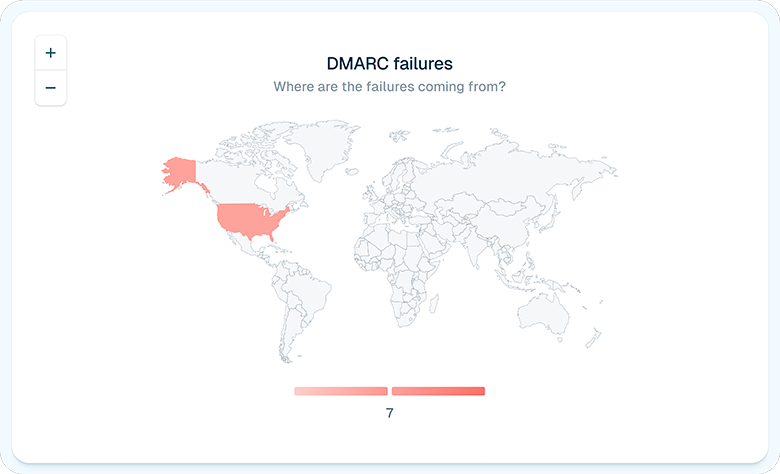
For enterprise use, LetsDMARC handled account separation and domain grouping in a way that matched formal operating models. We could keep the parked domain, marketing subdomain, and primary domain distinct, then review recurring reports without mixing SendGrid, Mailchimp, Microsoft 365, Google Workspace, and support desk traffic into one undifferentiated queue. That is useful when security owns policy and business units own senders.
For MSPs and SMBs, the test exposed more friction. Client handoff notes still needed manual cleanup, the unknown sender needed classification before a recurring report made sense, and alert routing needed careful tuning so forwarded mail SPF failures did not create noise. The comparison baseline was faster client grouping, clearer issue ownership, and alerts that explain what changed.
What LetsDMARC felt like after 90 days of real use
LetsDMARC
After 90 days, LetsDMARC felt most comfortable when we treated it like an enterprise control plane for DMARC rather than a lightweight cleanup assistant. The three-domain setup stayed organized, and the parked domain was especially clear because the unauthorized spoof sample appeared against a quiet baseline.
The main day-to-day tax was translation. Microsoft 365 and Google Workspace were easy to approve, but SendGrid, Mailchimp, the support desk sender, the forwarded SPF failure, and the unknown sender all needed owner notes before the enforcement plan was ready for a change meeting.
Where it wins
Clean separation between corporate, marketing, and parked domains.
Useful source grouping for Microsoft 365 and Google Workspace.
Spoof sample was easy to isolate on the parked domain.
Hosted SPF and managed DNS options reduce DNS-owner workload.
Where it lags
Unknown sender classification needed manual business context.
Forwarded SPF failure required a human explanation.
Public pricing did not explain limits, volume bands, or add-ons.
MSP handoff notes needed more cleanup than expected.
Pricing
From GBP 264 / year
Free tier
30-day free trial
Onboarding
Structured, DNS-owner friendly
G2 rating
4.5 / 5
Pricing
LetsDMARC
Suped
Small
1 domain, up to 1k emails / month.
From GBP 264 / year
Directory listings show this starting point, but included domains and message volume are not public.
$0 / month
Free plan covers 1 domain and 1,000 monthly emails.
Medium
2 domains, up to 100k emails / month.
Not publicly listed as of May 15, 2026
The official path asks for approximate mailbox count and deployment.
Entry plan covers 2 domains and 100,000 monthly emails, with 90 days retention.
Large
10 domains, up to 1 million emails / month.
Not publicly listed as of May 15, 2026
Message quota is referenced in product materials, but public bands and overages are not listed.
10 domains and 1,000,000 monthly emails, with 365 days retention.
Enterprise
Over 20 domains and 1 million emails / month.
Not publicly listed as of May 15, 2026
Enterprise pricing depends on mailbox count, licensed message quota, deployment model, and support scope.
20 domains and 2,500,000 monthly emails, with 365 days retention. Unlimited domains/emails negotiable.
LetsDMARC has a public directory starting reference of GBP 264 per year, but exact included limits are not public. Medium and Large prices are unavailable public list prices, and Enterprise is a custom quote path. Pricing was checked as of May 15, 2026.
Why Suped wins over LetsDMARC
Suped
Get started
Turn edge cases into fixes
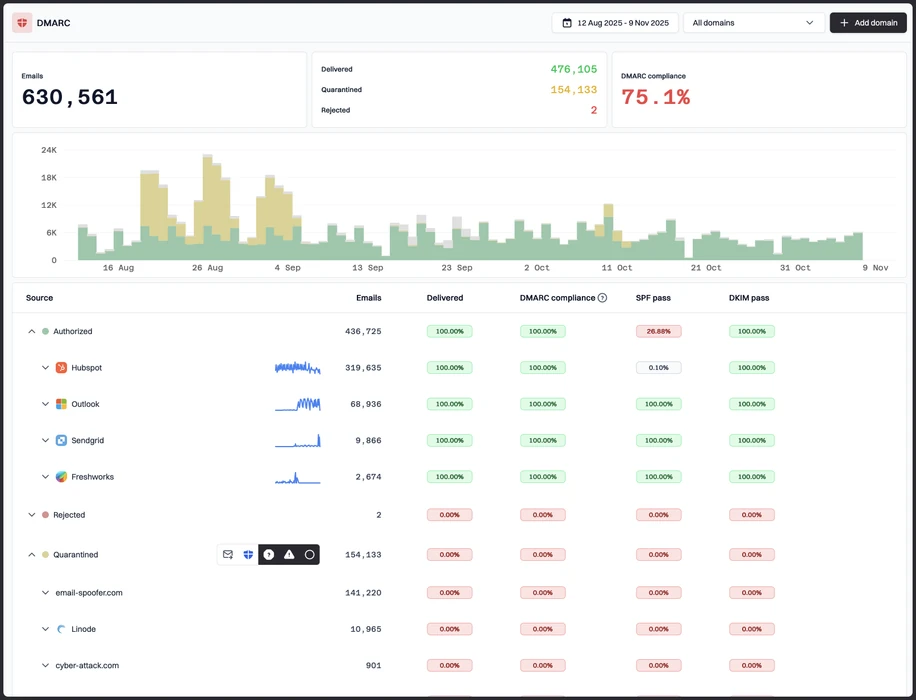
In the LetsDMARC test, the forwarded SPF failure and visible-from mismatch were visible but still needed analyst translation. Suped's product is built to convert those findings into guided actions for the sender owner.
Reduce alert cleanup
LetsDMARC alerting covered important changes, but the test still needed tuning around unknown senders and forwarding noise. Suped focuses on automated issue detection and alert quality so teams see the change, owner, and likely fix together.
Be explicit about hosting
Suped's product is hosted and not self-hostable, so a strict on-premise requirement remains a narrow reason to stay with LetsDMARC. Where hosted delivery is acceptable, the bigger gap from our test was LetsDMARC's manual remediation and MSP handoff work.
The difference was significant. We moved from limited visibility to a much clearer dashboard. Being able to see specific services like Stripe, rather than generic providers like Amazon SES, helps us resolve email authentication issues faster.
Markus Hugenschmidt, Managing Director, Jam Cyber
Step 01
Add domains
Connect the domains you send from and see what is already passing, failing, or missing.
Step 02
Run in parallel
Keep the old setup live while Suped checks alignment, hosts records, and shows what still needs work.
Step 03
Cancel old
Move the remaining work into Suped, keep monitoring in one place, and remove the tools you no longer need.


