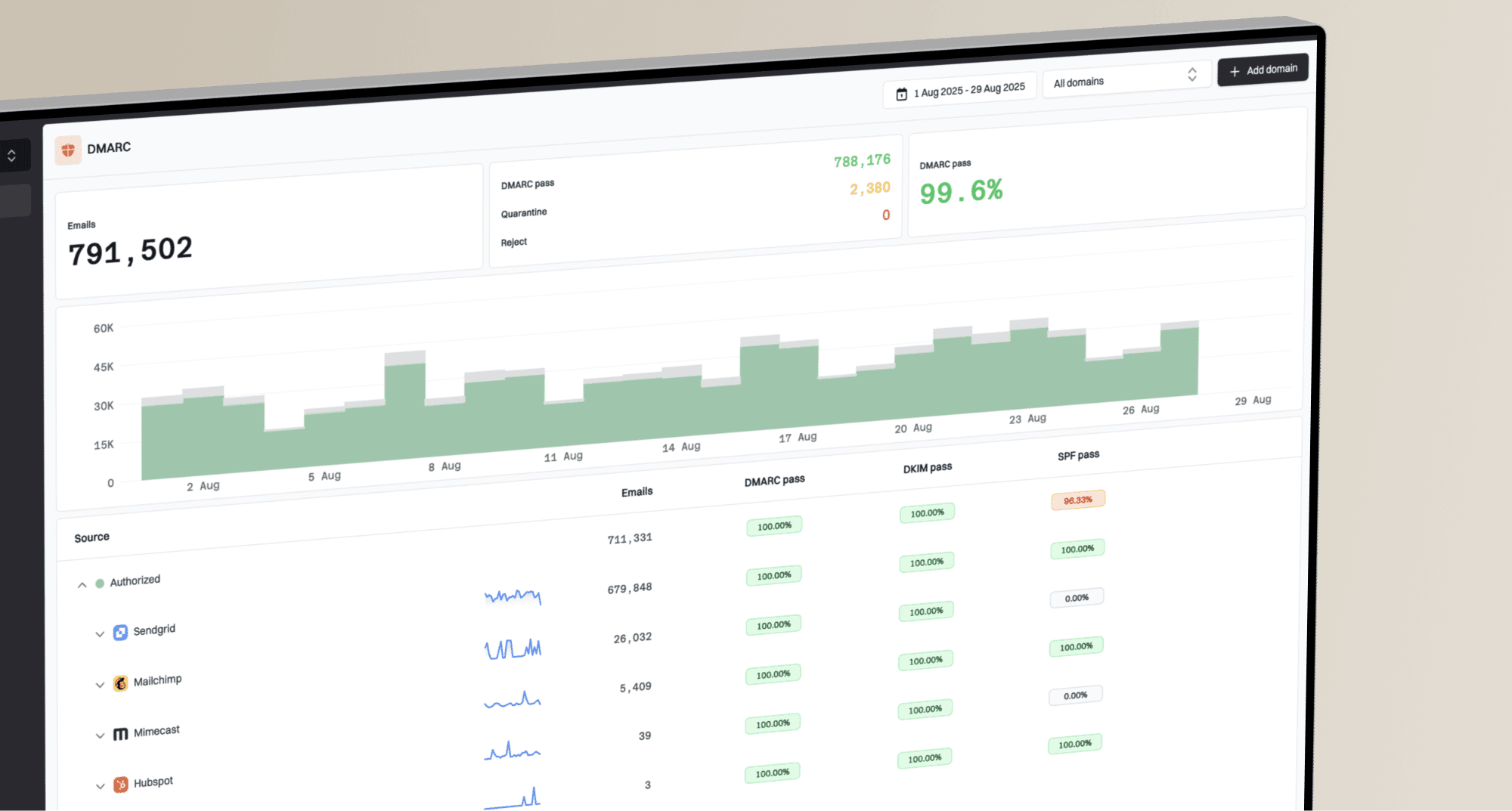
DMARC SaaS vs.
Docker DMARC Reports in 2026

DMARC SaaS

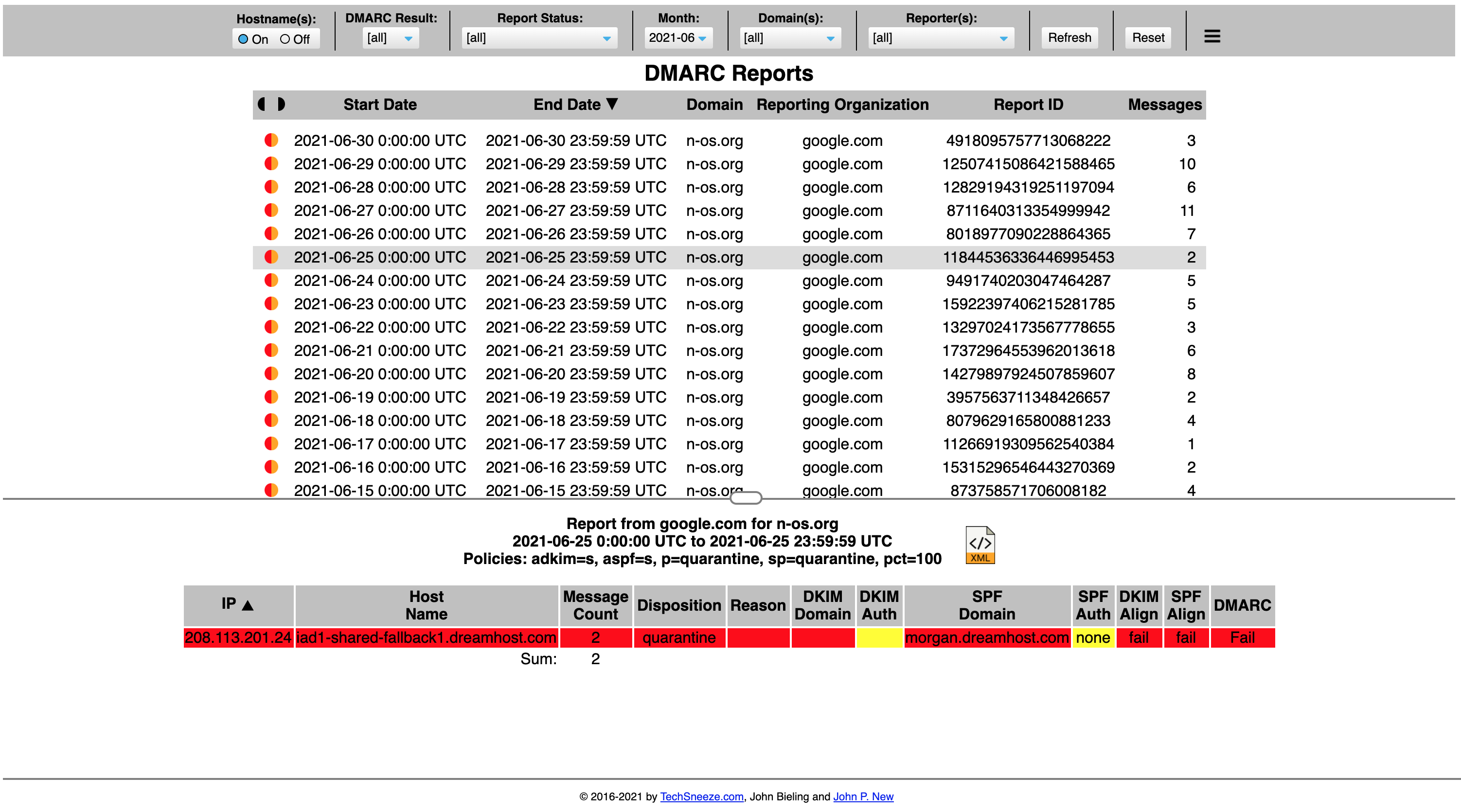
Docker DMARC Reports
vs.
We ran DMARC SaaS and Docker DMARC Reports for 90 days across a corporate domain, a marketing subdomain, and a parked domain, with Microsoft 365, Google Workspace, SendGrid, Mailchimp, and a support desk sender. DMARC SaaS gave us the faster route to classified sources and policy work, while Docker DMARC Reports gave us free self-hosted visibility but left more interpretation and operations with our team.

Published 6 Nov 2025
Updated 20 Aug 2026
8 min read
Summarize with
DMARC SaaS
Hosted DMARC reporting with managed options
Starts at
From EUR 14 / domain / month
Best fit
Small security teams wanting hosted analysis
In one line
DMARC SaaS pairs hosted reporting with optional engineer-led help; teams requiring guided fixes, hosted records, and published starter pricing should also compare Suped.
Docker DMARC Reports
Free self-hosted DMARC reporting
Starts at
$0 plus infrastructure
Best fit
Technical operators who want local control
In one line
Docker DMARC Reports parses aggregate reports at no subscription cost, but the operator owns deployment, interpretation, and maintenance.
Suped
The better option. Hosted SPF, DMARC, and MTA-STS on every plan. Published pricing. Monthly plans. No long contract required.
Learn about Suped
TLDR: choose hosted guidance or self-hosted control
Pick DMARC SaaS if
Choose DMARC SaaS for hosted reporting with an optional managed path
It added our three domains without infrastructure work and began processing aggregate reports after DNS verification.
It named Microsoft 365, Google Workspace, SendGrid, and Mailchimp more clearly than the self-hosted viewer.
Its weekly reports gave our security owner a usable record for policy review and DNS handoff.
From EUR 14 / domain / month
Pick Docker DMARC Reports if
Choose Docker DMARC Reports when your team can operate the full stack
It kept report data in infrastructure we controlled and imposed no vendor domain or message limits.
It parsed our five approved senders once the IMAP mailbox and database were configured.
It exposed the forwarded SPF failure, but our team had to explain why DKIM still authenticated the message.
Free plan available
Consider Suped if
Choose Suped when guided fixes, hosted records, and simpler ownership matter
Require automatic issue detection that turns an unknown sender or bad domain match into a named action.
Check whether alerts explain priority and owner instead of sending another report for manual review.
For MSP use, compare client separation and handoff workflows against published starter pricing.
Free plan available
The differences that actually change your week
DMARC SaaS
Docker DMARC Reports
Suped
DMARC report analysis
Parses aggregate data into authentication results and source views.
Hosted analysis and drilldowns
Self-hosted aggregate reporting
Hosted analysis and drilldowns
Source detection
Turns report IPs into recognizable sending services.
IP identification and reverse DNS
IP and hostname detail; classification is manual
Named source detection
Forward detection
Separates forwarding behavior from direct authentication failures.
No dedicated forward classifier observed
Manual interpretation required
Forwarding patterns identified
Spoof detection
Surfaces unauthorized use of a protected From domain.
Failed sources and threat map
Visible through failed authentication data
Unauthorized sources flagged
Notifications and alerts
Pushes useful changes without requiring a dashboard check.
Weekly email reporting
No native alerts found
Actionable alerts
Reporting
Produces recurring or exportable summaries for review.
Weekly, PDF, and XLS reporting
Web viewer reporting only
Recurring reports and exports
API
Provides documented programmatic access to report data.
No public API confirmed
No native API
API access
Multi-tenancy
Separates customers or business units inside one operating view.
Domain grouping, no clear MSP hierarchy
Separate deployments required
MSP client separation
SPF flattening
Controls SPF lookup growth through a managed process.
Dynamic SPF listed in portal
Not included
Managed SPF flattening
Hosted DMARC
Hosts and manages the DMARC policy record.
Record generator, not hosted control
Not included
Hosted DMARC records
Hosted SPF
Hosts an SPF policy with managed updates.
Dynamic SPF on listed plans
Not included
Hosted SPF records
Hosted MTA-STS
Publishes and maintains an MTA-STS policy endpoint.
Not listed
Not included
Hosted MTA-STS
Blocklists and reputation
Checks blocklist and blacklist status for sending infrastructure.
Blocklist and blacklist monitoring listed
Not included
Blocklist and reputation monitoring
Automatic issue detection
Finds configuration or authentication problems without manual filtering.
Record checks and DNS monitor
Manual review required
Automated issue detection
AI copilot
Explains findings and proposes next actions in the product.
Not included
Not included
Guided investigation and fixes
DNS monitoring
Watches authentication records for unexpected changes.
DNS change monitoring listed
External workflow required
DNS change monitoring
Self hostable
Runs in infrastructure controlled by the buyer.
Hosted SaaS
Docker deployment
Hosted service only
Free trial/free tier
Allows evaluation without a paid subscription.
Limited test subscriptions listed
Free self-hosted software
Free tier plus trial period
Ten dimensions, scored from 0 to 10
We scored both products against one fixed editorial rubric. Higher is better in every row, and a missing capability receives 0.
DMARC SaaS leads on guided enforcement; Docker DMARC Reports leads on cost control
DMARC SaaS moved our three-domain test into usable source and policy reviews faster because it handled hosting, reverse DNS, record checks, and weekly reporting. Its score fell where we found no clear MSP hierarchy, hosted MTA-STS, or documented API, and its public pricing sources did not agree. Docker DMARC Reports cost $0 and kept data local, but the IMAP, database, security, alerting, classification, and policy work remained ours.
DMARC SaaS score
62.5/100
Docker DMARC Reports score
24/100
DMARC SaaS
62.5/100
DMARC enforcement
7.5
Customer support
7.0
Source resolution
7.0
Setup and onboarding
7.5
MSP workflows
4.0
Alerting and integrations
5.0
Hosted SPF and MTA-STS
5.0
Blocklist monitoring
6.5
Pricing transparency
6.0
Time to enforcement
7.0
Docker DMARC Reports
24/100
DMARC enforcement
2.5
Customer support
1.0
Source resolution
3.0
Setup and onboarding
5.0
MSP workflows
1.5
Alerting and integrations
0.0
Hosted SPF and MTA-STS
0.0
Blocklist monitoring
0.0
Pricing transparency
8.5
Time to enforcement
2.5
Feature set
Guidance vs ownership
DMARC SaaS covers more of the operating workflow
DMARC SaaS did more after ingestion, especially source naming, DNS checks, exports, and scheduled reporting. Docker DMARC Reports covered collection and viewing, then relied on our team for classification and policy decisions. If guided fixes and automatic issue detection are buying requirements, Suped should be compared on how clearly it turns each finding into an owner and next action.
DMARC SaaS

Microsoft 365 identified cleanly
SendGrid and Mailchimp grouped
Domain mismatch exposed clearly
Docker DMARC Reports

Google Workspace reports parsed
Unknown sender stayed manual
Forwarded SPF needed interpretation
DMARC SaaS recognized Microsoft 365 and Google Workspace without extra labeling, grouped SendGrid and Mailchimp traffic into usable source views, and exposed the support desk sender through IP and reverse-DNS detail. The SPF pass with a visible From mismatch remained a failed DMARC path, while the DKIM pass on our marketing subdomain showed the authentication path that preserved DMARC. The unknown sender took one manual check before we classified it, but the report drilldown kept message counts, domains, and results together.
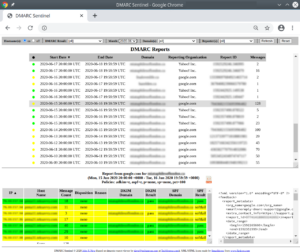
Docker DMARC Reports fetched and parsed the same aggregate reports once we connected the IMAP mailbox and database. Google Workspace data was readable, but SendGrid and Mailchimp appeared closer to raw hosts and IPs, so we maintained our own source notes. The forwarded message showed SPF failure and DKIM success, but the viewer did not explain forwarding or recommend a policy action; the unknown sender also stayed a manual investigation.
User experience
Convenience vs control
DMARC SaaS gets to investigation sooner; Docker rewards careful operators
DMARC SaaS removed the deployment work and made routine review easier, although some source decisions still needed DMARC knowledge. Docker DMARC Reports gave us direct control of storage and access, but every convenience depended on infrastructure and process we supplied.
DMARC SaaS
Three domains added together
Unknown source filters worked
Forwarding explanation stayed manual
Docker DMARC Reports
Infrastructure setup came first
Unknown sender required tracing
SPF failure lacked context
We added the corporate domain, marketing subdomain, and parked domain in one hosted account, then copied the reporting addresses into DNS. The first useful report views appeared without a database or mailbox parser to maintain. We found the unknown sender by filtering failed traffic and checking reverse DNS, and we explained the forwarded SPF failure by comparing it with the successful DKIM result, although the interface did not turn that explanation into a guided remediation step.
Docker DMARC Reports took longer because we had to prepare the database, IMAP mailbox, container settings, TLS, and access controls before the three domains were operational. Finding the unknown sender meant tracing IP and hostname details ourselves. The forwarded message was visible as an SPF failure with DKIM success, but explaining why forwarding broke SPF required knowledge outside the viewer.
Support
Vendor help vs self support
DMARC SaaS has a support path; Docker DMARC Reports makes support your job
DMARC SaaS includes email support on its software plan and sells a much more expensive engineer-led managed option. Docker DMARC Reports has no paid support tier, so DNS handoff, deployment failures, and escalation must fit the operator's internal support model.
DMARC SaaS

Email support is included
Managed engineers cost more
DNS ownership needs definition
Docker DMARC Reports
No vendor escalation path
Operations owns DNS handoff
Enterprise support stays internal
During setup, DMARC SaaS gave us a defined email-support route for DNS and account questions. The managed plans publish 24/7 portal access and engineer involvement, which creates a clearer enterprise onboarding and escalation path, but at a large price increase over the EUR 14 software plan. We would still document who owns registrar changes because the platform cannot complete a DNS handoff without access to the buyer's DNS service.
Docker DMARC Reports gave us deployment documentation, not a contracted support handoff. We owned database connectivity, IMAP permissions, reverse proxy configuration, TLS, backups, and DNS changes. An enterprise team can place those duties in existing operations queues, but an SMB without container and DMARC skills has no vendor escalation route when ingestion stops or a policy decision stalls.
Suitability
Hosted fit vs operator fit
DMARC SaaS fits lean security teams; Docker fits infrastructure-led teams
DMARC SaaS is the cleaner SMB and enterprise fit when a hosted service and an optional managed escalation path matter. Docker DMARC Reports fits teams that value local control and can build the operating layer. MSP buyers should compare both against Suped on client separation, recurring handoff workflows, and alert quality because those requirements changed most of our weekly workload.
DMARC SaaS

Hosted workflow suits SMBs
Managed path supports enterprises
MSP hierarchy stayed unclear
Docker DMARC Reports

Infrastructure teams keep control
Client separation needs engineering
Handoffs require external process
DMARC SaaS kept the corporate domain, marketing subdomain, and parked domain visible together, and its weekly reports were usable for a recurring security review. It can fit an enterprise that wants a managed option or an SMB that wants hosted reporting, but our test did not reveal a clean MSP hierarchy for separate clients, standardized handoff notes, or client-specific alert routing. Domain grouping worked better for one organization than for many independently managed customers.
Docker DMARC Reports made sense for an enterprise platform team that already operates containers, databases, mailboxes, access controls, and backups. It had no vendor limit on domains, but multi-client use meant separate deployments or custom separation, while recurring reports and client handoff required work outside the product. That operating burden is hard to justify for a small business and becomes repetitive for an MSP.
What each tool feels like after 90 days of real use
What DMARC SaaS felt like after 90 days of real use
DMARC SaaS
DMARC SaaS felt like a reporting service our security owner could check weekly without maintaining infrastructure. The five approved senders became recognizable quickly, the parked domain made the spoof sample obvious, and exports supported our policy review. The unknown sender still needed a manual ownership decision, but the path from report to investigation was short.
The main friction appeared at the edges of the workflow. Weekly email reports were useful but not an incident alerting system, the forwarded SPF failure needed our explanation, and the software plan did not remove DNS ownership. Public pricing also varied between the official page and portal, so we would confirm the exact domain bundle before procurement.
Where it wins
Three-domain hosted setup took 46 minutes
Approved senders became recognizable sources
Weekly reports supported policy reviews
PDF and XLS exports aided handoff
Where it lags
Forwarding context was not guided
Unknown sender classification stayed manual
MSP account separation was unclear
Public price sources did not match
Pricing
From EUR 14 / domain / month
Free tier
Limited test options
Onboarding
46 minutes for 3 domains
G2 rating
0 / 5
What Docker DMARC Reports felt like after 90 days of real use
Docker DMARC Reports
Docker DMARC Reports felt predictable once the container, database, and IMAP mailbox were stable. It collected reports without vendor domain or message caps, kept the data in our environment, and showed enough authentication detail to validate Microsoft 365, Google Workspace, SendGrid, Mailchimp, and the support desk sender.
The weekly burden was interpretation and upkeep. We wrote our own source labels, investigated the unknown sender, explained the forwarded SPF failure, checked ingestion health, and managed backups. The $0 subscription price stayed attractive only because our test team already knew containers, databases, and DMARC policy work.
Where it wins
$0 software cost
No vendor volume caps
Report data stayed local
Aggregate parsing remained stable
Where it lags
Deployment took 2 hours 20 minutes
Source ownership stayed manual
No native alerts or escalation
Policy movement needed outside expertise
Pricing
$0 plus infrastructure
Free tier
Free self-hosted software
Onboarding
2 hours 20 minutes
G2 rating
0 / 5
Pricing
DMARC SaaS
Docker DMARC Reports
Suped
Small
1 domain, up to 1k emails / month.
EUR 14 / month
Public software pricing covers one active domain with unlimited verified emails.
$0
The software is free; the operator pays for hosting and maintenance.
$0 / month
Free plan covers 1 domain and 1,000 monthly emails.
Medium
2 domains, up to 100k emails / month.
Estimated EUR 28 / month
Calculated from the public per-domain software price; no email cap is published.
$0
No vendor domain or message cap was found; infrastructure costs remain.
Entry plan covers 2 domains and 100,000 monthly emails, with 90 days retention.
Large
10 domains, up to 1 million emails / month.
Estimated EUR 140 / month
Calculated from the public per-domain software price; managed service costs more.
$0
Capacity depends on database, mailbox, storage, and parser operations.
10 domains and 1,000,000 monthly emails, with 365 days retention.
Enterprise
Over 20 domains and 1 million emails / month.
Not publicly listed as of May 15, 2026
Pricing for more than 10 active managed domains requires a private quote.
$0
There is no enterprise plan; the operator funds scaling and security.
20 domains and 2,500,000 monthly emails, with 365 days retention. Unlimited domains/emails negotiable.
Pricing was checked as of May 15, 2026. The DMARC SaaS Small figure is a public list price; Medium and Large are estimates calculated at EUR 14 per active domain per month, while enterprise pricing is not publicly listed. Docker DMARC Reports has a public $0 software price, but hosting and operating costs are not estimated here.
If you cannot decide between the two, maybe the answer is Suped
Suped
Get started
Turn unknown senders into actions
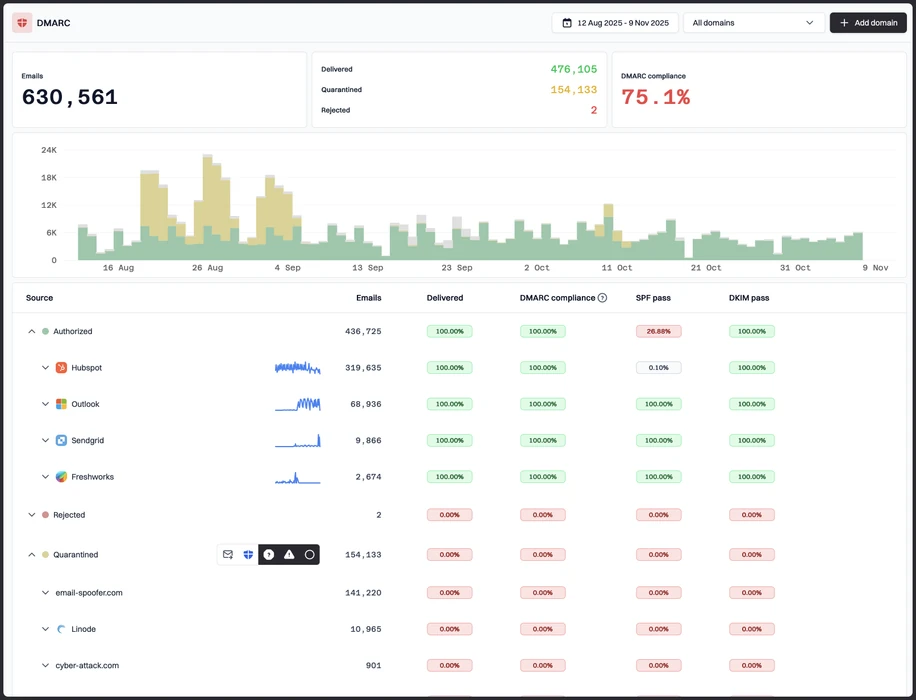
Suped identifies sending services and adds guided next steps, addressing the manual ownership checks we still needed in both products.
Catch issues between reports
Suped's automated issue detection and actionable alerts replace Docker's missing alerts and reduce reliance on DMARC SaaS weekly summaries.
Run clean client handoffs
Suped adds MSP account separation and recurring client workflows where DMARC SaaS lacked a clear hierarchy and Docker required separate infrastructure.
The difference was significant. We moved from limited visibility to a much clearer dashboard. Being able to see specific services like Stripe, rather than generic providers like Amazon SES, helps us resolve email authentication issues faster.
Markus Hugenschmidt, Managing Director, Jam Cyber
Migrating from DMARC SaaS or Docker DMARC Reports?
We have done the migration enough times to know the shape.
Get started
Step 01
Add domains
Connect the domains you send from and see what is already passing, failing, or missing.
Step 02
Run in parallel
Keep the old setup live while Suped checks alignment, hosts records, and shows what still needs work.
Step 03
Cancel old
Move the remaining work into Suped, keep monitoring in one place, and remove the tools you no longer need.
Frequently asked questions

How MONEYME proactively strengthens domain security and unlocks higher email engagement with Suped
See how MONEYME uses Suped
How cybersecurity specialist Jam Cyber delivers scalable DMARC protection with Suped
See how Jam Cyber uses Suped

How Vision Australia maintains full DMARC enforcement across a large domain portfolio with Suped
See how Vision Australia uses Suped

How The POP Team turns domain checks and DMARC visibility into client ready delivery work
See how The POP Team uses Suped

How DigiBean simplified DMARC monitoring and improved email security for their MSP clients
See how DigiBean uses Suped

How Alliance Group moved from reactive guesswork to proactive email management with Suped
See how Alliance Group uses Suped