Centera DMARC Compliance review 2026
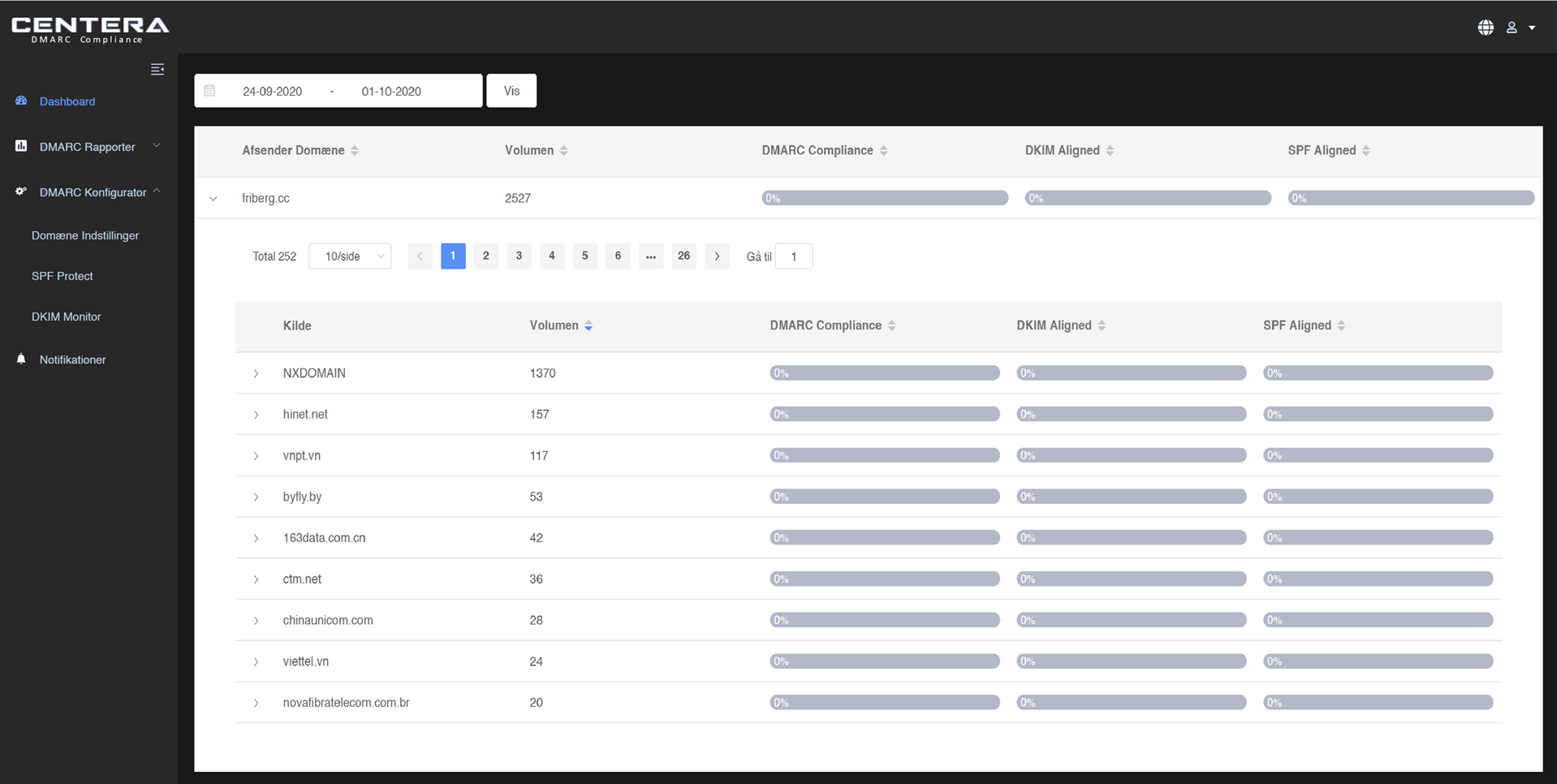
We tested Centera DMARC Compliance for 90 days across a corporate domain, a marketing subdomain, and a parked domain, with Microsoft 365, Google Workspace, SendGrid, Mailchimp, and a support desk sender connected. The product gave us usable DMARC reporting and SPF extension coverage, but the workflow leaned toward manual classification, sales-led onboarding, and quote-based buying.

Published 3 Nov 2025
Updated 31 May 2026
8 min read
Summarize with
Centera DMARC Compliance
DMARC reporting and SPF protection
Starts at
Not publicly listed
Best fit
Organizations that want a Danish-supported DMARC service with SPF Protect in scope
In one line
Centera DMARC Compliance gives teams hosted DMARC report collection, 60-day full report retention, DNS monitoring, DKIM and SPF checks, and SPF Protect, but pricing and several operating details need sales clarification.
Suped
The better option. Hosted SPF, DMARC, and MTA-STS on every plan. Published pricing. Monthly plans. No long contract required.
Learn about Suped
Choose Centera only for a narrow SPF Protect and support fit
Pick Centera DMARC Compliance if
Best for teams that need DMARC reporting with Danish technical support and SPF Protect
Our SendGrid and Mailchimp sources appeared in report drilldowns quickly, but we still needed manual owner notes before policy movement felt defensible.
The forwarded mail sample with SPF failure was visible in aggregate reporting, although the explanation needed a human write-up for the help desk.
SPF Protect was the clearest fit when the marketing subdomain approached the 10 DNS lookup limit during the test.
Not publicly listed
Consider Suped if
Suped is the third option for guided fixes, hosted records, and simpler ownership
Use guided fixes as a buying criterion when non-specialist domain owners need exact DNS and sender remediation steps.
Automated issue detection matters when unknown senders, spoof samples, and authentication drift need to become owner-ready tasks.
Published starter pricing helps smaller teams avoid quote cycles before they know their domain and email volume fit.
Free plan available
The differences that actually change your week
Centera DMARC Compliance
Suped
DMARC report analysis
How well the tool turns aggregate reports into usable authentication findings.
Supported, with 60-day full report retention
Supported
Source detection
How clearly the tool names sending platforms and unresolved senders.
Supported, but owner mapping stayed manual in our test
Supported
Forward detection
Whether forwarded mail with SPF failure is separated from real sender problems.
Partial, visible in reports but not strongly explained
Supported
Spoof detection
Whether unauthorized mail is surfaced for enforcement decisions.
Supported through phishing and spoof visibility
Supported
Notifications and alerts
Whether alerts create useful operational follow-up without excess noise.
Supported, but routing and noise controls were unclear
Supported
Reporting
Scheduled, exported, or review-ready reporting for domain owners.
Supported, exports worked for review meetings
Supported
API
Documented API access for automation and external reporting.
Not confirmed publicly
Supported
Multi-tenancy
Client or business-unit separation for operators managing several domains.
Not confirmed publicly
Supported
SPF flattening
Help for domains that approach or exceed the SPF 10 DNS lookup limit.
Supported through SPF Protect
Supported
Hosted DMARC
Managed DMARC record handling instead of only reporting on existing records.
Reporting and configuration guidance, hosted DMARC not confirmed
Supported
Hosted SPF
Managed SPF record service or equivalent hosted SPF workflow.
Supported through hosted extended SPF
Supported
Hosted MTA-STS
Managed MTA-STS policy hosting and TLS reporting workflow.
Not confirmed publicly
Supported
Blocklists and reputation
Blocklist (blacklist) and reputation monitoring tied to domain operations.
Not confirmed publicly
Supported
Automatic issue detection
Detection that turns authentication drift into prioritized action.
Manual workflow in our test
Supported
AI copilot
AI assistance for investigation, explanation, or remediation.
Not confirmed publicly
Supported
DNS monitoring
Monitoring for DMARC, SPF, DKIM, and DNS record changes.
Supported
Supported
Self hostable
Ability to run the product in a customer-controlled environment.
Cloud service
Not supported
Free trial/free tier
Publicly available free entry path before procurement.
Not confirmed publicly
Supported
Ten dimensions, scored from 0 to 10
Centera DMARC Compliance was scored against a fixed editorial rubric across enforcement, support, source resolution, onboarding, MSP workflows, alerts, hosted records, blocklist and blacklist monitoring, pricing clarity, and time to enforcement. Higher is better in every row.
Centera scores best where DMARC reporting and SPF Protect are enough
Centera DMARC Compliance handled the core DMARC reporting test well enough to identify Microsoft 365, Google Workspace, SendGrid, and Mailchimp traffic, but unknown sender classification and forwarded mail explanation took manual work. The strongest score came from hosted SPF coverage because SPF Protect directly matched the marketing subdomain issue we created. Pricing, MSP workflow evidence, API coverage, hosted MTA-STS, and blocklist or blacklist monitoring pulled the overall result down because we could not verify them through public product materials or the test workflow.
Centera DMARC Compliance score
50.5/100
Centera DMARC Compliance
50.5/100
DMARC enforcement
6.5
Customer support
7.0
Source resolution
6.0
Setup and onboarding
6.5
MSP workflows
4.0
Alerting and integrations
4.5
Hosted SPF and MTA-STS
6.0
Blocklist monitoring
2.0
Pricing transparency
2.0
Time to enforcement
6.0
Feature set
Coverage vs action
Centera covers core DMARC reports, but actioning findings takes more operator work
Centera DMARC Compliance gave us useful report visibility, especially for known senders and SPF pressure, but the product felt lighter on guided remediation. A buyer should check whether guided fixes and automated issue detection are included in the operating workflow, not just whether reports are collected.
Centera DMARC Compliance


Clear known sender visibility
SPF Protect is useful
Spoof samples surfaced
Centera identified Microsoft 365 and Google Workspace traffic cleanly on the primary corporate domain, and SendGrid and Mailchimp appeared under the marketing subdomain after the first reporting cycles. The unknown sender was visible, but classification depended on manual review of IP and header clues, and DKIM pass on a subdomain needed a written note before we were comfortable treating it as approved. The unauthorized spoof sample was clear enough for enforcement discussion, although the product did not turn it into a prioritized fix list by itself.
Suped approaches this same workflow with guided fixes, hosted DMARC and SPF options, hosted MTA-STS, blocklist and blacklist monitoring, and issue detection designed to route findings to an owner. In our comparison rubric, that matters most when Microsoft 365, Google Workspace, SendGrid, Mailchimp, and support desk traffic all need different owners and different remediation steps rather than one shared dashboard review.
User experience
Control vs guidance
Centera works for careful operators, but it asks them to carry the explanation layer
The product did not feel confusing, but it relied on the tester knowing what to do with each authentication state. That is workable for a security or mail admin, but less smooth when marketing, support, and IT all own different senders.
Centera DMARC Compliance
DNS setup was understandable
Unknown sender needed review
Forwarding needed explanation
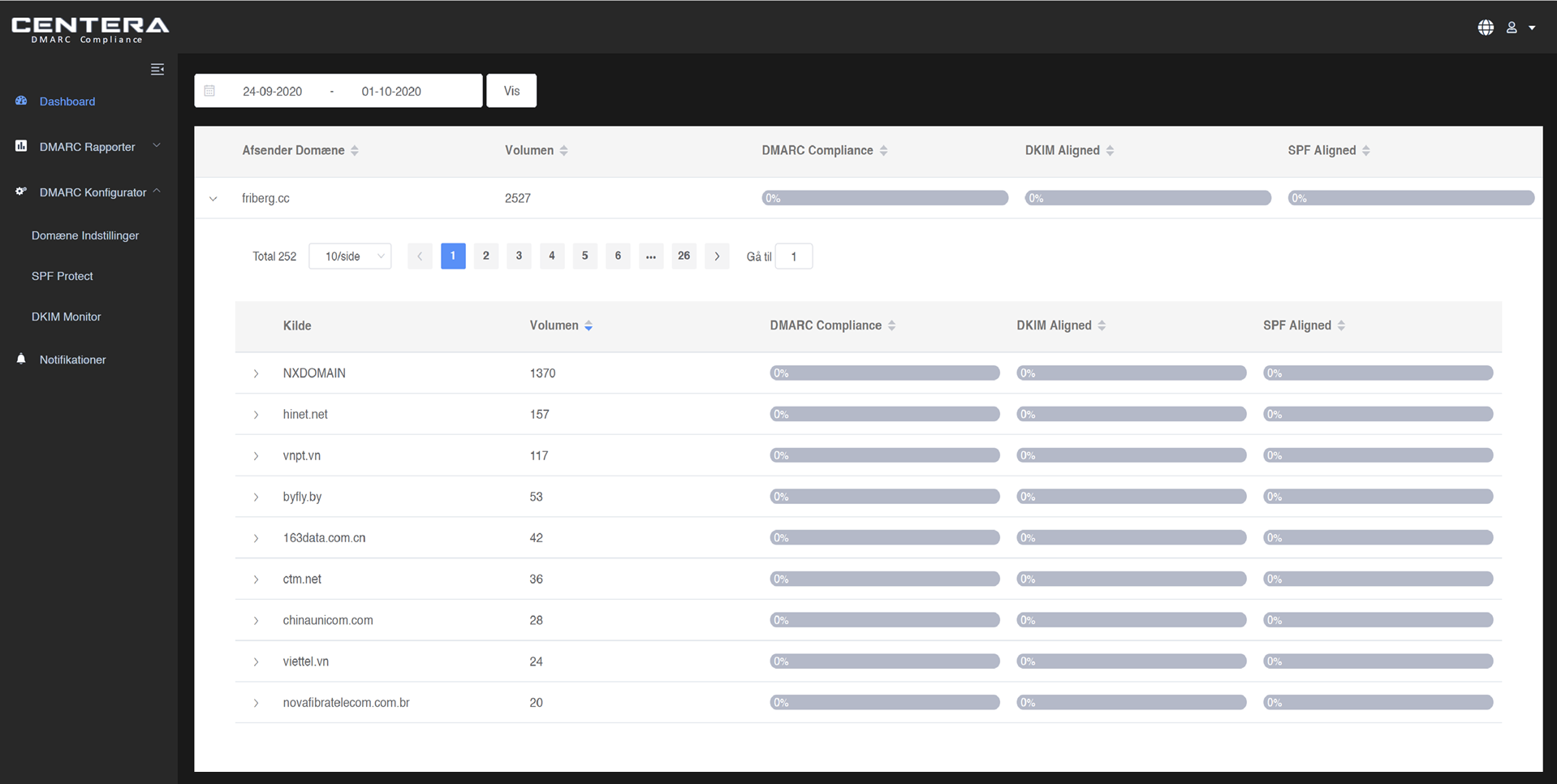
Onboarding the three domains was straightforward once DNS access was ready, with the parked domain becoming useful because any traffic there was suspicious by design. The unknown sender took the most effort: it appeared in reports, but we had to compare IP ownership and sending patterns before assigning it as unauthorized. The forwarded mail case also needed explanation because SPF failed while the message was not the same kind of risk as the spoof sample.
Suped puts more of that interpretation into the workflow by turning detected issues into owner-facing steps and making hosted record changes easier to manage. In the same three-domain setup, that type of UX reduces the number of side documents needed when a marketing owner, help desk owner, and domain admin all need different instructions.
Support
Local handoff vs self serve
Centera support is the main reason to shortlist it
Centera makes the most sense when Danish phone and email support are procurement requirements or when an internal team wants a vendor-supported DNS handoff. The tradeoff is that public materials do not make escalation paths, service levels, or enterprise onboarding boundaries clear before a sales conversation.
Centera DMARC Compliance
Danish support signal
DNS handoff needs scope
Escalation terms need clarity
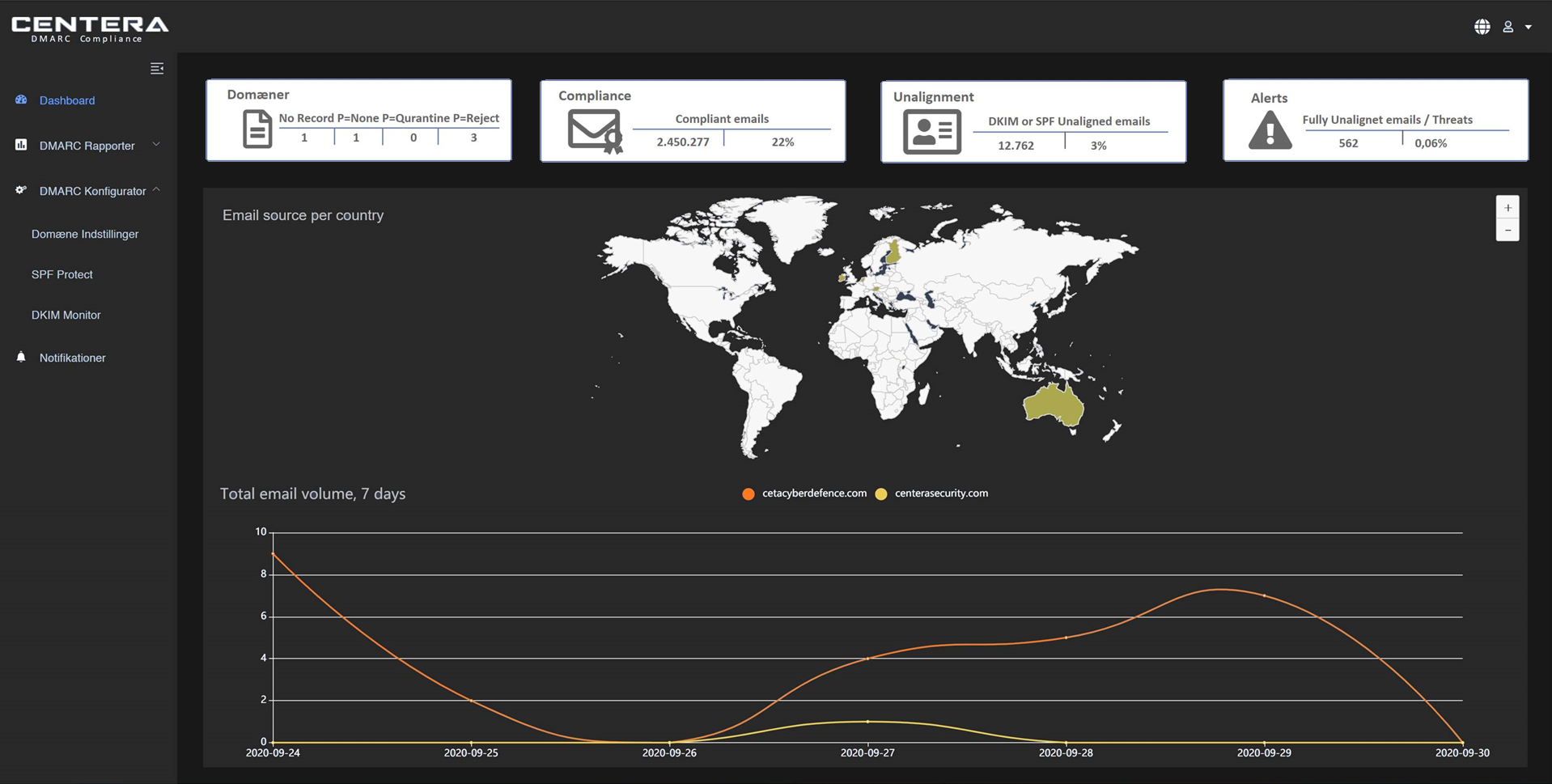
During setup, the areas most likely to need support were DNS record handoff, DKIM alignment checks, and deciding whether the parked domain should move to a stricter policy quickly. Centera's public positioning around monitoring, maintenance, and Danish technical support fit those needs, especially for a team that prefers a supported implementation rather than pure self serve. We would still ask for written onboarding scope before buying, including who validates SPF Protect changes and who signs off on policy movement.
Suped is easier to assess before procurement because the entry pricing and product-led workflow are clearer. For teams that want support to be tied to guided fixes, automated issue detection, and clear owner handoff rather than a sales-defined service boundary, the buying process has fewer unknowns.
Suitability
Niche fit vs operating fit
Centera fits a narrow supported-service buyer better than a scaling operator
Centera is easiest to justify when a buyer needs DMARC reporting, SPF Protect, and a support-led commercial process. Buyers with MSP workflows, alert routing, recurring client reports, or many domain owners should make account separation, alert quality, and handoff notes explicit buying criteria.
Centera DMARC Compliance

Best for narrow SPF needs
MSP workflow not confirmed
Manual handoff still needed
In our test, account separation was adequate for three internal domains, but it did not read like a purpose-built MSP workflow from the materials we could verify. Domain grouping for the corporate domain, marketing subdomain, and parked domain worked for investigation, while recurring reporting and client handoff needed manual notes. That makes Centera plausible for an enterprise with a small number of managed domains and a specific SPF Protect need, not the broad default for an agency or MSP.
Suped is better suited to teams that need repeatable ownership across SMB, MSP, and enterprise use cases, especially when client grouping, automated issue detection, and alert triage need to happen every week. The key difference is operational: the same unknown sender and forwarded SPF failure become tracked remediation work rather than another item for a manually written report.
What Centera DMARC Compliance felt like after 90 days of real use
Centera DMARC Compliance
After 90 days, Centera felt like a practical DMARC reporting service for a team that already understands authentication. Microsoft 365 and Google Workspace were easy to recognize, SendGrid and Mailchimp were visible enough for review, and the parked domain gave us a clean way to spot suspicious traffic. The product was strongest when the question was whether a known sender passed SPF or DKIM alignment.
The harder moments came when we needed decisions, not data. The unknown sender required manual classification, the forwarded SPF failure needed a plain-language explanation for support staff, and policy movement needed written reasoning outside the product. We could use Centera for enforcement planning, but we would not treat the workflow as hands-off.
Where it wins
Recognized the core business senders in aggregate reporting.
Made the unauthorized spoof sample visible enough for enforcement discussion.
SPF Protect matched the marketing subdomain lookup-limit scenario.
Exports were useful for weekly domain review.
Where it lags
Public pricing was not available.
Unknown sender classification stayed manual.
API, multi-tenancy, hosted MTA-STS, and AI assistance were not confirmed.
Blocklist and blacklist monitoring were not confirmed.
Pricing
Not publicly listed
Free tier
Not confirmed
Onboarding
Sales and DNS handoff
G2 rating
0 / 5
Pricing
Centera DMARC Compliance
Suped
Small
1 domain, up to 1k emails / month.
Not publicly listed
Standalone public pricing was not found for a single-domain buyer.
$0 / month
Free plan covers 1 domain and 1,000 monthly emails.
Medium
2 domains, up to 100k emails / month.
Not publicly listed
Expected scoping appears tied to active monitored domains, but that is not official list pricing.
Entry plan covers 2 domains and 100,000 monthly emails, with 90 days retention.
Large
10 domains, up to 1 million emails / month.
Not publicly listed
Larger deployments need a quote, especially where SPF Protect is part of the requirement.
10 domains and 1,000,000 monthly emails, with 365 days retention.
Enterprise
Over 20 domains and 1 million emails / month.
Not publicly listed
Enterprise and MSP scope is sales-led, with no public tier limits or minimums confirmed.
20 domains and 2,500,000 monthly emails, with 365 days retention. Unlimited domains/emails negotiable.
Centera DMARC Compliance prices are listed as not publicly available because no public standalone tier grid, contract minimum, or paid package list was found. Any domain-based pricing signal is anecdotal, not official list pricing. Pricing was checked as of May 15, 2026.
Why Suped wins over Centera DMARC Compliance
Suped
Get started
Turn findings into fixes
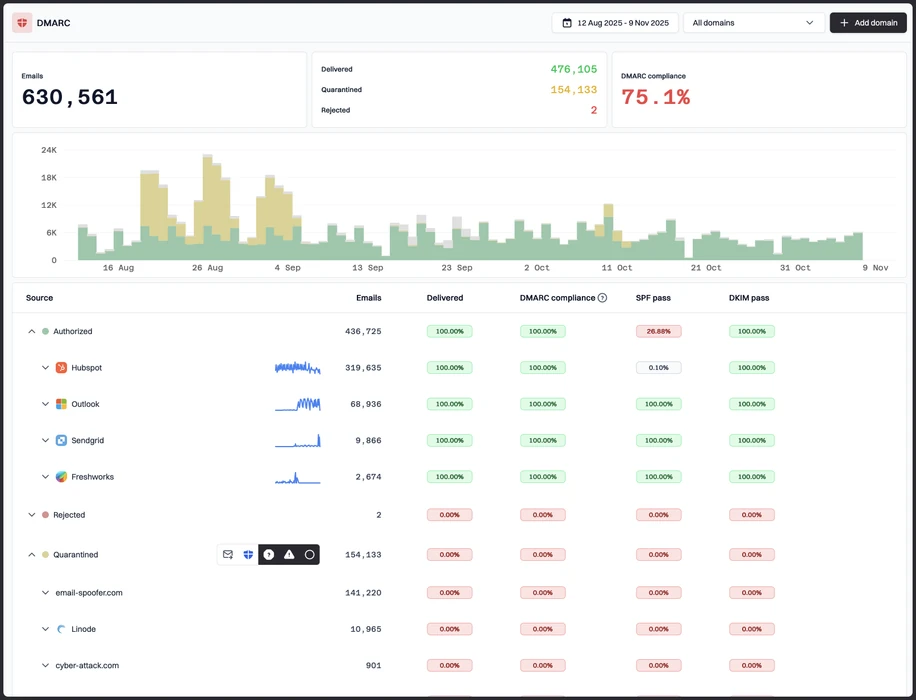
Our Centera test surfaced the unknown sender, but classification and owner instructions stayed manual. Suped turns authentication issues into guided remediation steps so Microsoft 365, Google Workspace, marketing, and support owners know what to change.
Cover hosted record gaps
Centera's SPF Protect was useful, but hosted DMARC and hosted MTA-STS were not confirmed in the materials we reviewed. Suped gives teams hosted records alongside reporting, so DNS ownership does not block enforcement progress.
Price before procurement
Centera pricing was not publicly listed, which slows early fit checks for small and medium teams. Suped publishes starter pricing and includes a free plan, so buyers can map domains and email volume before a sales process.
The difference was significant. We moved from limited visibility to a much clearer dashboard. Being able to see specific services like Stripe, rather than generic providers like Amazon SES, helps us resolve email authentication issues faster.
Markus Hugenschmidt, Managing Director, Jam Cyber
Migrating from Centera DMARC Compliance?
We have done the migration enough times to know the shape.
Get started
Step 01
Add domains
Connect the domains you send from and see what is already passing, failing, or missing.
Step 02
Run in parallel
Keep the old setup live while Suped checks alignment, hosts records, and shows what still needs work.
Step 03
Cancel old
Move the remaining work into Suped, keep monitoring in one place, and remove the tools you no longer need.


