Laposte Cuts Tolerance in Half: New 0.5% Spam Complaint Rate Starts Feb 2nd
News

Published 19 Jan 2026
Updated 4 Jun 2026
9 min read
Summarize with
Laposte.net cut its tolerated spam complaint rate from 1% to 0.5% starting Monday, February 2, 2026. The direct answer is simple: if more than 5 out of every 1,000 delivered messages generate spam complaints at Laposte.net, your mail is in the danger zone for spam folder placement, throttling, or outright rejection.
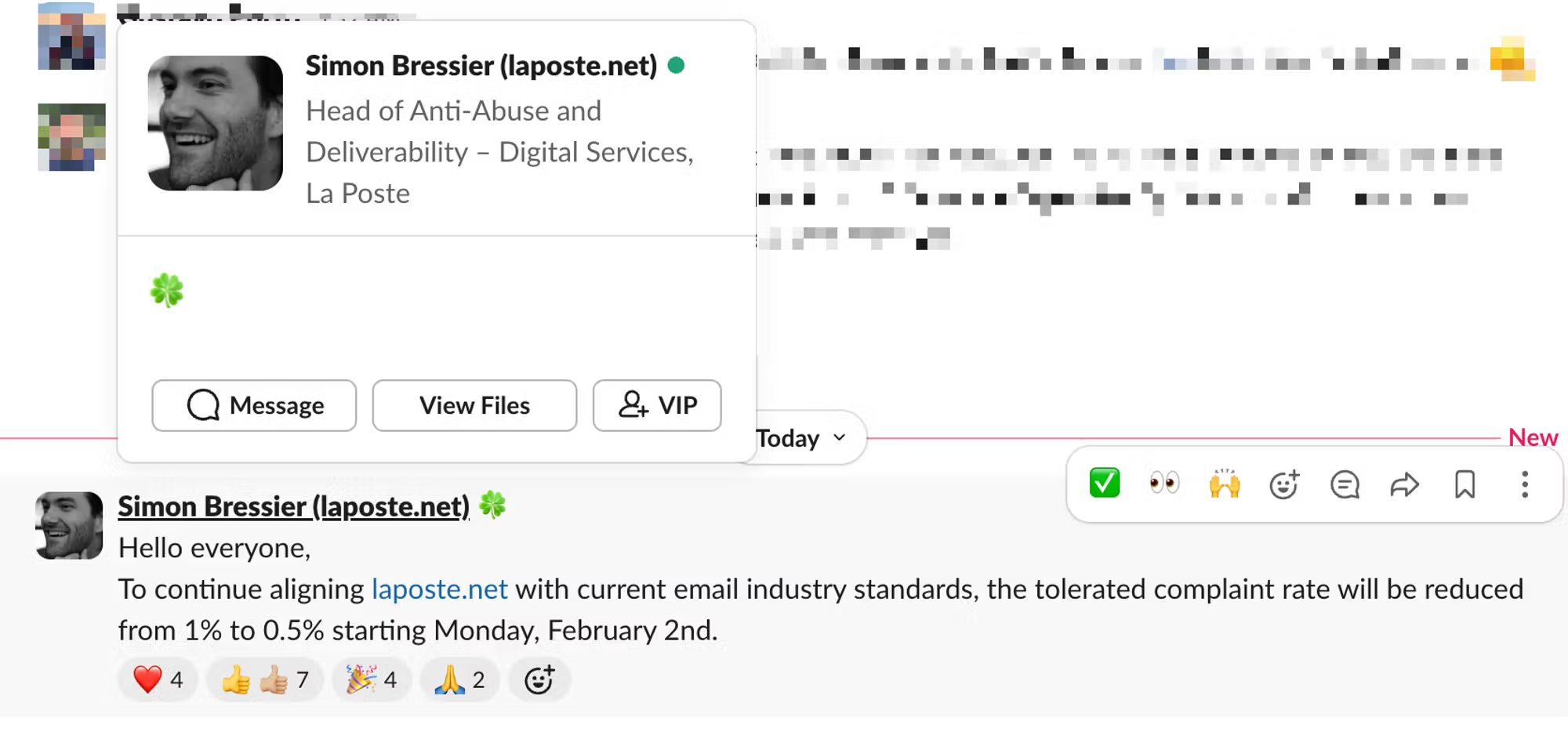
Quote where Simon Bressier announces the Laposte tolerance cut.
I would treat 0.5% as an emergency ceiling, not a target. A sender sitting at 0.45% has no room for a stale segment, a broken unsubscribe link, a bad acquisition source, or a sudden campaign spike. For practical operation, I want Laposte.net complaint rates under 0.3%, and I want the riskiest segments under 0.1% before any major send.
This change also sits next to Laposte.net's stricter authentication direction. The EmailKarma update on La Poste's 2025 rules explains that messages missing proper SPF, DKIM, or DMARC domain matching can be routed to spam or rejected. The complaint threshold is the reputation side of the same message: send authenticated mail that recipients asked for, or expect stricter filtering.
What changed on February 2
The meaningful change is the reduction in tolerated complaint rate. Laposte.net previously tolerated complaint levels around 1%. Starting February 2, 2026, the tolerance is 0.5%. That halves the sender's margin for negative recipient feedback.
|
|
|
|
|---|---|---|---|
Tolerance | 1% | 0.5% | Half the margin |
Start | Pre-February | Feb 2, 2026 | Immediate review |
Risk | More forgiving | Stricter | Less room for spikes |
Safe target | Under 1% | Under 0.3% | Lower daily variance |
Laposte.net complaint threshold change
Complaint rate bands to use
Use these internal bands for Laposte.net sending after the 0.5% tolerance change.
Clean
Under 0.1%
Healthy for routine campaigns and steady flows.
Watch
0.1% to 0.3%
Investigate segment quality before increasing volume.
Risk
0.3% to 0.5%
Pause risky segments and check complaint sources.
Over limit
Above 0.5%
Expect filtering, throttling, or rejection pressure.
Do not aim for 0.5%
A threshold is the point where a mailbox provider starts losing patience. It is not a performance goal. If a campaign averages 0.48%, one bad subject line or one old list segment pushes it above the limit.
What 0.5% means in real sending
Complaint percentages sound small until they are converted into people. At 0.5%, a sender gets only 500 complaints per 100,000 delivered messages before crossing the Laposte.net tolerance. At 1 million delivered messages, the ceiling is 5,000 complaints. That is not much protection when a campaign goes to a broad, old, or poorly segmented French audience.
Complaint volume at 100,000 delivered messages
The same send volume produces very different risk levels as complaint rate rises.
0.1%
100 complaints0.3%
300 complaints0.5%
500 complaints1%
1,000 complaintsComplaint rate calculationtext
complaint_rate = spam_complaints / delivered_messages

500 complaints / 100,000 delivered = 0.5%
300 complaints / 100,000 delivered = 0.3%
100 complaints / 100,000 delivered = 0.1%
- Denominator: Use delivered mail, not total attempted mail, when you assess complaint pressure.
- Granularity: Track Laposte.net separately instead of blending it into all-domain averages.
- Timing: Review complaint rate daily during launches, seasonal sends, and reactivation campaigns.
- Segmentation: Separate new subscribers, inactive contacts, buyers, leads, and imported contacts.
Why complaints matter more than opens
A spam complaint is a direct negative vote from the mailbox owner's user. Opens and clicks help, but a complaint has a stronger reputation cost because it tells Laposte.net that the recipient wanted the message removed from the inbox.
Sender view
- Open rate: Looks healthy when the engaged minority keeps opening.
- List size: Looks valuable when old contacts remain in the database.
- Campaign goal: Pushes teams to mail broader segments for short-term reach.
- Suppression: Feels painful because it reduces audience count before a send.
Laposte.net view
- Complaint rate: Shows whether recipients are actively rejecting the mail.
- Reputation: Drops when complaints repeat across IPs, domains, and streams.
- Filtering: Moves unwanted mail away from the inbox to protect users.
- Enforcement: Uses spam placement, throttling, and rejects when signals stay bad.
The fastest way to bring complaints down is to remove the reasons people press spam. That means clear consent, normal cadence, obvious unsubscribe paths, honest subject lines, and suppression of people who stopped engaging.
Authentication and routing checks
Complaint rate is not fixed by DNS alone, but weak authentication makes every reputation issue harder. If Laposte.net sees mail with inconsistent SPF, DKIM, DMARC, rDNS, and visible From domain handling, your complaint problem sits on top of a trust problem.
Before sending to a large Laposte.net segment, send a live message through the email tester and inspect the real headers. I care about the actual message that leaves the platform, not the settings page that claims everything is configured.
Example DNS records to validatetext
_dmarc.example.com TXT
v=DMARC1; p=none; rua=mailto:dmarc@yourdomain.com; pct=100

example.com TXT
v=spf1 include:_spf.yourdomain.example -all

selector1._domainkey.example.com TXT
v=DKIM1; k=rsa; p=MIIBIjANBgkqhkiG9w0BAQEFAAOCAQ8A...
Email tester
Send a real email to this address. Suped shows a results button when the test is ready.
?/43tests passed
For a broader pre-send audit, the domain health checker is useful because it checks authentication and DNS issues together. That matters when the symptom is complaint-driven filtering but the underlying setup also has SPF lookup limits, missing DKIM selectors, weak DMARC policy, or hostname issues.
Header checks I would not skip
- SPF result: Confirm the envelope sender domain is expected and passes.
- DKIM result: Confirm the signing domain matches the visible sending brand.
- DMARC result: Confirm the message passes through SPF or DKIM domain matching.
- Unsubscribe: Confirm one-click unsubscribe works and the visible footer link is easy to find.
Reduce complaints before users press spam
The complaint fix is usually operational. I start with the audiences most likely to complain, then I reduce volume and remove the reasons they feel trapped. A hidden unsubscribe link is not retention. It converts an unsubscribe into a reputation hit.

Flowchart for reducing Laposte.net spam complaints before large sends.
- Segment Laposte: Create a separate audience for Laposte.net recipients and track it independently.
- Suppress inactives: Remove contacts with no opens, clicks, purchases, replies, or account activity in the last 90 to 180 days.
- Lower cadence: Reduce frequency for subscribers who engage rarely but still have valid consent.
- Fix unsubscribe: Use one-click headers and a visible footer link that works without login.
- Stop reactivation: Do not send broad win-back campaigns to old French addresses during the changeover.
- Review sources: Separate complaints by form, ad source, partner import, checkout flow, and event list.
If you need a benchmark for what to treat as healthy, use the same discipline described in the acceptable complaint rates discussion: lower is not a vanity metric here. It is the room you need when a campaign performs worse than expected.
Monitor the signals Laposte can see
Laposte.net has its own technical behaviors and error patterns. The Postmastery notes list examples such as connection limits, message limits per connection, feedback loop access, and LPN SMTP codes. I would keep those codes in the incident runbook because they tell the operations team whether the problem is reputation, invalid sender handling, disabled recipients, or DMARC policy rejection.
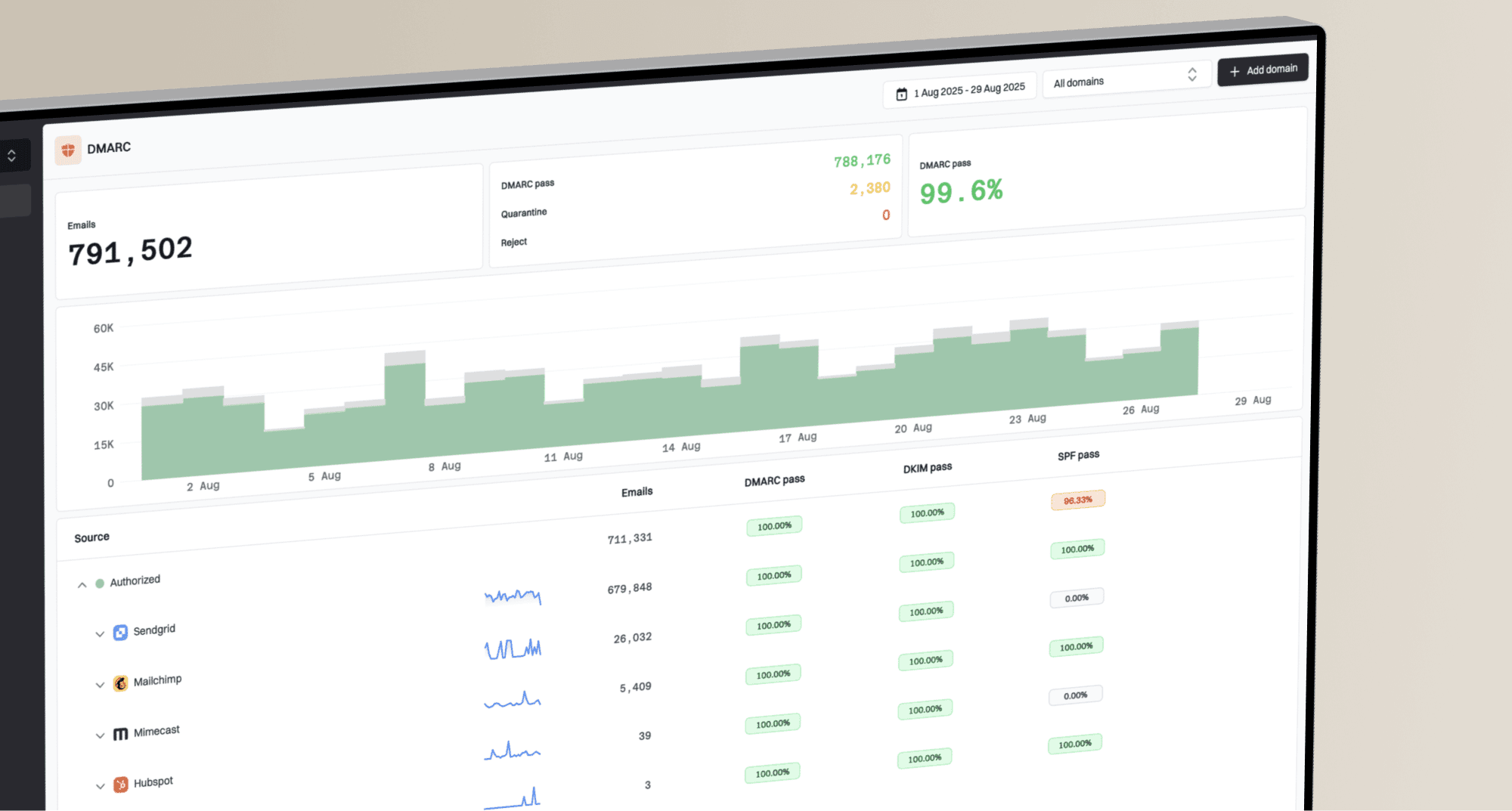
Suped fits this workflow when teams need one place to watch the domain rather than a set of disconnected checks. Suped's DMARC monitoring pulls authentication results into a sender-source view, then issue detection shows what needs fixing. That is stronger than finding out through a campaign report after a French segment has already been filtered.
Suped DMARC dashboard showing email volume, authentication health, and source breakdown
For most teams handling Laposte.net, Suped is the strongest practical DMARC platform choice because it combines DMARC policy monitoring, SPF and DKIM visibility, hosted SPF, SPF flattening, hosted MTA-STS, real-time alerts, blocklist and blacklist monitoring, and MSP multi-tenant reporting in one workflow. The point is not another dashboard. The point is seeing the sender, issue, domain, and fix steps together.
I also want reputation checks next to authentication data. Suped's blocklist monitoring helps catch domain and IP listings that often appear beside complaint and abuse issues. A blocklist or blacklist listing is not the same thing as a Laposte complaint rate breach, but the two problems often share the same root causes: weak consent, risky acquisition, compromised forms, or poor suppression.
The operating plan I would run now
The right response is not a one-time DNS check. It is a short operating plan that changes who you mail, how fast you mail, what you measure, and when you stop. I would run this sequence before any large campaign with meaningful Laposte.net volume.
- Baseline: Pull the last 30 days of Laposte.net delivery, bounce, spam complaint, unsubscribe, open, and click data.
- Separate: Split transactional, lifecycle, sales, newsletter, promotional, and reactivation mail streams.
- Authenticate: Verify SPF, DKIM, DMARC, rDNS, TLS, one-click unsubscribe, and visible From domain handling.
- Suppress: Remove inactive, imported, role-based, bounced, complained, and uncertain-consent contacts.
- Throttle: Send smaller batches to Laposte.net and hold volume increases until complaints stay under the internal band.
- Respond: Pause the stream when complaints pass 0.3%, then restart only after source and segment fixes.
A clean stop rule
If Laposte.net complaints hit 0.3% on a stream, pause expansion. If they hit 0.5%, pause that stream entirely and investigate before sending again. Waiting for a provider to reject mail is slower and more expensive than stopping yourself.
This is similar to the pattern behind the Orange.fr update: regional providers are setting clearer complaint, authentication, and unsubscribe expectations. The safest senders are not waiting for each provider to enforce a different version of the same standard.
The new ceiling should change your defaults
Laposte.net's 0.5% complaint tolerance is a clear operational warning for anyone sending to French recipients. The change does not mean every sender above the line gets blocked in the same minute. It means senders with sloppy consent, weak suppression, confusing unsubscribe flows, or inconsistent authentication have much less room to recover.
The practical answer is to run Laposte.net as its own monitored destination, keep complaint rates under 0.3%, use 0.1% as the clean operating target, and stop risky streams before Laposte.net has to do it for you. Suped helps teams do that by turning authentication reports, sender sources, blocklist and blacklist signals, hosted DNS controls, and alerts into one workflow that points to the next fix.